


Over 5,000 rescuers deployed after M7.0 earthquake hit China's Xizang
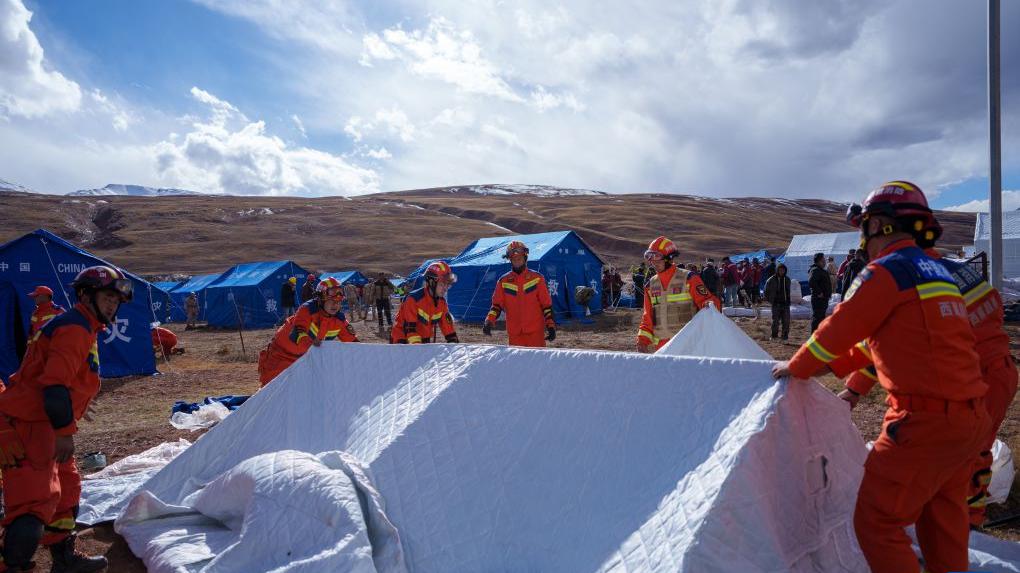
Firefighters set up tents in a village in Maru Township, Baqen County, Nagqu City, southwest China's Xizang Autonomous Region, October 23, 2026. (Photo: Xinhua)
Southwest China's Xizang Autonomous Region has deployed more than 5,000 rescue personnel following a 7.0-magnitude earthquake that struck Baqen County in Nagqu City at around 10:33 p.m. Thursday.
The quake left 16 people dead and 76 injured, with 339 homes collapsed or damaged. By 3 p.m. Friday, 12,489 residents had been safely relocated. No one is reported missing after three rounds of comprehensive checks, according to the Baqen earthquake emergency command center.
With rescue operations in their critical "golden period," teams are scouring the area door-to-door and site-by-site.
Rescue and relief efforts underway
Shortly after the disaster, the PLA Western Theater Command activated its emergency response mechanism. By 4 p.m. Friday, over 400 PLA and People's Armed Police personnel alongside more than 50 vehicles had been deployed to treat the injured, erect tents and relocate locals. Two temporary medical stations and two hot-food distribution stations are operational.
The National Work Safety Emergency Rescue Center dispatched teams, comprising 34 personnel and 15 vehicles, equipped with more than 100 reconnaissance and heavy-lift drones, life detectors, demolition and shoring equipment and satellite communications to assess secondary-disaster risks.
China Mobile has repaired damaged base stations, restoring communication networks back to pre-earthquake levels.

Residents gathered in front of relief tents, Maru Township, Baqen County, Nagqu City, southwest China's Xizang Autonomous Region, October 23, 2026. (Photo: Xinhua)
Relief supplies sent to affected areas
Central, regional, municipal and county authorities have sent supplies including prefabricated houses, tents, quilts and winter clothing.
The National Commission for Disaster Reduction and the Ministry of Emergency Management raised the national natural disaster relief response to Level III.
Insulated tents, winter coats and folding beds are among 10,000 items of central relief supplies allocated, with a separate pool of 43,000 essentials, like mobile toilets, heating stoves, food and fuel, provided by the Red Cross Society of China, the China Charity Federation and other organizations.
The Ministry of Finance and the Ministry of Emergency Management jointly allocated 50 million yuan (about $7.5 million) to support rescue operations and assistance to affected residents, while the National Development and Reform Commission earmarked an additional 30 million yuan from the central budget to help restore damaged infrastructure and public service facilities.
The Organization Department of the Communist Party of China Central Committee has also allocated 25 million yuan in emergency relief funds, while the National Health Commission dispatched medical experts. Six medical teams from Xizang, bringing emergency equipment, medicines and specialized vehicles, are also on site. Medical teams in neighboring provinces are on standby and emergency blood supply mechanism has been activated.
Aftershocks possible
Analysis shows the earthquake epicenter lay within the Qiangtang block of the Qinghai-Xizang Plateau, driven by extensional faulting – horizontal crust stretching.
Six earthquakes of magnitude 7.0 or above have occurred within the Qiangtang block since 1900, the largest a 7.5 in Shuanghu County in 1997. But no quake of magnitude 7.0 or above had been recorded within 200 kilometers of the latest epicenter, according to the China Earthquake Networks Center (CENC), which described the event as "a release of energy stored in the block."
Experts say the coming days may see aftershocks. Preliminary assessments indicate the overall risk of large-scale geological disasters such as collapses and landslides is relatively low, though small-scale ones remain possible on some steep slopes and along roads.