


AI recreates Long March history in anniversary TV gala
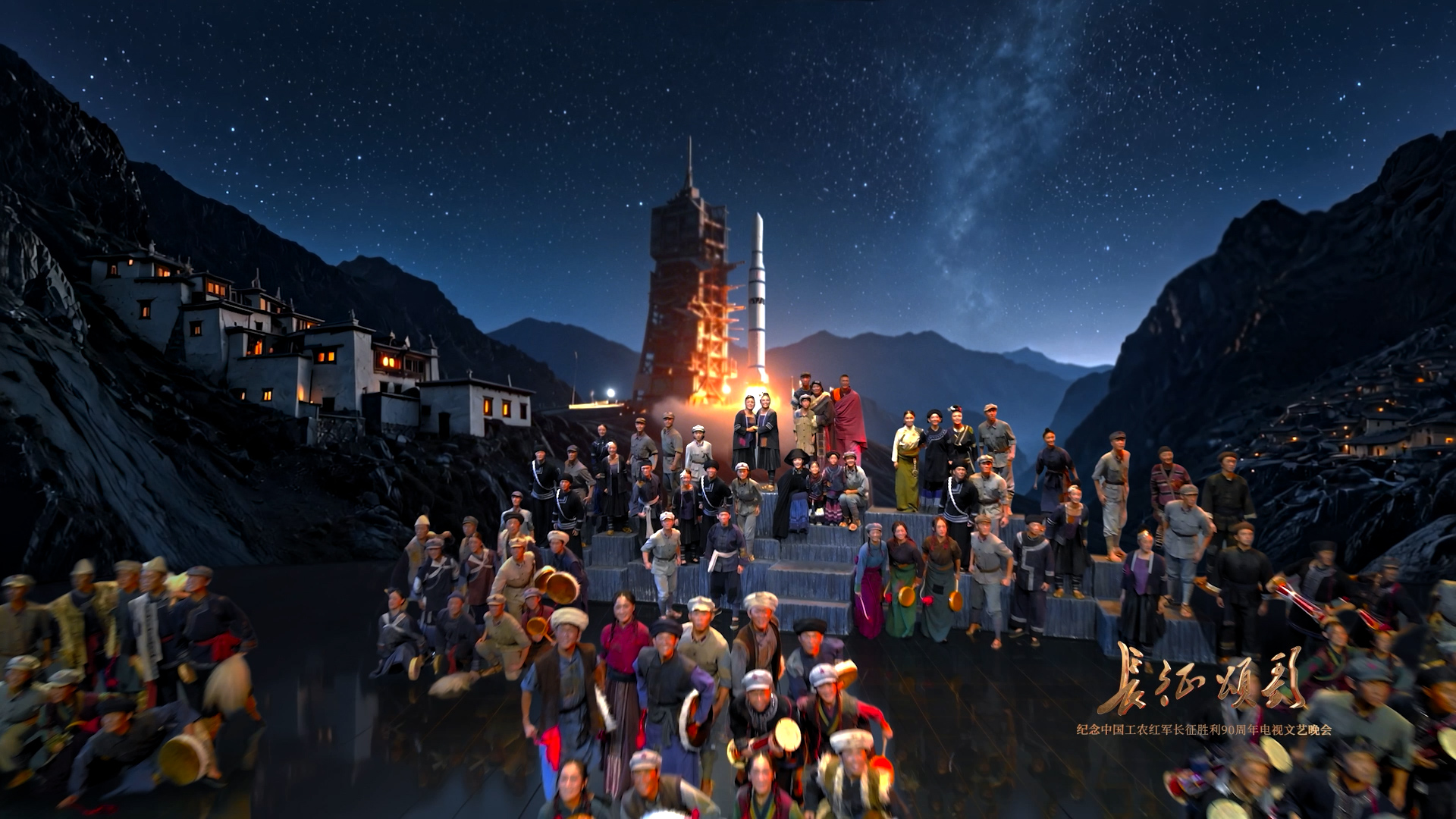
A video still of the TV gala marking the 90th anniversary of the Long March, October 22, 2026. (Photo: China Media Group)
A TV gala marking the 90th anniversary of the Long March – the Red Army's strategic retreat from 1934 to 1936, a foundational episode in modern Chinese history – aired on China Media Group (CMG) on Thursday. The program used artificial intelligence (AI) to recreate historical moments and explained how creators balanced spectacle with historical accuracy.
In one segment, actor Li Xuejian portrayed a Red Army cooking squad leader carrying a lit lantern from darkness into light. Li, whose hearing and speech are impaired, performed without speaking; rehearsals were conducted in writing. His narration was restored with CMG's AI digital technology using samples of his past performances and a voice actor's guidance, then adjusted over multiple rounds.
Another segment, "Jiajin Mountain," linked two eras. In 1935, the Red Army crossed the snow-covered mountain. Ninety years after the crossing, a tunnel on National Highway 351 opened following 45 months of construction by more than 600 workers, serving 110,000 residents who had been cut off by winter snow. Using AI-generated content (AIGC) spatial expansion, the gala placed the marching column and the tunnel construction on the same screen.
The gala also deployed a cloud-based AI multi-view system. A camera array captured a 180-degree view, giving viewers a three-dimensional studio experience beyond fixed camera positions.
Creators said historical details were checked in three stages, including review by researchers, local memorial museums along the route, and historians and military museums. Artifacts were restored from collections. For example, a Dadu River boat was rebuilt 1:1 from a museum artifact. The aim, the directors said, was to let digital technology expand the canvas of time while rigorous research kept the history authentic.