


Chinese research team's pollution-free 'blanket' slows Dagu Glacier melt by over 80%, helps ice gain 10 cm in height
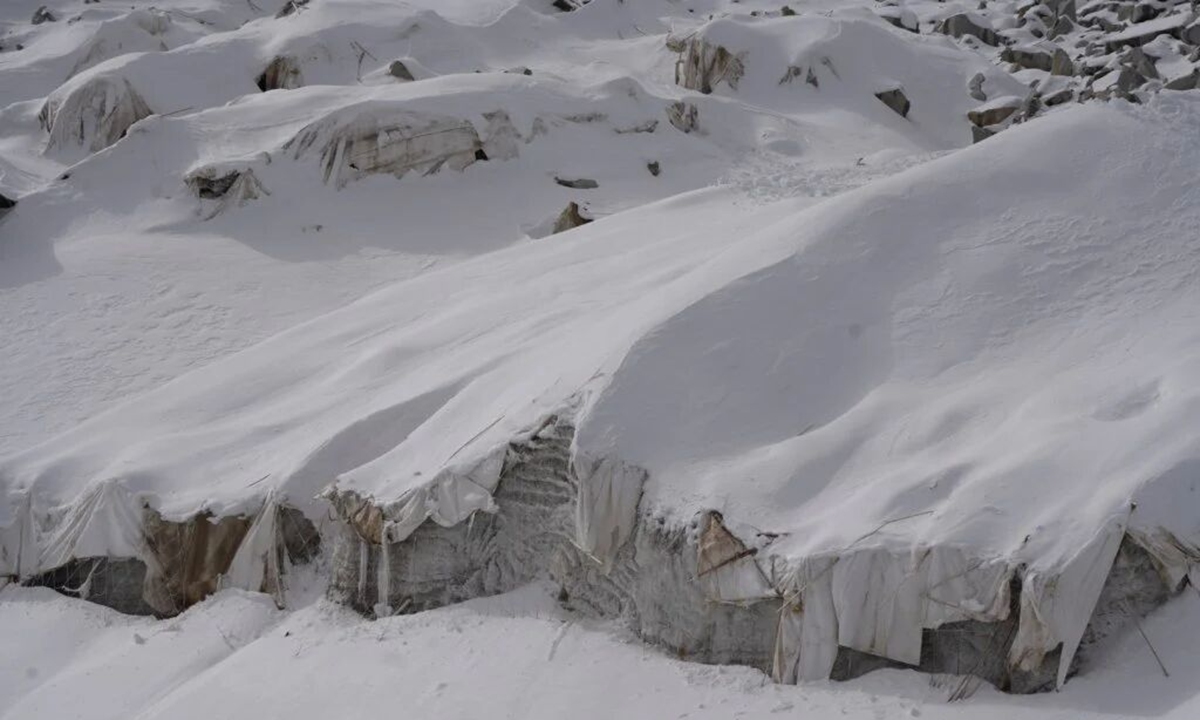
'Blanketing' experiment produces notable ice gains in parts of Dagu Glacier in Southwest China's Sichuan Province Photo: Courtesy of Nanjing University research team
A Chinese research team has made new progress in experiments using a protective covering to slow glacier melt, with a novel radiative-cooling nanofilm reducing glacier melt by more than 80 percent in treated areas of Dagu Glacier in Southwest China's Sichuan Province. Glacier surface in some parts of the experimental area have 'gained' 10 centimeters in elevation over six years, an experiment leader from the research team told the Global Times on Monday.
Over the past five decades, most of the world's glaciers have experienced rapid melting. In addition to reducing greenhouse gas emissions to curb global warming, scientists have begun exploring ways to slow glacier melt by directly protecting glaciers with a protective "blanket" to test whether artificial measures could slow glacier melt, according to the Science and Technology Daily.
Dagu Glacier is a maritime glacier strongly influenced by the maritime monsoon climate, which brings relatively abundant precipitation to the region. Compared with continental glaciers, maritime glaciers can accumulate or lose ice more rapidly and tend to experience more frequent movement, making them particularly vulnerable to retreat, Wang Feiteng, a researcher of Northwest Institute of Eco-Environment and Resources under the Chinese Academy of Sciences, who first conducted the "blanket" experiment on Dagu Glacier, told the Global Times on Monday.
The research team selected Glacier No. 17, which covers approximately 0.17 square kilometers and is the largest individual glacier in the Dagu Glacier area, for the experiment. Given its size, substantial melting of this glacier could have a significant impact on the overall retreat of the Dagu Glacier area.
The principle behind the so-called "blanket" experiment is similar to covering ice pops with a blanket in a freezer to keep them from melting, Zhuang Lichao, a postdoctoral researcher at Nanjing University's School of Energy and Resources, told the Global Times.
The covering material helps insulate the ice surface and reflect sunlight, reducing the direct solar radiation reaching the glacier and the effects of turbulent heat exchange between the ice surface and the near-surface atmosphere, thereby slowing melting, Zhuang explained.
Since 2022, the Nanjing University team has laid nearly 10,000 square meters of nanofilm on Glacier No. 17 at Dagu Glacier. The material is installed each year before the main summer melting season begins in May and is fully retrieved before the snowfall season arrives in late September.
Measurements show that parts of the glacier in the experimental area have increased in height by 10 centimeters, while the covering has reduced melting by more than 80 percent, according to the research team.
The material is biodegradable and does not cause pollution, Zhuang said, adding that some of it can also be recovered and reused after the experiment.
The approach is not the first attempt by Chinese researchers to slow glacier melting by covering the ice surface. In 2020, Wang's team drew on snow-storage and ice-preservation techniques used at the 2022 Beijing Winter Olympics. The team used white geotextile fabric to reduce ice loss from melting by as much as one meter, achieving a reduction in melting of around 70 percent in the treated area.
The "blanket" experiment has proved effective given the glacier's characteristics and geographical location, the material developed by Nanjing University's team is an upgrade to ours, Wang said.
Zhuang noted that scientists in other countries facing glacier loss, including Switzerland, are also experimenting with protective coverings, although some use wool blankets instead of advanced nanofilms. Chinese researchers are continuing to upgrade the materials used in their experiments, seeking to improve their effectiveness in slowing ice loss while ensuring that the coverings do not pollute the natural environment.
Nevertheless, such interventions can only mitigate glacier melting to a certain extent and cannot address its underlying cause, he noted.
Earth is currently in a relatively warm interglacial period, during which glacier formation, accumulation and erosion are comparatively limited, Wang said.
Over the 23-year period beginning in 2000, the world's more than 215,000 glaciers have lost an average of 273 billion tons of ice annually, while the rate of glacier melting accelerated by 36 percent between 2012 and 2023 compared with the previous decade, according to the UN.
The approach has practical limitations when applied to large glaciers in remote areas that are difficult to access. Artificial snowfall to increase a glacier's albedo - its ability to reflect sunlight - could be a more effective alternative in some circumstances, he suggested.
"Although these methods can slow glacier melting, they are a temporary remedy rather than a fundamental solution," Zhuang said. Ultimately, rescuing glaciers requires efforts to reduce energy consumption and carbon emissions at both global and regional levels and to curb global warming.