


China-Myanmar crude oil pipeline delivers over 100 million tons, helping bolster energy security
The China-Myanmar crude oil pipeline has transported more than 100 million tons of oil since it began operations in 2017, marking a milestone for a major energy import corridor that has strengthened energy supplies and improved energy distribution in Southwest China, according to the China Oil & Gas Pipeline Network Corp (PipeChina).
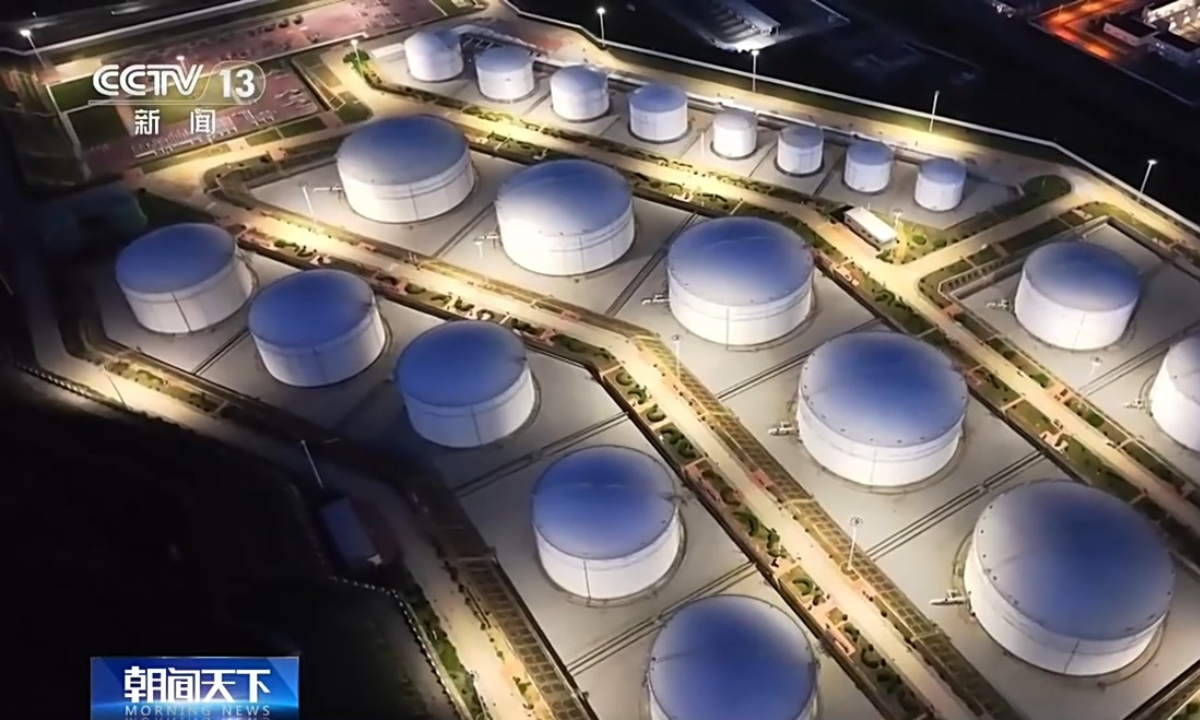
An aerial view of an oil storage facility featured in a CCTV News report on the China-Myanmar crude oil pipeline on October 26, 2026. (Photo: Screenshot from CCTV News)
The pipeline, China's fourth major energy import corridor, starts in Myanmar and enters China through Ruili in Southwest China's Yunnan Province. Its 618-kilometer domestic section extends to the Yunnan Petrochemical refinery in Anning, Yunnan Province. The pipeline began operations in June 2017, CCTV News reported on Monday, citing PipeChina.
Before the pipeline entered service, Yunnan relied heavily on long-distance overland shipments of refined oil products from China's eastern coastal regions, said Cheng Yutao, deputy manager of the marketing department at PipeChina's Yunnan branch.
Today, crude oil imported through the pipeline is refined locally at Yunnan Petrochemical, with refined products transported onward through the Southwest China refined oil pipeline, completing an integrated industrial chain covering oil imports, refining and outbound transportation of refined oil products, Cheng said.
To address operational challenges posed by Yunnan's mountainous terrain, the pipeline operator has adopted intelligent management practices featuring unmanned operations, unattended stations and designated emergency response personnel. Five smart stations have been established, while the pipeline currently transports an average of 35,000 tons of crude oil per day, CCTV News reported.
The pipeline also offers China an alternative route for importing crude oil that bypasses the Strait of Malacca. On June 7, 2017, crude oil transported through the China-Myanmar pipeline reached Yunnan Petrochemical after 19 days of transportation within China, marking the successful commissioning of the pipeline's domestic section.
Compared with the route via the strait, it reduces transportation distances by 1,820 nautical miles, helping lower transportation risks and costs, according to a report by China Energy News.
Beyond serving China's domestic market, the project has also supported regional energy trade. Xinhua News Agency reported in June 2019 that refined products from Yunnan Petrochemical were supplied to Yunnan, Sichuan, Chongqing and Guizhou, while the refinery began exporting gasoline and diesel to Southeast Asian markets in 2018.
In April 2019, it exported nearly 50 tons of liquefied petroleum gas (LPG) to Myanmar, marking China National Petroleum Corp's (CNPC) first LPG exports to Southeast Asia. By June 2019, the refinery was exporting more than 10,000 tons of refined oil products per month on average, with 14 customs clearance points and export routes in use.
The latest milestone comes amid China's efforts to expand oil and gas pipeline construction. More than 2,500 kilometers of new major oil and gas pipelines were built nationwide since the beginning of 2026, bringing the total length of the country's major pipeline network to 112,900 kilometers, covering 30 provincial-level regions and the Hong Kong Special Administrative Region, CCTV News reported.