


Chinese defense firm introduces 40mm cased telescoped ammunition, already fielded by multiple domestic platforms
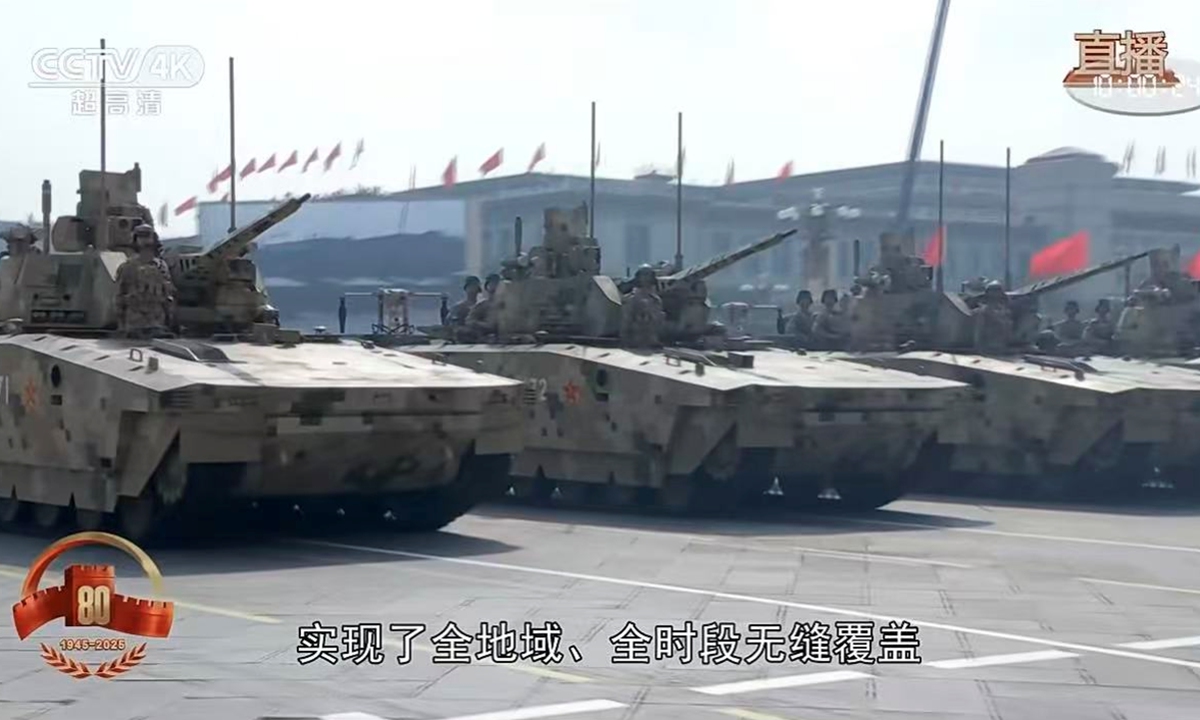
Type 100 support vehicles are reviewed at China's V-Day military parade on September 3, 2025. (Photo: Screenshot from Changan Wangjiang)
A new Chinese 40mm cased telescoped ammunition round can punch through 130 millimeters of homogeneous steel armor from a kilometer away - firepower that leaves conventional shells far behind - while offering three damage modes: armor-piercing, high-explosive fragmentation and programmable airburst. The round is already being used by multiple domestic weapons platforms, a Chinese state-owned defense company said on Monday, while providing footage showing the Type 100 support vehicles and new-generation airborne combat vehicles that debuted during the 2025 V-Day military parade.
The projectile of the telescoped ammunition is enclosed inside the cartridge case, making the entire round a single cylinder. A single shot can punch through 130 millimeters of homogeneous steel armor, and easily deal with field fortifications and low, slow and small (LSS) aerial targets, said Changan Wangjiang, a defense company under the China South Industries Group, in a video released on its official social media account on WeChat on Monday.
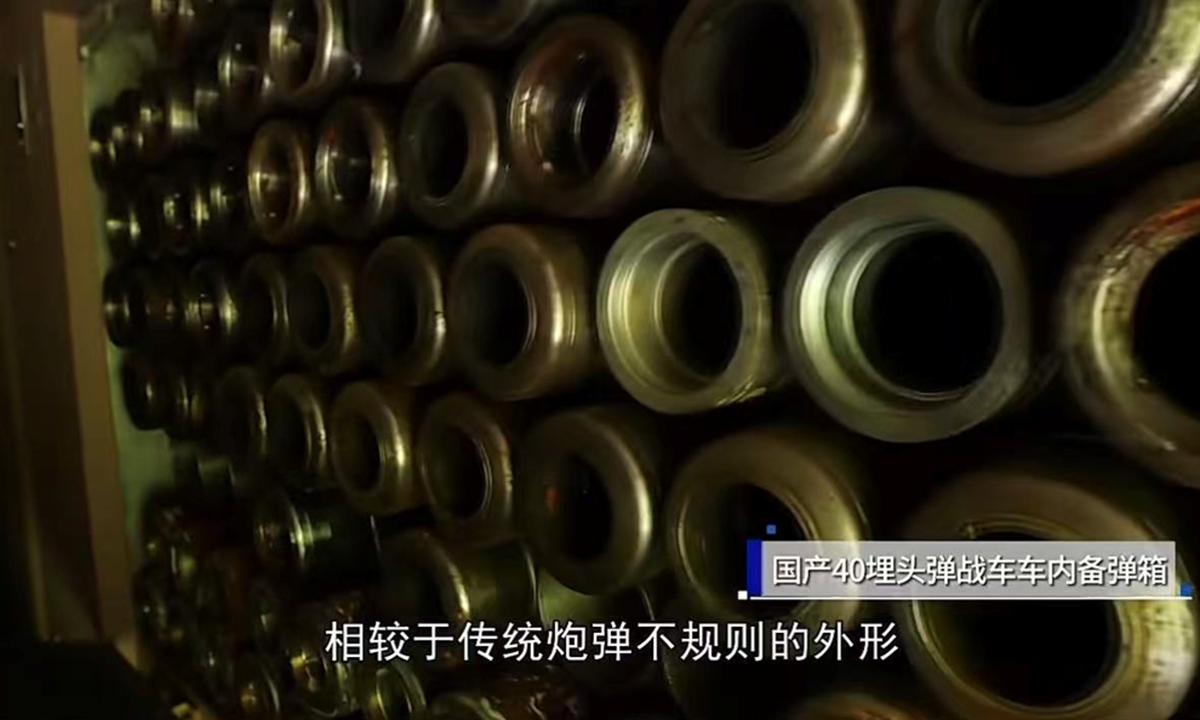
An ammunition storage box inside a vehicle armed with domestic 40mm cased telescoped rounds. (Photo: Screenshot from Changan Wangjiang)
The round also uses a dart-like aerodynamic layout and fin stabilization, achieving accuracy of 0.5 meters by 0.5 meters at one kilometer, making it not only powerful, but precise enough for near-perfect hits.
The 40mm round currently has three main damage modes.
The round's first damage mode is the armor penetration mode. Able to punch through 130mm of steel plate from a kilometer away, it can seriously damage main battle tanks. Its second mode, high-explosive fragmentation, sends blast waves in all directions upon impact. Just a few rounds can destroy fortifications and bunkers. The third, programmable airburst, detonates the shell midair to form a dense barrage that leaves drones and other low-slow-small aerial targets nowhere to hide.
Cased telescoped ammunition is not new, the concept has existed for years. China pursued it for several reasons, Chinese military affairs expert Song Zhongping told the Global Times. First, tanks and armored vehicles have limited internal space, so cased telescoped rounds allow more ammunition to be carried. Second, they hold more propellant, giving greater striking power. They also generate relatively low recoil and have a neat, regular shape that makes transport easier.
The 40mm round is already being used with multiple domestically produced weapons, achieving seamless coverage across all terrains and time periods, a development set to begin a new era of smarter, more efficient Chinese equipment, according to Changan Wangjiang. The information about the new round accompanied footage of Type 100 support vehicles and new-generation domestic airborne combat vehicles, both of which debuted at the V-Day military parade held in Beijing on September 3, 2025.
The Type 100 support vehicle can collaborate with the Type 100 tank. While the tank's main gun has strong firepower, the tank faces challenges in engaging multiple targets simultaneously. This is when the fire support vehicle comes in, using its higher rate of fire to suppress and eliminate unarmored targets such as foot soldiers operating anti-tank missiles or lightly armored vehicles, an expert told the Global Times in a previous interview.
Airborne combat vehicles can be transported across long distances via the air and provide heavily armored mobile support. They act as the airborne edges in the PLA's fast response and deep strike operations.
The large-scale fielding of specially improved conventional munitions shows that the PLA's overall ammunition design philosophy is becoming more forward-looking and more efficient, Song added.