


Global experts call for mutual learning at Shanghai forum
The world is in urgent need of mutual learning to bridge boundaries and build shared understanding among civilizations, and China's public relations practices offer much to learn, said global experts at the 2026 Shanghai International Public Relations Forum held on Wednesday.
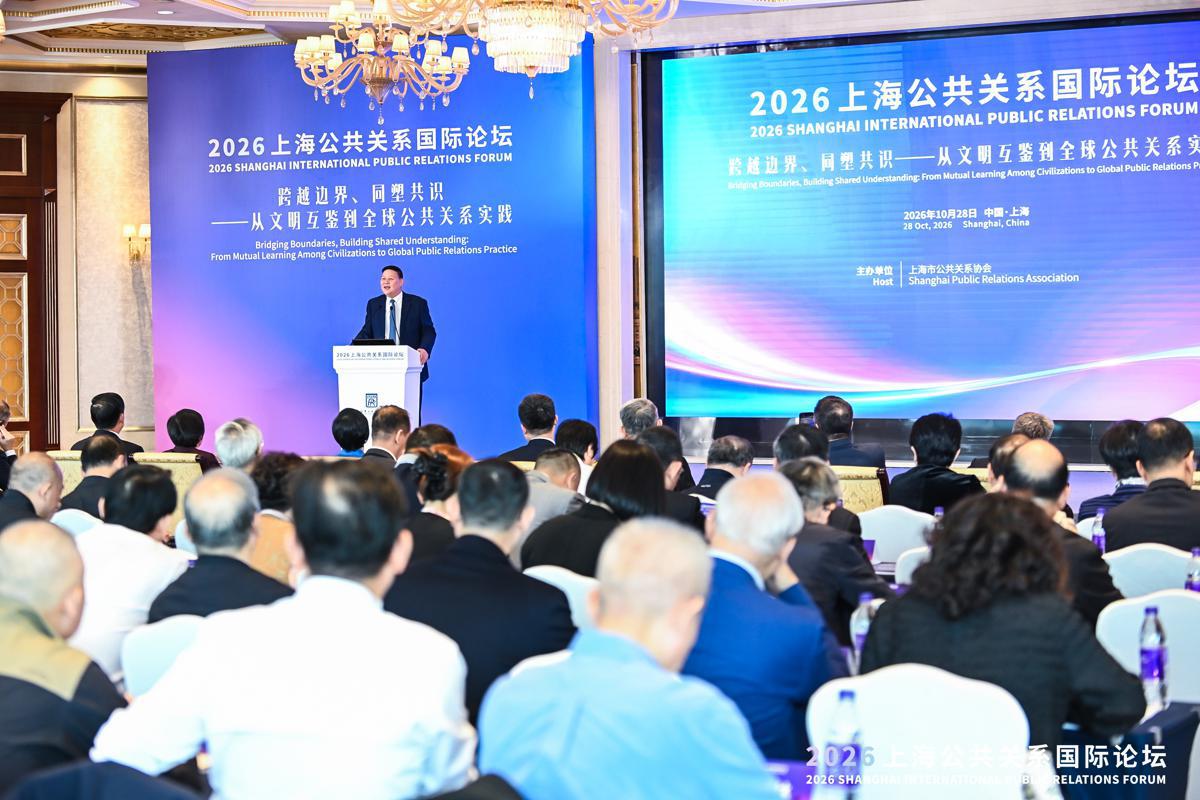
The 2026 Shanghai International Public Relations Forum is held in Shanghai on Oct 28. (Photo: China Daily)
The forum was hosted by the Shanghai Public Relations Association on the occasion of the organization's 40th anniversary of establishment. It aimed to leverage global expertise in public relations to promote exchanges and mutual learning among civilizations, build platforms for communication between China and other nations, foster consensus within the international community, and contribute to building a community with a shared future for humanity.
Sha Hailin, president of the Shanghai Public Relations Association, noted that the world is undergoing profound changes, with geopolitical tensions spreading and global challenges emerging one after another. Issues such as food security, climate change, public health and the governance of artificial intelligence are increasingly transcending national borders, and no country can remain unaffected.
"The world needs communication, dialogue and cooperation more than ever. Public relations exactly serves as the bridge of exchanges, and is increasingly becoming an important means of promoting shared understanding and enhancing international cooperation," Sha said.
Stephen Jackson, United Nations resident coordinator in China, said that mutual learning is at the heart of the United Nations Charter and public relations, at its best, is "mutual learning put to work".
He saw the UN's principles strike a strong resonance with China's Global Civilization Initiative, and the two sides are now building shared platforms for dialogues among civilizations.
"No civilization grew alone. Learning goes in both directions. The world has much to learn from China's experience, from poverty reduction to renewable energy to a civilization that has thought about harmony for millennia. And China, like every country, also gains from learning what others are doing well. That is not a concession. It is how every great civilization has grown," Jackson said.
He added that mutual learning does not mean agreeing with everyone, but means refusing to reduce a whole people to a headline. At the forum, he called for global efforts to tell stories that build understanding, invest in exchange in diverse forms, and resist caricature.
Experts at the forum also pointed out that mutual learning involves efforts in diverse forms.
Jeffrey Lehman, executive vice-chancellor and the United States president of New York University Shanghai, shared from an educational perspective that university students studying in other countries could help advance the cause of mutual learning.
He noted that educational exchange does more than just help students to be better prepared for a world of accelerating technological change, and a world where they will have to know how to work with others for creative breakthroughs. Educational exchange that leads to mutual learning is also critically important to the countries where those students are patriotic citizens. Such experience will completely change their lives, for the better.
"We need mutual learning among civilizations — so that our countries will flourish, and so that individual citizens within each country will flourish. I very strongly hope that we will continue to work to ensure that the members of Gen Z and Gen Alpha will have the same opportunities to experience educational exchange that I benefited from 51 years ago," Lehman said.