


China Focus: Xinjiang cotton outsmarts extreme heat, external pressure via greater resilience
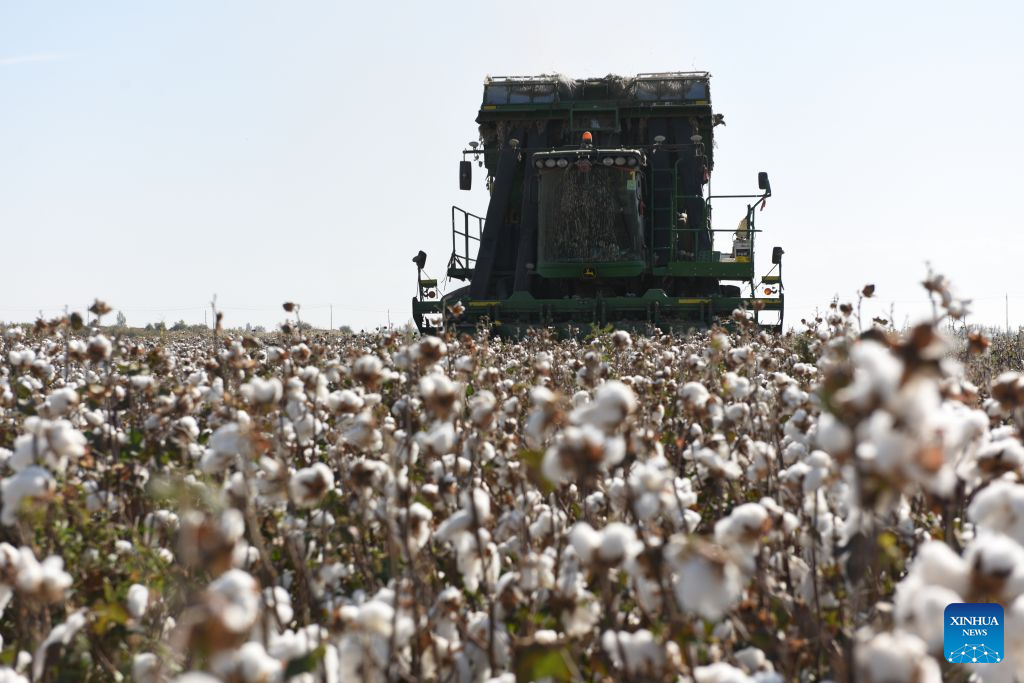
A cotton picker works at a cotton field in Donggou Village, Dianba Township of Changji Hui Autonomous Prefecture, northwest China's Xinjiang Uygur Autonomous Region, Oct. 10, 2026. (Photo: Xinhua)
URUMQI, Oct. 31 (Xinhua) -- In a 66.7-hectare demonstration cotton field in Changji, northwest China's Xinjiang Uygur Autonomous Region, the average seed cotton yield reached a record high of 9 tonnes per hectare this year.
This would be a strong harvest in any year. It is even more striking as Xinjiang just experienced the hottest summer since 1961. In northern Xinjiang, cotton fields endured 26 days of sustained high temperatures during the critical flowering and boll-setting stage, conditions that would normally cause a plunge in output.
Statistics from the China Cotton Association (CCA) put China's cotton planting area in 2026 at 43.054 million mu (about 2.87 million hectares), down 3.9 percent, with an estimated yield of 166.2 kilograms per mu, up 0.5 percent. Meanwhile, Xinjiang's cotton yield is expected to reach 173.8 kilograms per mu, higher than the national average. The region's total output is estimated to account for 95.9 percent of the national total, further consolidating Xinjiang's role as the "ballast" of China's cotton production.
How has the Xinjiang cotton industry maintained stable, high output despite the combined pressure of extreme weather, persistent "forced labor" disinformation and external sanctions? Xinhua reporters recently visited cotton fields, factory floors and an industry forum to explore what makes the local cotton industry so resilient.
SMART COTTON FIELDS
Song Meizhen, chief scientist of the high-quality cotton team at the western agricultural research center of the Chinese Academy of Agricultural Sciences, said the prolonged heat during this year's flowering and boll-setting stage created enormous stress. However, on-site yield measurement by an expert group showed the demonstration field surpassed 600 kilograms per mu, thanks to an integrated technology model combining good seeds, appropriate methods and suitable machinery.
The demonstration field is part of a smart cotton field jointly built by the Changji National Agricultural High-tech Industry Demonstration Zone and the research center, where weather stations, soil moisture sensors, inspection robots and drones form an integrated air-space-ground monitoring network.
The cotton varieties selected were high-quality, high-yield and multi-resistant lines such as Zhongmian 113. Sensors, notably, collected field data around the clock to enable precise water and fertilizer regulation.
Especially in June, July and August, when temperatures exceeded 35 degrees Celsius for nearly 30 days, the intelligent water-fertilizer integrated control system switched irrigation to low-volume, high-frequency water supply, reducing bud and boll shedding caused by heat and drought, Song said.
The flowering and boll-setting stage is critical for yield formation: high temperatures can disrupt pollination and cause shedding. In this smart cotton field, however, experience-based farming has been turned into data-based farming, allowing more timely and targeted responses to mitigate possible negative impacts.
This year, building on a green and intelligent cotton cultivation system developed over the past two years, the field further integrated cotton data with a production decision-making model, introduced plant-protection robots, and applied Internet of Things to deliver water and fertilizer. As a result, fertilizer use efficiency rose by 20 to 30 percent, while water consumption dropped by more than 30 percent.
Li Guozhao, a veteran cotton farmer, recalled that 36 years ago, he planted 15 mu of cotton. At that time, he cut cotton stalks by hand, irrigated the land by flooding, topped plants manually and hired pickers. By season's end, his hands were often covered with blood blisters.
Today, his 350 mu of cotton requires only two hired workers. Drone-based plant protection and machine picking cost as low as 160 yuan (about 23.83 U.S. dollars) to 180 yuan per mu. His next step is to install smart valves for irrigation, so he can water the fields via a tap on his phone.
The United States' so-called "Uyghur Forced Labor Prevention Act" took effect in 2022, and has since disrupted Xinjiang cotton exports to the U.S. market. "But the U.S. sanctions have had no impact on me," Li said.
In Xinjiang, the traditional hoe known locally as a khetman has long been replaced by Beidou satellite navigation, just as hand-picking cotton has made way for machine harvesting, leaving no ground for the "forced labor" narrative.
Across Xinjiang, a "super cotton field" project featuring extremely high unmanned operation rates in management had been extended to over 2 million mu by the end of 2025.
At present, the comprehensive mechanization rate for cotton cultivation and harvesting in Xinjiang has reached 97 percent, with machine-picking accounting for over 90 percent.
FULL-INDUSTRIAL-CHAIN STRENGTH
Resilience does not only grow in the fields. It extends into factory workshops.
Xinjiang is promoting local processing of the entire chain from planting, ginning and spinning to weaving, dyeing and garment-making. In 2025, the share of cotton processed locally reached 45 percent. During the 15th Five-Year Plan period (2026-2030), the region plans to continue developing industries of high-count combed yarn, home textiles and technical textiles.
In southern Xinjiang, Aksu and Bayingolin have laid out million-spindle intelligent spinning bases, while Kashgar and Hotan are taking on apparel and home-textile manufacturing. Dyeing and finishing operations are being concentrated in industrial parks for low-carbon upgrades.
In digital factories, intelligent cotton blending, automated transfer and real-time management systems are already online.
On April 10, an express train loaded with 1,118 tonnes of cotton departed from Bachu Station in Xinjiang for Zibo in east China's Shandong Province, which is 4,600 kilometers away. The entire lifespan of each cotton bale, from field picking and factory processing to rail transport, was recorded by Internet of Things systems. A receiving company can scan a code to see which Xinjiang cotton field the bale came from, which production line it passed through, and what temperature and humidity changes it experienced on the train.
Xinjiang, as China's "cotton granary," has continued to improve cotton output and quality in recent years and consolidate its advantage in large-scale farming, said Liang Yong, a national political advisor and director of the Xinjiang cotton industry development leading group office.
At the 2026 Xinjiang Cotton and Yarn Industry Development Forum held on Sept. 9, Liang noted that the region's textile and apparel industry has risen markedly in the national industrial landscape, with segments such as yarn, grey fabric and chemical fiber accelerating into the front ranks.
Originally aimed at blocking Xinjiang cotton from the U.S. market, sanctions have instead sped up the creation of a self-sufficient green manufacturing system. Sustainable cotton standards, low-carbon accounting and better quality for better prices are gradually taking hold. As experts at the forum noted, the more integrated the industrial chain becomes, the weaker the impact from any single-point blockade.
False narratives can be repeated and sanctions can be escalated, but truth will prevail, as the thriving cotton industry in Xinjiang attests. Here, season after season of high yields have shown that what sanctions cannot touch is an agricultural system successfully integrating technology, land, people and the industrial chain.
Earlier this week, the U.S. Department of Homeland Security announced that it had added three Chinese entities to the so-called "Uyghur Forced Labor Prevention Act Entity List," which China strongly condemns and firmly opposes.
The U.S. measures have no factual basis, a spokesperson for the Ministry of Commerce said, accusing the U.S. side of persistently manipulating human rights issues to pursue unilateral protectionism and bullying under the guise of human rights protection.
In an earlier statement, the CCA said the true intent behind such a move is to politicize and weaponize human rights issues in an attempt to contain the development of China's cotton and textile industries, while such actions will also undermine the stability of global cotton industrial chains.
China's cotton industry has the confidence and capabilities to overcome challenges posed by external pressure, it said, noting that China has the world's most complete cotton and textile industrial chains, a vast domestic consumer market, and an increasingly diversified international market layout.