


China's manufacturing PMI at 49.3 in October; new growth drivers remain in expansion
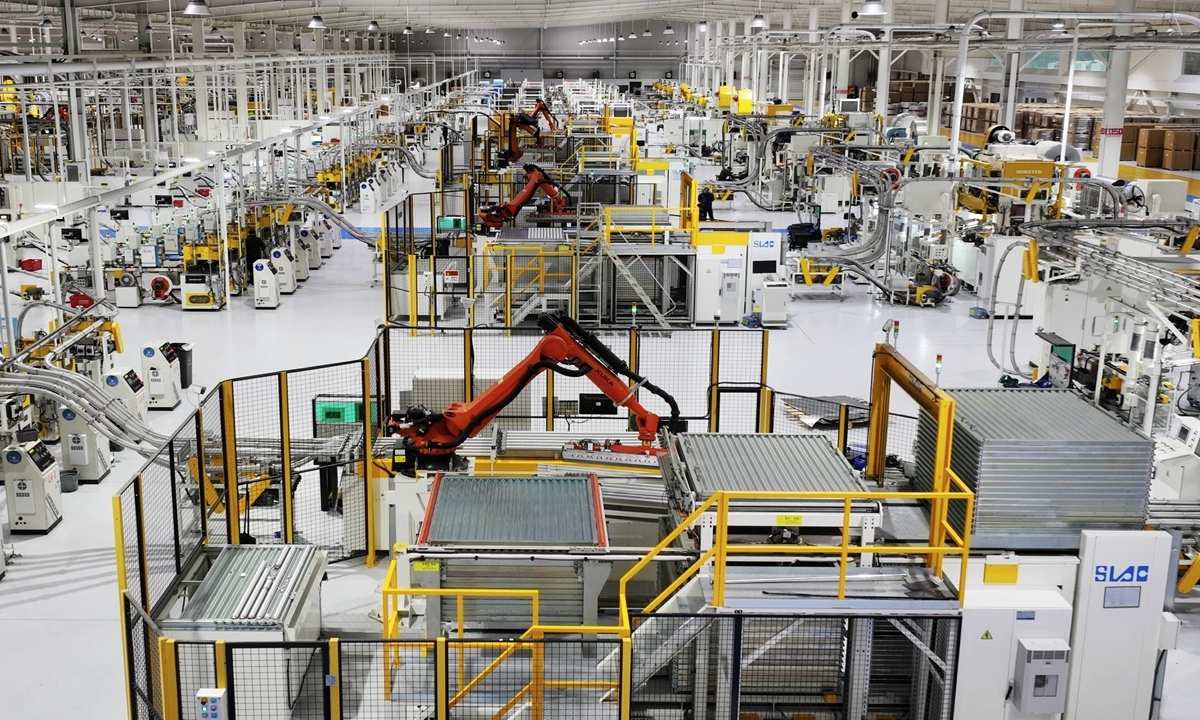
Industrial robots are operating on an intelligent production line in a smart manufacturing enterprise in Yangzhou, East China's Jiangsu Province. (Photo: VCG)
China's factory activity saw a mild contraction in October, with the purchasing managers' index (PMI) for the manufacturing sector falling to 49.3 from 50.1 in September, according to data released by the National Bureau of Statistics (NBS) on Saturday.
Despite the slight contraction, new growth drivers continued to expand, underscoring their strong support for the manufacturing sector.
Chinese economic experts said the decline was mainly driven by a pullback in overseas-related orders after a temporary surge in September, softer consumer demand following the week-long National Day holiday, and the seasonal slowdown in the basic raw materials sector. They described the shift as a temporary and stage-specific adjustment.
By enterprise size, the PMI for large enterprises stood at 50.2, down 0.4 percentage points from the previous month but still above the 50-point threshold. The PMIs for medium-sized and small enterprises fell by 1.3 and 1.4 percentage points to 48.4 and 47.5, respectively, according to the NBS.
Of the five sub-indices that make up the manufacturing PMI, the suppliers' delivery times index was above the 50-point threshold, while the production, new orders, raw materials inventory and employment indices remained below it.
Huo Lihui, a chief statistician with the NBS, attributed the retreat to some demand being brought forward ahead of the National Day holiday earlier this month and a complex international environment.
The production sub-index stood at 49.8, down 1.9 percentage points from September, while the new orders sub-index fell 1.1 percentage points to 49.4, as both supply and demand moderated during the month.
The PMI for high-tech manufacturing stood at 51.3, while that for equipment manufacturing came in at 50.6, both remaining above the 50-point threshold that separates expansion from contraction.
The figures indicate that emerging industries continued to sustain growth momentum, supported by the ongoing development of new quality productive forces, Huo noted.
According to the official data, the services sector also showed signs of seasonal strength. Business activity indices for industries including railway transport, water transport, postal services, internet software, and IT services were all above 55.0, indicating relatively high levels of prosperity.
Analysts said the rebound in industries tied to holiday travel and consumption — including rail transport, lodging, and cultural and recreational services — helped lift activity, with these sectors all remaining in expansion.
Huo said the services business expectations index stood at 55.2, staying in a relatively elevated range and suggesting that most firms remained confident about the sector's outlook.
China's manufacturing sector is facing renewed short-term pressure, but the broader industrial picture remains resilient, supported by rapid expansion in high-tech industries and emerging export sectors that are increasingly offsetting weakness in traditional manufacturing, Li Chang'an, a professor at the Academy of China Open Economy Studies at the University of International Business and Economics, told the Global Times on Saturday.
"Overall manufacturing sentiment softened last month, but new industries continue to provide important support," Li said.
High-tech industries and emerging export sectors are still expanding, the expert said, adding that China's industrial base is undergoing structural adjustment in which new growth drivers are playing a greater role in export performance and industrial upgrading.
October's PMI readings pointed to a mixed picture, with seasonal factors and weaker demand weighing on activity even as new growth engines remained intact, Wen Bin, chief economist at China Minsheng Bank, told the Global Times on Saturday.
Wen pointed out that China's exports may find some seasonal support in the fourth quarter, when shipments typically pick up ahead of Western holidays such as Christmas.
Meanwhile, Li identified continued strength in the "new trio" — electric vehicles, batteries and solar cells — and other high-tech exports, including integrated circuits, as factors likely to underpin manufacturing stability.