


China's 'porcelain capital' wins Global Award for Sustainable Development in Cities
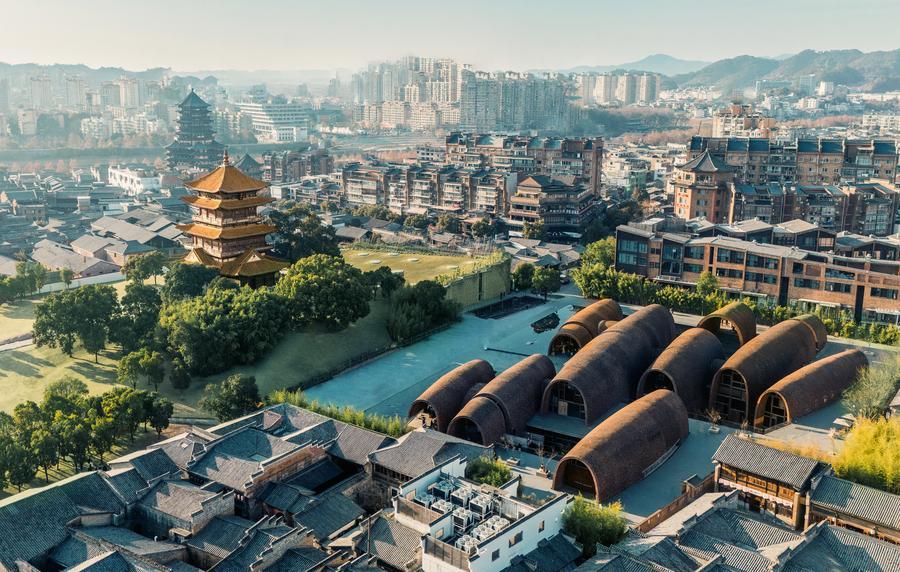
This file photo taken on Jan. 17, 2025 shows a view of the Taoyangli Historical and Cultural Block in Jingdezhen, east China's Jiangxi Province. (Photo: Xinhua)
FUZHOU, Oct. 31 (Xinhua) -- The global observance of 2026 World Cities Day was held on Saturday in east China's Fuzhou, with five cities, including China's "porcelain capital" Jingdezhen, honored with the fourth-cycle Global Award for Sustainable Development in Cities, also known as the Shanghai Award.
The event runs from Oct. 31 to Nov. 2. Apart from Jingdezhen, the other four recipients of the Shanghai Award, which recognizes cities for achievements in sustainable urban development, are Addis Ababa in Ethiopia, Santiago de Cali in Colombia, Istanbul in Türkiye, and Katowice in Poland.
The event brings together senior United Nations officials alongside representatives from national governments, local authorities, international organizations, academic institutions, the private sector, and community networks to share best practices and advance practical solutions to common urban challenges.
In December 2013, the 68th United Nations General Assembly adopted a resolution designating Oct. 31 as World Cities Day starting in 2014. It was the first international day proposed by the Chinese government at the United Nations.
Ceramic culture has long been an ideal medium for cross-civilization dialogue. As a cornerstone commodity of the ancient Silk Road, Jingdezhen porcelain was a defining cultural symbol, through which the world came to know China and China reached out to the world.
Building on this legacy, Jingdezhen has embraced a model of development that combines cultural preservation with creative renewal. Former porcelain factories have been reimagined as cultural and creative districts, old streets are lined with ceramic-themed installations, and historic neighborhoods have been carefully preserved and revitalized.
The city is home to more than 3,200 inheritors of intangible cultural heritage in ceramic craftsmanship. It has also been named in the UNESCO Creative Cities Network as a City of Crafts and Folk Art.
Jingdezhen's recognition is just one example of China's broader urban renewal efforts.
Urban renewal also holds huge potential for investment and consumption. China has set a target of renovating 1,500 old streets and factory compounds from 2026 to 2030, bringing in new industries and business models to inject fresh momentum into urban development.
"Converting old streets and factory sites into cultural and creative districts drives growth in dining, retail and entertainment," said Yan Yuejin, deputy director of the E-house China R&D Institute. ■