


Chinese ship-owner CMES holds vessel-naming ceremony in South Korea, advancing the two countries' shipbuilding cooperation
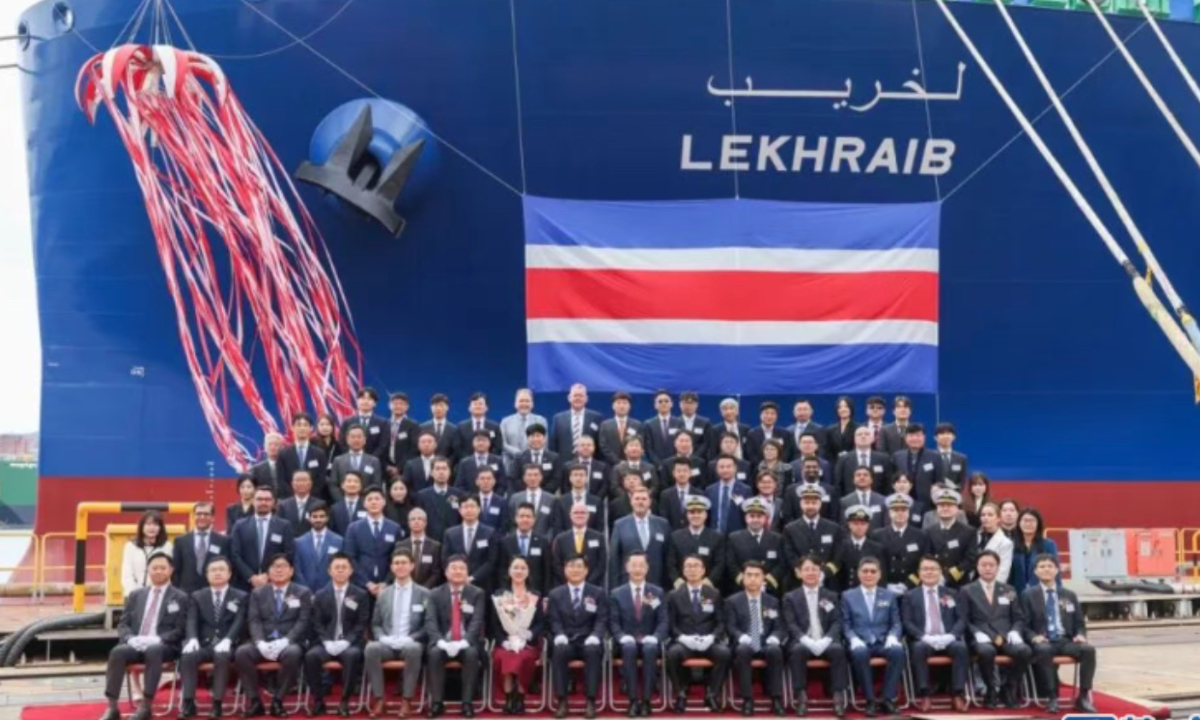
(Photo: screenshot of www.imarine.cn)
The first vessel under China Merchants Energy Shipping's (CMES) second-phase LNG project with QatarEnergy was named in South Korea on October 28-29, according to media reports, marking progress in cooperation between Chinese ship-owners and South Korean shipbuilders.
The LEKHRAIB, the first of six 174,000-cubic-meter LNG carriers ordered by CMES from South Korea's Samsung Heavy Industries (SHI), was named during ceremonies held on Geoje Island and in Busan. The vessel will provide long-term LNG transportation services for QatarEnergy.
The project forms part of QatarEnergy's fleet expansion to support rising LNG production and exports. In addition to the six vessels built by Samsung Heavy Industries, CMES secured long-term transportation contracts for four larger 271,000-cubic-meter QC MAX carriers, which are being built by China's Hudong-Zhonghua Shipbuilding.
LNG carriers are among the most technologically demanding commercial vessels, as they transport natural gas at temperatures of around minus 162 C. Their construction requires specialized cargo containment and insulation systems. The LEKHRAIB features a GTT Mark III Flex membrane containment system, with a designed daily boil-off rate of no more than 0.085 percent, as well as dual-fuel engines.
The project reflects the changing dynamics of the global LNG carrier market. South Korean shipbuilders have long held a strong position in large LNG carrier construction, while Chinese shipyards have been expanding their capabilities and securing more orders for advanced vessels, Wang Peng, an associate researcher at the Beijing Academy of Social Sciences, told the Global Times.
The participation of Samsung Heavy Industries and Hudong-Zhonghua in the same project highlights both countries' roles in meeting growing global demand for LNG transportation. Cooperation between Chinese ship-owners and South Korean shipyards is developing alongside competition between the two countries' shipbuilding industries, particularly in the high-end vessel market, Wang said.