


'Two launches, lunar orbit rendezvous': China unveils detailed plan for manned moon landing
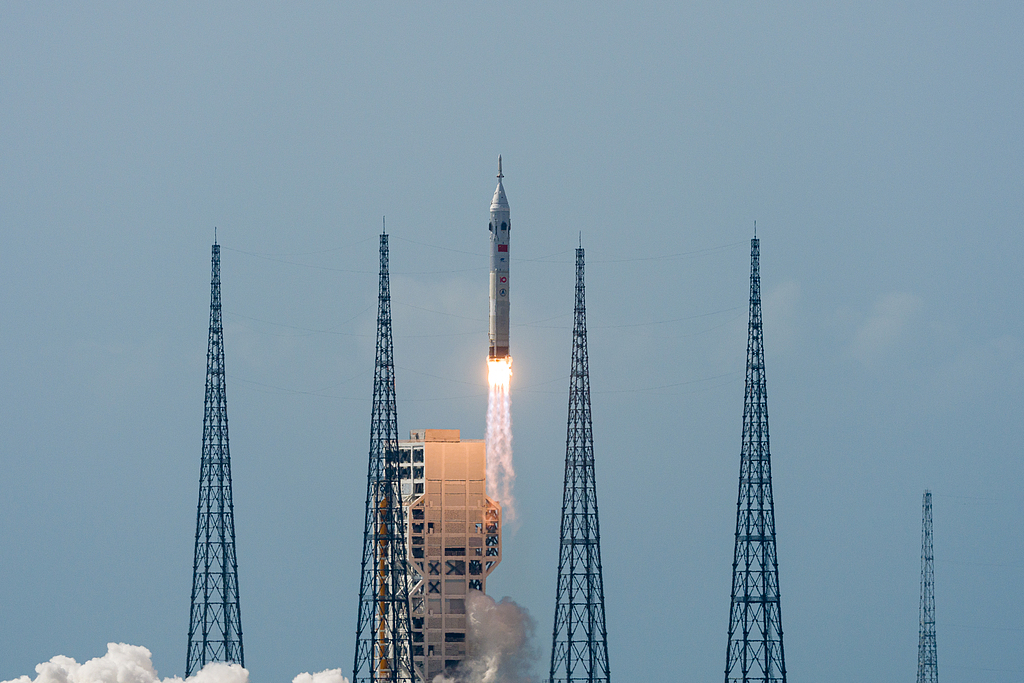
A Long March-10 rocket lifts off during a low-altitude demonstration and verification test that also tested the Mengzhou crewed spacecraft's escape system under maximum aerodynamic pressure, at the Wenchang Space Launch Site in Hainan Province, China, February 11, 2026. (Photo: VCG)
China will adopt a "two launches, lunar orbit rendezvous" architecture for its manned lunar exploration program, a senior engineer said on Saturday, as development work for lunar landing advances steadily.
Wang Xiang, deputy chief designer of China's manned space program and chief designer of the lunar exploration program, outlined the plan at the seventh Manned Space Symposium in Beijing.
China aims to land astronauts on the moon for the first time before 2030, according to previously announced plans by the China Manned Space Agency.
Under the scheme, two rockets would separately send the Lanyue (meaning "embracing the moon") lunar lander and Mengzhou (meaning "dream vessel") crewed spaceship into the Earth-moon transfer orbit, and the two spacecraft would perform a rendezvous and docking in the lunar orbit. Astronauts would then transfer from the Mengzhou spaceship into the Lanyue lander for the descent to the lunar surface and subsequent scientific work.
Wang said the approach matches China's existing technical capabilities and infrastructure, and the separate development of the spaceship and lunar lander can help standardize production and support the formation of a long-term family of vehicles.
While the plan also presents considerable challenges, Wang said the new system for mobilizing resources nationwide is the fundamental advantage for addressing them.
He said the program has established system plans, technical standards and quality requirements under a single development framework, and has adopted an integrated design approach with emphasis on interface verification between subsystems.
So far, the development of the Long March-10 carrier rocket, the Mengzhou crewed spaceship and the Lanyue lunar lander has been progressing smoothly.
Major tests already completed include the Mengzhou spaceship's zero-height abort and maximum dynamic pressure escape tests, the Lanyue lander's landing and takeoff test, plus the low-altitude demonstration and validation test for the Long March-10 rocket.
Wang said future lunar exploration should follow the principle of building knowledge and capability before moving into resource utilization, with a prolonged survey phase needed to understand the moon in a steady, step-by-step manner.
He added that manned lunar landing and unmanned lunar exploration share many common elements in key technologies, infrastructure and personnel, and that achievements from the Chang'e lunar exploration program will also support the manned landing effort.