


Robots tackle Mount Taishan in climbing competition, showcasing powerful capabilities
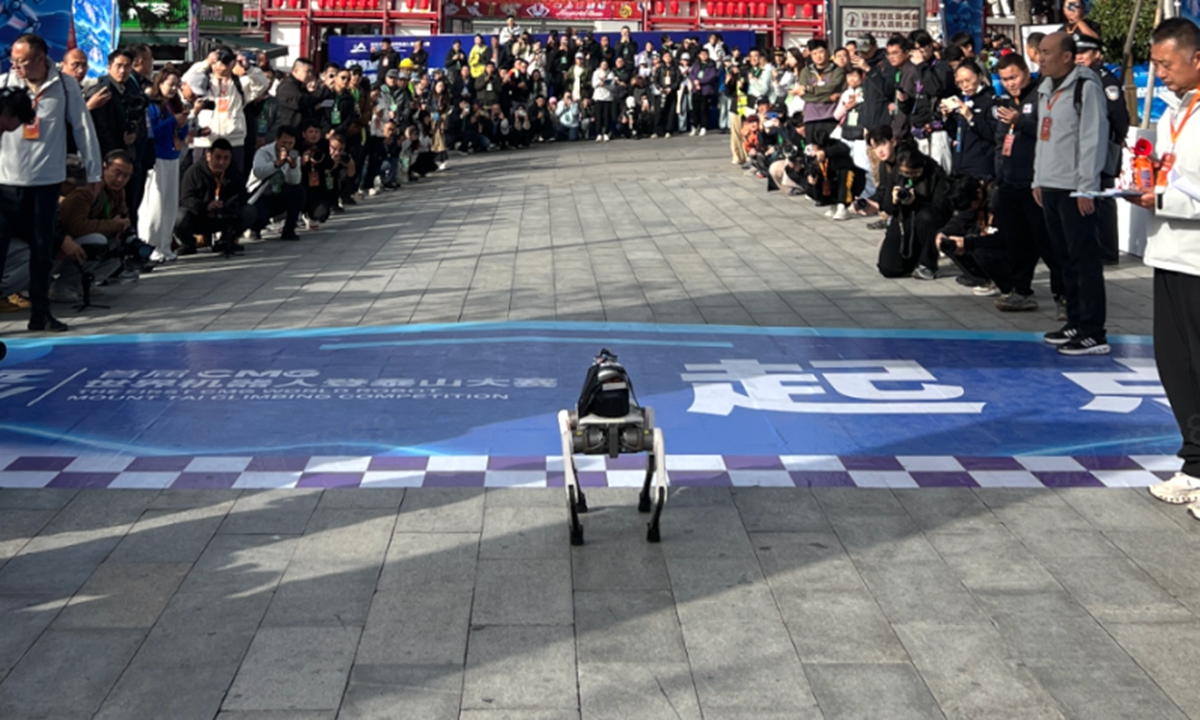
UNIUBI AI's Cyvet, an independently developed quadruped robot, participates in the inaugural CMG World Robot Mount Taishan Climbing Competition in Tai'an, East China's Shandong Province, on November 2, 2026. (Photo: Courtesy of the company)
Centuries-old stone steps on Mount Taishan turned into an unlikely racetrack on Monday as nearly 90 robot teams from leading enterprises, universities and research institutes gathered in Tai'an, East China's Shandong Province, for the inaugural CMG World Robot Mount Taishan Climbing Competition.
Humanoid robots and robot dogs tested their climbing capabilities. They were seen climbing, pausing, recalculating, and then moving forward again with surprising agility. Some moved with careful precision, others with a quick, springy gait, giving spectators a glimpse of how far robotics has come, and how far it still has to go in real-world scenarios.
The competition's main course stretched about 3.9 kilometers from Hongmen to Zhongtianmen on Mount Taishan, with more than 3,100 steep stone steps and an elevation gain of roughly 600 meters. For human hikers, the route usually takes 1.5 to 2 hours. For robots, it took less than an hour.
According to CCTV News, Beijing Lingyi Technology, a wholly owned subsidiary of Hangzhou-based Unitree Robotics, won the quadruped robot speed race. Its robot completed the grueling climb in 43 minutes and 41 seconds, crossing the finish line after a steady, mechanical ascent over uneven steps, stone ridges and narrow mountain paths.
"Adapting to Mount Taishan's road conditions was the biggest challenge. These steps were built centuries ago. Some are high, some low, some wide, some narrow, and there are also cobblestone sections," said Chen Lin, a navigation engineer on the Hangzhou-based UNIUBI AI team.
The team's quadruped robot used lidar to scan the terrain, distinguish steps from rocks and other obstacles, and generate a 3D point-cloud map for navigation.
UNIUBI AI's Cyvet, an independently developed quadruped robot, was the smallest quadruped robot in this year's event. In testing, Cyvet completed the route from Hongmen to Zhongtianmen autonomously in 35 minutes 47 seconds, the company told the Global Times.
According to the organizers, the competition had two main categories: speed races and specialized events. Its four official events were humanoid robot racing, legged robots load-carrying and exoskeleton-assisted climbing, as well as an all-terrain scouting challenge.
Organizers said that the event was designed to evaluate and test the machines' perception, balance, decision-making, execution, and environmental adaptability in rugged terrain. Practical applications for such technology include emergency response, delivery of materials, and mountain inspections.
Among the competitors was Shandong Yobotics Intelligent Robot Co, which brought three models to the mountain - the quadruped robot Y30, the quadruped E15 and the humanoid robot E1. The company said that its robots are designed for demanding real-world scenarios such as factory inspection, pipeline patrol, emergency rescue and firefighting.
Notably, the E1 humanoid robot achieved runner-up honors in humanoid robot racing, completing the course in 36 minutes and 18 seconds.
The race highlighted the progress made by domestically produced robots in terms of speed, coordination, and practical application, while also injecting new momentum into the development of the industry, industry analysts said.
"Like the early exhibitions of aircraft and automobiles, robot sporting events can serve as visible indicators of technological maturity, attracting public attention while also drawing investment," Xiang Ligang, president of the Beijing Institute of Intelligent Era Industry, told the Global Times on Monday.
When multiple robots compete within the same environment, their weaknesses are often exposed rapidly, and useful approaches can be observed, evaluated, and adapted from rivals. In this respect, competition functions as a practical testing ground, enabling products to improve more quickly than through laboratory trials alone, Xiang said.
From quadruped robots to humanoid models, the competition demonstrated that robots are moving beyond laboratory demonstrations into practical applications such as rescue, inspection, and delivery.
The event also revealed the challenges ahead: mountain paths still expose weaknesses in balance, perception, and decision-making. In that sense, Mount Taishan was both a milestone and a reality check for the robotics industry, Xiang noted.
The Mount Taishan competition came amid the rapid expansion of China's robotics sector. China accounted for nearly three-fifths of industrial robots installed worldwide in 2025, further strengthening its position as the world's largest market for industrial robotics, according to the World Robotics 2026 report.
Data from China's Ministry of Industry and Information Technology showed that the country had more than 400 humanoid robot models and produced more than 40,000 units in the first half of 2026.