


UK parliamentary committee seeks China trade curbs, tariff preparations while saying decoupling unrealistic; pragmatic co-op serves British interests: experts
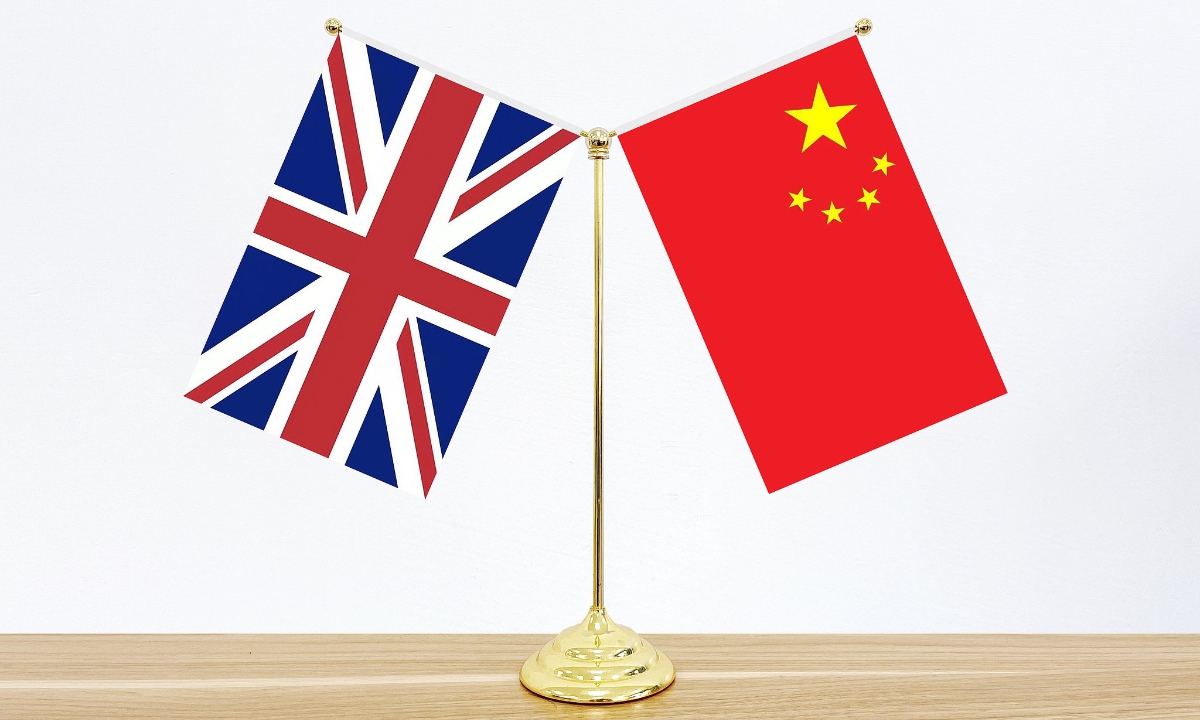
China-UK (Photo: VCG)
A British parliamentary committee on Monday called for tighter restrictions on trade and investment with China and preparations for possible tariffs, even as it acknowledged the economic benefits of cooperation, underscoring Britain's challenge in charting a coherent long-term trade policy toward China amid deepening bilateral economic ties.
The report comes as the British government seeks to deepen economic ties with China and secure greater market access for British businesses. Chinese experts said a pragmatic, flexible approach would better serve Britain's economic interests, while protectionist restrictions risk shutting British firms out of opportunities the government is seeking to unlock.
In its latest report on UK-China economic and trade relations, the House of Commons Business, Innovation, Science and Trade Committee criticized the government for failing to deliver on its promise of a strategic, long-term and consistent approach to China.
It called for a risk-based framework, including a "red zone" where Chinese trade and investment would be prohibited in areas involving capabilities Britain must retain as sovereign or develop with allies.
The committee also urged stronger trade remedies and safeguards for sensitive technologies and data. It recommended preparing a tariff regime for use if China refuses to “rebalance” its economy, continues what the committee called unfair industrial “subsidies” and fails to offer fully reciprocal market access.
However, the report also acknowledged the case for continued engagement, noting that British businesses have a profitable presence in China and are eager to expand, while low-cost, increasingly high-quality Chinese imports benefit British consumers. It also recognized China as a world-leading science power, and British firms want access to Chinese innovation.
Calling China Britain's "most complex economic partner," the report cited annual UK-China trade of about £140 billion, accounting for roughly 7 percent of Britain's total trade. It acknowledged that economic de-coupling from China was "neither realistic nor desirable."
House of Commons committee reports can carry considerable weight in policy discussions, but their recommendations are not binding on the government, Li Guanjie, a research fellow with the Shanghai Academy of Global Governance and Area Studies under the Shanghai International Studies University, told the Global Times on Monday.
The British government has until January 2, 2027, to formally respond to the report, according to the UK Parliament's website. This means the proposed measures, including potential tariffs, have yet to be adopted as government policy.
Li pointed to a contradiction at the heart of the report, saying that while it calls for tougher trade and investment restrictions, it also acknowledges that Britain cannot afford to decouple from China. "The report itself offers no clear answer to how these conflicting positions can be reconciled," Li said.
Jian Junbo, director of the Center for China-Europe Relations at Fudan University, said the report seeks to draw clearer boundaries between economic security and cooperation, reflecting calls for a more consistent and predictable China policy. “But it still puts security concerns first when assessing trade and investment with China,” Jian said, describing the approach as a tendency to view economic relations through a security lens.
The British government's recent actions, meanwhile, point to continued economic engagement. Then Prime Minister Keir Starmer visited China in January with nearly 60 business and cultural organizations, while the two countries held a meeting of the UK-China Joint Economic and Trade Commission in London in July, advancing cooperation on services, investment and market access.
In an October 8 video call with British Chancellor of the Exchequer John Healey, Chinese Vice Premier He Lifeng called on both sides to strengthen economic and financial cooperation, respect each other's core interests and pursue mutual benefit and win-win results. Healey expressed Britain's willingness to deepen dialogue and cooperation in these areas and advance bilateral relations, according to Xinhua News Agency.
Li said British government's current approach toward China is relatively pragmatic and rational, shaped largely by the two countries' relative economic strengths, market sizes and trade relations.
With China's vast domestic market and strong manufacturing capabilities, Britain has an interest in expanding market access, boosting exports and pursuing more business opportunities. Maintaining policy flexibility may therefore better serve Britain's interests than imposing rigid restrictions that could narrow its own scope for economic cooperation, Li said.
China is equivalent to Britain's third-largest goods trading partner, after the EU and the US, with bilateral economic ties supporting more than 370,000 British jobs, according to the UK Foreign Office. In a September 8 parliamentary response, the department reaffirmed its commitment to a "consistent, long term and strategic approach" to economic relations with China.
British businesses have shown continued commitment to the Chinese market. A 2025–26 survey by the British Chambers of Commerce in China found that most British businesses maintained (41 percent) or increased (35 percent) their investment in China in 2025, underscoring their continued long-term commitment to the Chinese market, according to the Chamber.
For the long-term development of China-UK economic and trade relations, Britain should avoid viewing the Chinese market primarily through a security lens and instead pursue cooperation in a more open and constructive manner, guided by free trade principles, Jian said.
China welcomes greater investment by British companies and hopes Britain will provide a fair, impartial and non-discriminatory environment for Chinese investors, Chinese Commerce Minister Wang Wentao said at trade talks in London in July, as both sides expressed willingness to deepen cooperation in services and investment.