


When sci-fi meets reality and AI takes center stage
Inside a hulking former industrial gas holder, now transformed into an arts venue in Beijing's 798 Art Zone, the scene looks straight out of a science-fiction film — yet the future it depicts feels closer than ever.

Visitors attend "2026 Three-Body Day", an event marking the 20th anniversary of the sci-fi epic, at a "military base" depicted in the story. (Photo: China Daily)
Hundreds of fans of Liu Cixin's Remembrance of Earth's Past trilogy, also known as The Three-Body Problem trilogy, queued for activities inspired by the celebrated sci-fi saga. Visitors could apply for jobs at a fictional secret military base, try a billiard table used by a physicist in the story to work through complex problems, or use artificial intelligence tools to design a spaceship.
The gathering was part of "2026 Three-Body Day", an annual event hosted by Chinese company Three-Body Universe and held on Oct 24 and 25. Marking 20 years since the first book began serialization in Science Fiction World magazine in 2006, the event brought together fans, filmmakers and researchers to revisit the trilogy's ideas and explore the challenges of adapting its expansive universe for the screen.
The first book won the 2015 Hugo Award for Best Novel, making Liu the first Asian writer to receive the honor. The trilogy has since sold more than 40 million copies worldwide and been translated into 45 languages.
Liu, the event's initiator, used the occasion to reflect on the upheavals of the digital age.
In the world of The Three-Body Problem, humanity faces the prospect of an alien invasion. Although no such threat has materialized in reality, Liu said, another once-futuristic concern has become tangible: the "invasion" of AI.
"The arrival of AI has largely changed our lives. It could replace human jobs, throwing many people into unemployment — and forcing us to confront the meaning of our own existence," added Liu, encouraging everyone to strive for a better future.
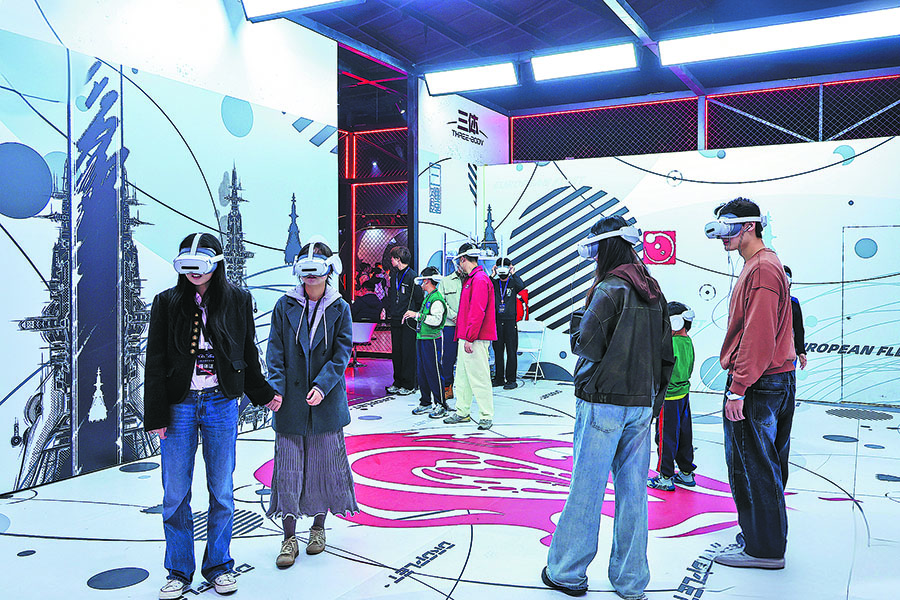
Fans wear virtual reality headsets to immerse themselves in the world of the sci-fi epic. (Photo: China Daily)
Bringing it to the screen
Spanning 18.9 million years, the sci-fi epic has inspired adaptations in different formats, from animation and television dramas to an upcoming film. At the event, creators discussed how to translate its vast cosmic vision and philosophical questions into visual stories.
Zhang Yimou, the renowned director who announced in 2024 that he would helm a film adaptation of The Three-Body Problem, said he was impressed by the devoted fans who had traveled from across the country to attend. He described it as an honor to be involved with the acclaimed novel.
With the film's script still being refined, Chen Yu, its screenwriter and a professor at Peking University's School of Arts, said in a master class that he intended to preserve the original work's distinctive character and ideas. The film is scheduled to be released in 2028.
For Chen, the threats posed by extraterrestrial civilizations and AI ultimately serve a common purpose: prompting people to reflect on what makes human existence meaningful.
"In an age dominated by computers' ceaseless calculations, or a universe governed by cold, relentless rules — human existence itself is the miracle," he said. "Because only we can offer an experience of being alive that nothing else can replace."
The challenge of adaptation is not limited to the upcoming film. Yang Lei, director of the 2023 Chinese television series Three-Body, recalled how bringing the story to the screen had fulfilled a long-held dream. The drama, released in China and overseas, follows scientist Wang Miao, played by Zhang Luyi, and police officer Shi Qiang, played by Yu Hewei, as they investigate a series of suicides among prominent scientists and uncover an alien plan to obstruct Earth's scientific progress before a fleet arrives in about 450 years.
Walking into the event venue and seeing re-created scenes from the novels left Yang excited and emotional. He had read the books repeatedly, he said, until their world had almost become part of him.
Yet the series' central appeal, in Yang's view, lies in more than its mysterious events or extraterrestrial technology. It also asks how civilizations should respond to the unknown.
He pointed to the "dark forest" theory from the trilogy's second book, The Dark Forest, in which civilizations resemble armed hunters moving through a forest, each uncertain whether others pose a threat.
"When you hear someone's footsteps nearby, do you shoot them, or do you cough to warn them?" Yang said. "That is a difficult choice, and the entire Three-Body series is, in fact, exploring this kind of survival rule."
Yang also revealed that a spin-off of the 2023 series, titled Da Shi after police officer Shi's nickname, would begin filming in the fourth quarter of this year. Reuniting Zhang Luyi as Wang and Yu as Shi, the new story follows the pair as they investigate a mysterious case while expanding outward into a broader ensemble.
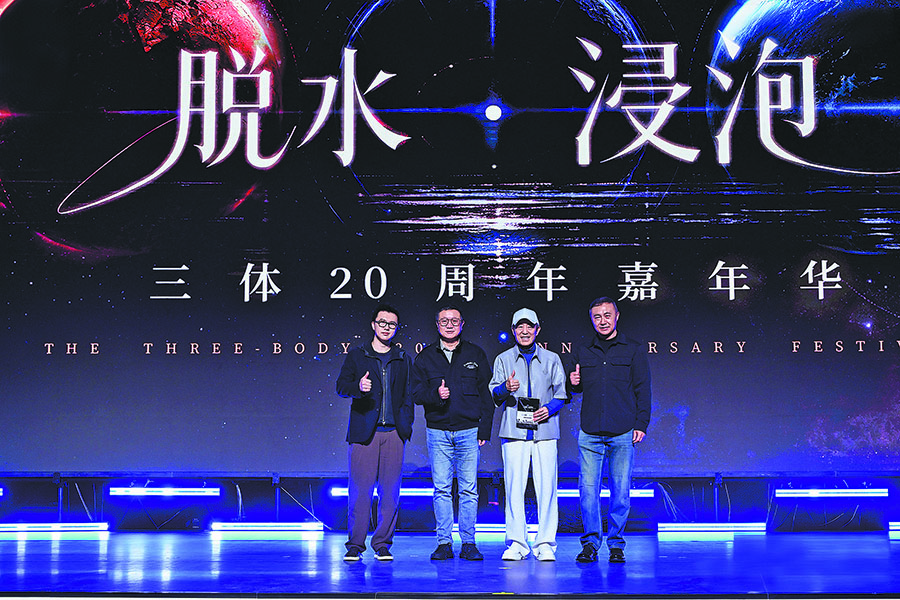
"2026 Three-Body Day" brought together celebrities, including writer Liu Cixin (second from left) and director Zhang Yimou (second from right), who is working on the film adaptation of The Three-Body Problem. (Photo: China Daily)
Science behind spectacle
Making such stories convincing requires more than imaginative production design. Yang and visual director Lu Beike said their team grounds fantastical scenes in research into physics, materials science and the social conditions of the periods depicted.
One example is "Operation Guzheng," a fictional military mission to intercept messages linked to the alien threat. Because the sequence takes place at a specific time along the Panama Canal, the filmmakers considered the direction of sunlight when planning the shots.
"We even argued over this detail for days," Yang said. Lu pointed out that the canal runs northwest to southeast, meaning the description in the novel called for front lighting. Yang, however, wanted backlighting.
The disagreement illustrated a recurring tension in adapting science fiction: remaining faithful to the logic of the imagined world while making choices that serve the visual narrative. Yang said the same attention to detail would carry over to Da Shi, with scientific accuracy balanced against artistic expression.
Meanwhile, another figure from the trilogy's universe is moving into the spotlight. Sophon, the intelligent, proton-sized supercomputer created by the Trisolarans, lends its name to a new drama. With filmmaker Lu Yang as executive producer and Xin Yukun directing, Sophon will explore the fate of ordinary people amid a crisis threatening civilizations on Earth.
For Xin, working on the project has prompted reflection beyond the demands of filmmaking. Reading Liu's work, he said, can help readers step back from immediate worries and see their lives against a broader backdrop.
In addition, Three-Body: The Dark Forest, a new series adapted from the trilogy's second book, is expected to complete its preparation work by the end of this year, according to producer Bai Yicong. The project's costume and styling design is one-third complete, and the second round of concept art has been completed.
These may exemplify the trilogy's lasting appeal. Two decades after the story first reached readers, its alien civilization, scientific puzzles and visions of cosmic danger still invite creators and audiences to reconsider humanity's place in the universe, according to some industry observers attending the event.

Fans crowd outside a hulking former industrial gas holder-turned arts venue in Beijing's 798 Art Zone. (Photo: China Daily)