


Shenzhen announces phased, area-specific low-altitude flight restrictions from November 7 to 21
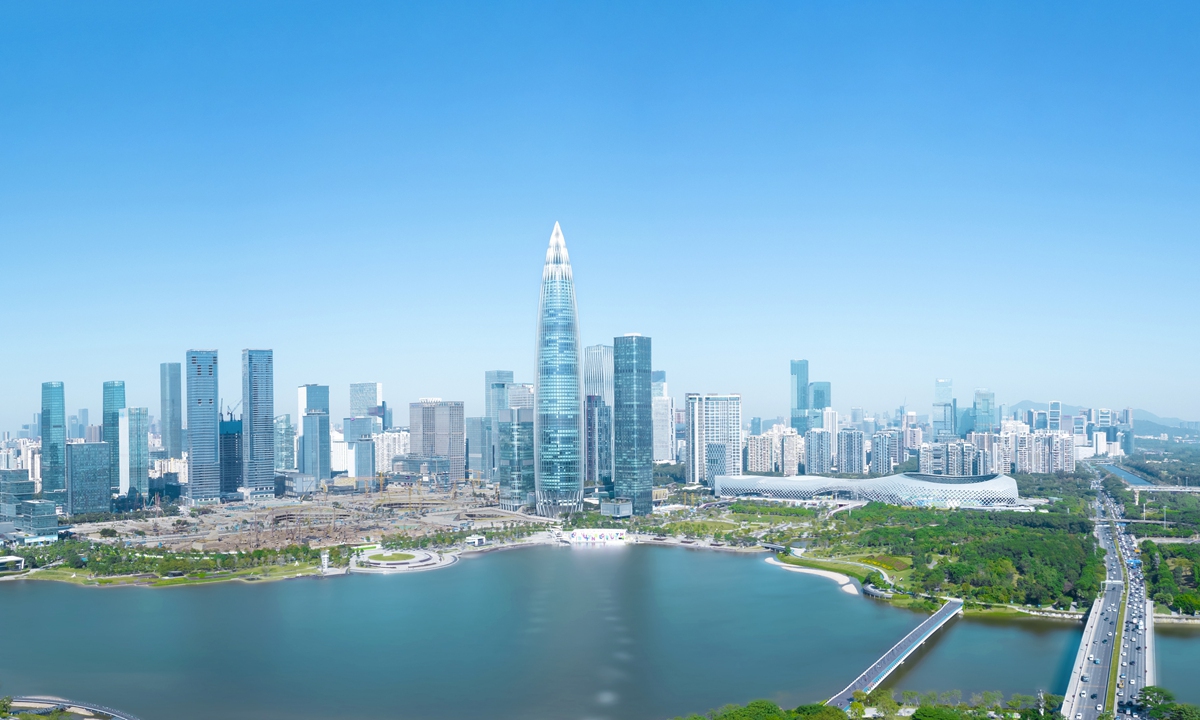
Skyline of Qianhai area in Shenzhen, South China's Guangdong Province (Photo: VCG)
The municipal government of Shenzhen, South China's Guangdong Province, issued a notice on Tuesday on low-altitude flight restrictions from November 7 to 21, with controls to be implemented in phases and across different areas to minimize the duration of controls while maintaining as many low-altitude flight operations as possible.
Flights by relevant aircraft and airborne objects will be prohibited from flying within the administrative areas of Futian and Nanshan districts from November 7 to November 10. From November 11 through November 21, the restrictions will apply across Shenzhen, excluding the Shenzhen-Shanwei Special Cooperation Zone, according to the Shenzhen Municipal People's Government.
The aircraft and airborne objects covered by the notice mainly include unmanned aerial vehicles (UAVs), aircraft used for general aviation activities, model aircraft, balloons, kites, Chinese sky lanterns and other airborne objects. During the designated periods and within the restricted areas, all entities, organizations and individuals are prohibited from conducting flight activities using low-altitude aircraft or airborne objects.
Special flights for security support, emergency rescue and police duties may only be carried out after obtaining approval from the relevant authorities in accordance with the law, the notice stated.
Those who violate relevant laws and regulations or the notice by conducting unauthorized or illegal flight activities will be penalized by the competent authorities in accordance with the law. Where such violations constitute crimes, criminal liability will be pursued.
China's Interim Regulations for Managing UAV Flight, which took effect on January 1, 2024, explicitly stipulate that air traffic management authorities may designate temporary restricted flight zones to ensure the security of major events. Such zones should be announced in advance by people's governments at or above the city level, and unmanned aircraft are prohibited from taking off within the designated areas and periods without prior approval.
In recent years, other Chinese cities have also adopted temporary low-altitude flight restrictions when hosting major events.
As the host of APEC in 2026, China will hold the 33rd APEC Economic Leaders' Meeting in Shenzhen on November 18 and 19. The APEC CEO Summit will be held on the sidelines of this meeting, according to the Xinhua News Agency.
The notice said Shenzhen's low-altitude flight restrictions will be implemented in phases and across different areas, with the aim of shortening the duration of controls and preserving as many low-altitude flight operations as possible.
The approach seeks to strike a balance between security requirements, the development of the low-altitude economy and the public's normal flight needs.
A dedicated approval channel will be available during the restricted periods for special flight missions, including security support and emergency rescue, it noted. The government called on organizations and the public to actively cooperate with the registration and management requirements for low-altitude aircraft and airborne objects, strictly observe the rules and refrain from unauthorized flights.