


A bridge built through words: Egyptian guide's journey from Chinese learner to cultural ambassador
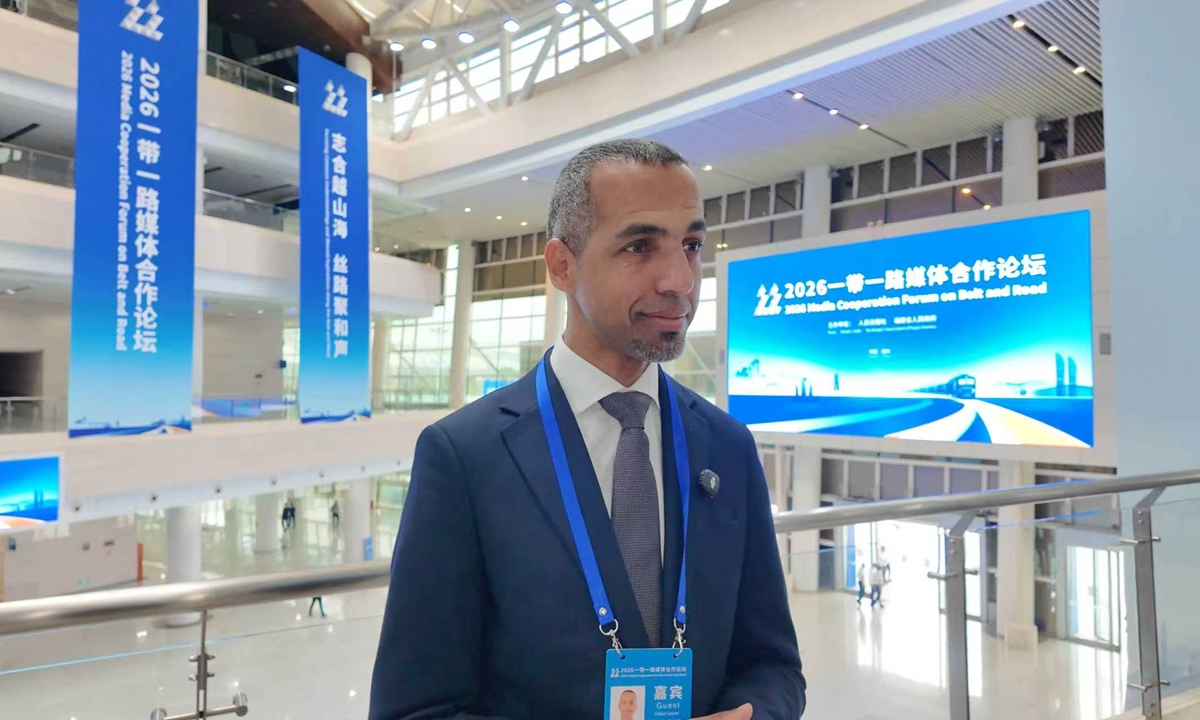
Abbas Saeed, a Chinese-speaking Egyptian tour guide (Photo: Yu Jiayin/GT)
A playful question caught Abbas Saeed, a Chinese-speaking Egyptian tour guide, off guard - or so the Global Times reporter thought. Asked his age using an old-fashioned Chinese expression that even native speakers rarely say in everyday conversation, Abbas understood it immediately and replied, without hesitation, that he was born in 1984. His immediate response left the reporter genuinely impressed by his command of Chinese.
The 2026 Belt and Road Media Cooperation Forum opened on Tuesday in Fuzhou, East China's Fujian Province, bringing together more than 200 foreign delegates representing 182 media outlets and institutions from 100 countries, as well as international and regional organizations.
Abbas was among the international guests. But what brought a tour guide to the podium of a major international media forum? His answer lay in a simple aspiration: to become a bridge connecting people.
"When people talk about the Belt and Road Initiative, they often think of major projects, trade routes, ports and high-speed railways. But today, I want to talk about its human dimension - the real arteries that connect the hearts and minds of people in our two countries: media and cultural exchanges."
Rather than dwelling on grand projects and figures, Abbas brought his speech back to people and the bonds between them. In his view, the Belt and Road Initiative is fundamentally a path toward a shared future built through joint efforts, while media and cultural exchanges play a central role in bringing the initiative closer to ordinary people and giving it vitality.
Abbas also delivered part of his speech in Chinese. His fluency was so impressive that, had audiences heard only his voice without seeing him, they might hardly have guessed that he was not a native Chinese speaker.
Abbas recalled with the Global Times how his journey with the Chinese language began, his determination still evident in his voice.
"Everyone in my family said Chinese was the most difficult language in the world. I was determined to prove them wrong - that if you dare to try and believe in yourself, there is no obstacle you cannot overcome."
In 2002, Abbas enrolled in the Department of Chinese Language at Ain Shams University in Egypt. Just three months later, he made an unusual decision: to stop speaking Arabic, his native language, at least for a while.
"I spoke Chinese with my classmates at school, but Chinese was so difficult that they didn't want to speak it with me. That was fine. I just talked to myself," he recalled. "Learning Chinese taught me to listen to myself and gave me a way to communicate with the world."
After graduating, Abbas worked as a tour guide for three years, then spent another three years deepening his understanding of Chinese culture and gaining valuable experience in diplomatic exchanges. Throughout this period, he continued to hone his skills and build the expertise he would need.
"I don't want to be just an ordinary tour guide, or an ordinary bridge between people. I want to be a bridge that truly connects them," Abbas told the Global Times.
The word "connection" came up repeatedly in the interview. In Abbas' view, the impact of the Belt and Road Initiative on Egypt goes far beyond any single project. High-speed railways, ports and construction projects have helped drive economic development, creating jobs and raising incomes for ordinary Egyptians. But he believes the deeper and more lasting impact lies in the connections forged between people and the dialogue between civilizations.
The work of a tour guide may seem routine, but it offers one of the most direct forms of face-to-face cultural exchange. Abbas gave a simple example: When a Chinese tourist with little knowledge of Egyptian civilization learns about the history behind the pyramids through his explanations, a conversation between two civilizations has already begun. That, he said, is a bridge built through direct human interaction.
Over the years, Abbas has developed his own approach to bringing the two ancient civilizations closer: using simple, accessible Chinese to draw connections between Egyptian and Chinese history.
"When introducing Egyptian historical sites, I try to relate them to periods of history that Chinese people are familiar with, making the distant world of the pharaohs feel more accessible. When introducing China to Egyptians, I also draw on their own cultural perspectives, so that Chinese stories are easier for them to understand and relate to," he explained.
Both China and Egypt are ancient civilizations, Abbas noted, and their cultures share many values and ideas despite their geographical distance. Finding these common threads, he believes, is one of the best ways to bring their people closer together.
From a determined Chinese-language learner to an informal ambassador for cultural exchange, Abbas has used a language far from his own to highlight the small, everyday connections between two civilizations - the very connections that can sometimes be overlooked amid grand narratives of international cooperation.
His insistence that he does not want to be just an ordinary bridge perhaps says it all. A bridge does not need to stand out or draw attention to itself. Its real purpose is to bring people on either side closer, until the distance between them no longer seems so great.