


China Focus: Exploring future at CIIE as global firms innovate with China
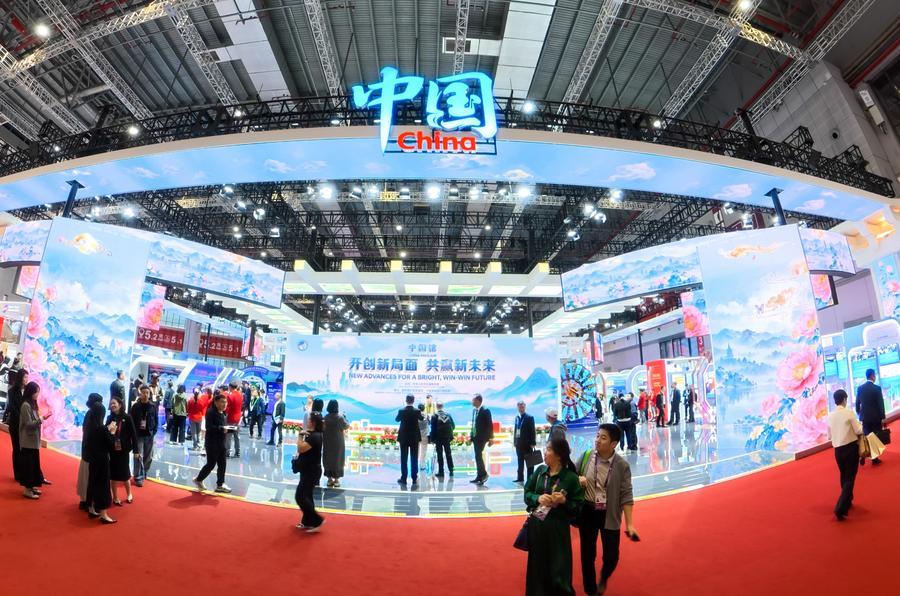
People visit the China Pavilion during the ninth edition of the China International Import Expo (CIIE) at the National Exhibition and Convention Center (Shanghai) in east China's Shanghai, Nov. 5, 2026. (Photo: Xinhua)
A room that adjusts its climate before one wakes, a taxi without a steering wheel, and a humanoid robot that plays table tennis are among the scenes of future life at the ninth China International Import Expo (CIIE), which opened here on Thursday.
Many of these frontier and deep tech offerings displayed at China's flagship import platform are not simply sold, but also developed, tested and scaled up in China, as multinationals turn the rigors of the world's most competitive market into innovation partnerships.
A DAY IN THE FUTURE
At 7:30 a.m., before the curtains even open, the room is already perfectly conditioned, tuned by Bosch's AI-Hybrid smart home climate system built around user habits, which made its global debut at the CIIE.
Step into a Tesla Cybercab for the commute, and the steering wheel and pedals are gone. The redesigned passenger-oriented cabin shifts focus from driving to taking in the view outside.
In another vehicle, French firm Michelin's Touch Intelligence technology repurposes real-time data from existing sensors to assess tire conditions, without extra hardware.
At the factory, the Honeywell Forge intelligent connectivity platform helps production move from automation toward autonomy. By connecting machines, sensors and control systems, the platform alerts operators to potential malfunctions and provides maintenance advice.
Back in the office, Qualcomm's higher-speed, wider-bandwidth 6G terminal -- whose prototype was first shown at the CIIE -- enables AI-powered devices ranging from smart glasses to embodied robots to operate within a richer ecosystem.
In the gym after work, a humanoid robot tracks a table tennis ball's trajectory, calculates its stroke strategy and strikes back in real time, with no remote control required.
At a community pharmacy, shelves are stocked with new skincare and wellness products drawing on AI beauty devices, longevity science and hair-regrowth technologies developed by L'Oréal, Estée Lauder and Shiseido.
Back home, Singaporean brand OSIM's AI-powered massage chair uses non-contact sensors to read a user's heart rate and stress levels and tailor a massage routine.
Behind all these scenarios, AI computing runs at full tilt in data centers, supported by cooling solutions from U.S. materials science giant Dow, which is attending the CIIE for the ninth time.
FROM TARGET MARKET TO INNOVATION PARTNER
"When you invest in China, you are investing in the most competitive market in the world," said Pua Seck Guan, executive chairman and CEO of Singapore-based Perennial Holdings, a newcomer to the CIIE.
The firm has set up China's first wholly foreign-owned tertiary general hospital in Tianjin, northern China. The hospital has treated patients from more than 40 countries and regions, and the company is pursuing healthcare investments in more Chinese cities.
Experts noted that China is shifting competition away from a race to the bottom toward quality, technology and innovation -- and foreign companies are among the beneficiaries.
Michelin has found that trends in electric vehicles and autonomous driving often emerge in China ahead of other markets.
"China is both a test ground and a gym for strengthening our innovation capabilities," said Jay Wu, a senior executive at Michelin China. "We are evolving from 'In China, for China' to 'With China, for the World' -- that is, innovating with China and creating value for the world."
Beyond products, the CIIE has also helped multinationals expand partnerships from product supply to joint research, technology validation and new industrial applications, Wu added.
"Shanghai is a natural launchpad for our innovations," said Puay Koon Chia, Dow Asia Pacific president, noting Dow's materials science expertise can support digital transformation, advanced manufacturing, renewable energy and the transition to a circular, lower-carbon economy in China.
The Shanghai Dow Center, the company's largest integrated R&D hub outside the United States, brings together more than 300 scientists and over 80 advanced labs.
Healthcare giant Medtronic sees China as a global leader in digital health applications, said Cao Shan, vice president of corporate affairs and communications at Medtronic Greater China.
"The country's innovation speed, complete supply chain and talent advantages are highly competitive worldwide, and that is why we are continuing to deepen our footprint here," Cao said.