


China has capacity, willingness to advance global marine biodiversity governance, expert says
Photo: VCG
China has both the capacity and willingness to play a bigger role in global marine biodiversity governance, including by supporting developing countries and hosting the Secretariat of the UN treaty on marine biodiversity in areas beyond national jurisdiction (BBNJ Agreement) in Xiamen, an expert told the Global Times on Saturday. The remarks came as a report on China's role in global marine biodiversity governance was released in both Chinese and English on Thursday.
China, by helping bridge differences between developed and developing countries, has advanced the conclusion of a landmark agreement in global ocean governance, namely the Agreement under the United Nations Convention on the Law of the Sea on the Conservation and Sustainable Use of Marine Biological Diversity of Areas beyond National Jurisdiction, which entered into force early this year, according to the report released by the China Institute for Marine Affairs under the Ministry of Natural Resources.
Chen Xidi, an expert at the China Institute for Marine Affairs under the Ministry of Natural Resources, told the Global Times that a considerable number of countries expect China to play a greater role in implementing the BBNJ Agreement. “China has the capacity and willingness to meet these expectations,” he said.
In designing and refining relevant legal arrangements, China has advocated a benefit-sharing mechanism encompassing both monetary and non-monetary benefits to safeguard the legitimate rights and interests of developing countries, and supported an integrated approach to biodiversity conservation and the sustainable use of marine resources, said the report.
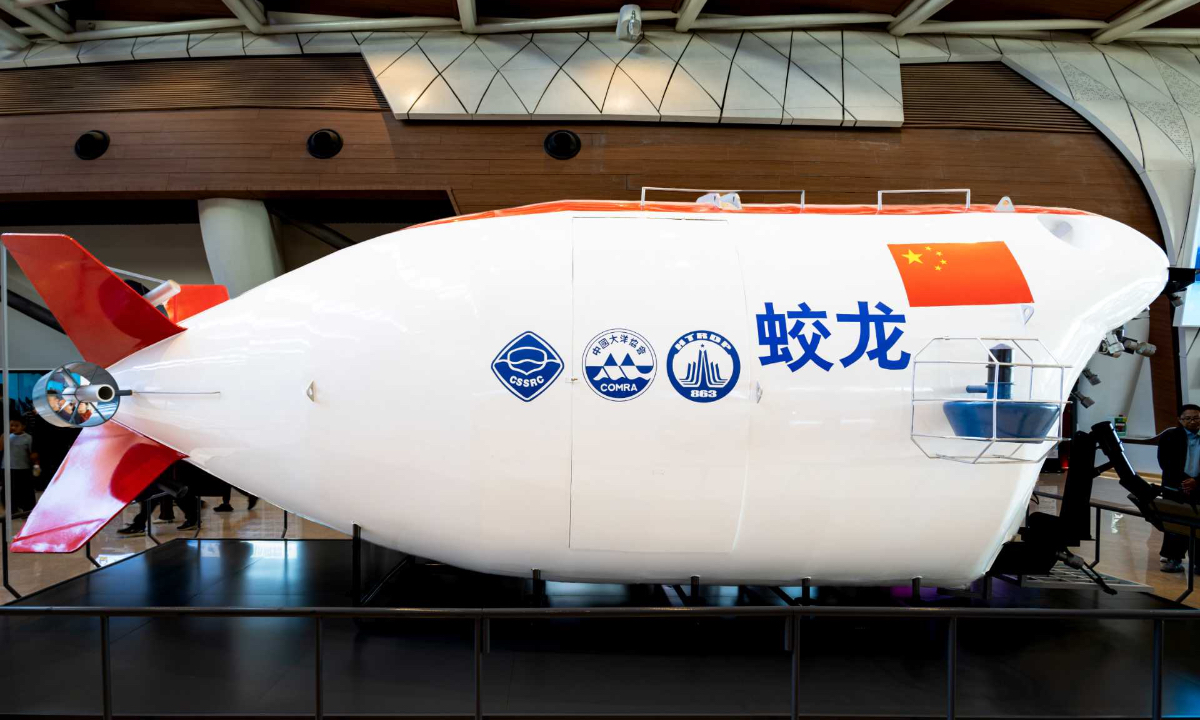
A model of the Jiaolong manned submersible on display at the National Maritime Museum of China in North China's Tianjin Municipality on October 2, 2026. (Photo: VCG)
The report noted that China has made its research platforms accessible to international partners and shared scientific results with them through scientific research expeditions conducted using its deep-sea submersibles such as Jiaolong and Fendouzhe, as well as research vessels like Shenhai Yihao.
China has also preserved nearly 60,000 samples of marine microbial resources and established repositories and databases, and offered specialized services to facilitate access to samples and data. The country has also supported developing countries in environmental impact assessment, according to the report.
"China has continued to make its marine research expeditions open to international partners, working with foreign experts on joint marine research projects using its advanced vessels and facilities. Under the UN Decade of Ocean Science for Sustainable Development, China has also launched international large-scale scientific programs that bring together scientists from dozens of countries," Chen said.
China has also provided assistance to developing countries in Africa and the Pacific region in areas such as seabed surveys and exploration, and marine spatial planning. It has actively opened up and shared marine genetic resources and related information, helping advance international marine scientific research, Chen added.
“Through scientific expeditions and surveys in the high seas and international seabed areas, China has also helped expand humanity's understanding of the deep ocean, generating scientific knowledge that can benefit the international community and support global conservation efforts,” he noted.
Beyond its efforts in research, China has made substantial efforts to protect marine ecosystems at home. It has designated about 150,000 square kilometers of marine ecological conservation red-line areas, established 353 marine protected areas and implemented 194 marine ecological conservation projects. Notably, China is among the few countries worldwide to have achieved a net increase in mangrove areas, a significant achievement reflecting its progress in domestic marine conservation, Chen explained.
The report also highlights China's expanding network of marine cooperation. China has signed marine cooperation agreements with more than 50 countries and international organizations, jointly established over 40 marine research centers and laboratories, and invested about 200 million yuan ($29.96 million) in more than 100 small but impactful marine cooperation projects. It has also organized more than 300 training courses in marine science, technology and management, benefiting over 6,000 young researchers and officials from developing countries.
China's application to host the BBNJ Secretariat in Xiamen is another part of these efforts. The report notes that by applying to host the Secretariat, the country has undertaken further international responsibilities to address the absence of headquarters of UN ocean-related bodies in Asia and provide a platform for China to contribute to the agreement's implementation.
The report highlights the milestone significance of the BBNJ Agreement for global ocean governance and showcases China's significant contributions to its adoption and implementation, experts said.