


China kicks off 43rd Antarctic scientific expedition

Members of China's 43rd Antarctic scientific expedition team aboard the icebreaker Xuelong 2 are pictured before their departure from Nanshan Port in Sanya, south China's Hainan Province, Nov. 7, 2026. (Photo: Xinhua/Guo Cheng)
SANYA, Nov. 7 (Xinhua) -- China held a departure ceremony in Sanya, south China's Hainan Province, on Saturday to mark the start of its 43rd Antarctic scientific expedition.
Organized by the Ministry of Natural Resources, the mission will upgrade China's polar research stations and logistics network and carry out comprehensive multidisciplinary surveys and monitoring in Antarctica. It will also pursue priority research at the frontiers of polar science, test and apply domestically developed equipment, and deepen bilateral and multilateral cooperation in science and logistics support.
The expedition is supported by the icebreakers Xuelong and Xuelong 2, along with another vessel. More than 600 team members from over 100 domestic institutions are participating, and the team is expected to return to China in April 2027 after completing its tasks.
The expedition will complete final construction and acceptance work at the Qinling Station, including its main building, communications systems and sewage treatment facilities, to further strengthen its operational support and scientific research capacity, said Luo Guangfu, head of the station. The mission will also advance long-term monitoring of the polar ocean and polynyas.
It will also carry out site surveys and mapping for planned supporting facilities at a prospective new research station. As the Great Wall and Zhongshan stations have operated for decades, the team will prepare for upgrades, including safety assessments of fuel storage tanks and station buildings, said Jin Xinmiao, head of the Zhongshan Station.
Building on the 3,413-meter ice-sheet drilling achieved during the 42nd expedition, the team will continue clean hot-water drilling through the overlying ice and carry out in-situ observation and sampling of a subglacial lake.
The team will also conduct multidisciplinary surveys and long-term monitoring covering physical oceanography, marine chemistry and marine biology, focusing on the impact of climate change on the marine ecosystem.
Several types of domestically developed polar equipment, including unmanned aircraft, ground vehicles, pressurized buildings, ice-surface machinery, and modular facilities, will be tested in Antarctica to strengthen China's self-reliant polar support capacity.
The expedition will also cooperate with Norway, Chile and Bulgaria on research into Antarctic ice sheets, geology and snow and ice environments, and invite scientists from Thailand, France, Belgium, Portugal and China's Hong Kong and Macao special administrative regions to participate.
"Pursuing scientific answers in the frozen frontier, we are confident in completing the mission," said Zhang Tijun, leader and chief scientist of China's 43rd Antarctic expedition.
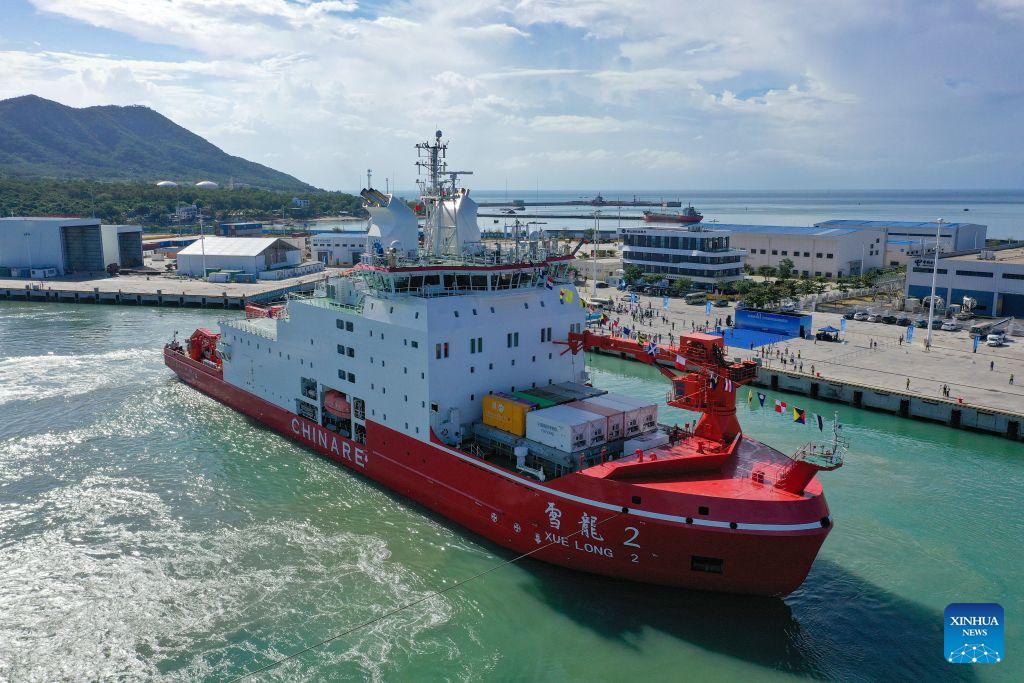
An aerial drone photo shows China's icebreaker Xuelong 2 departing from Nanshan Port in Sanya, south China's Hainan Province, Nov. 7, 2026. (Photo: Xinhua)