


When AI predicts what works, but not why: three leading scientists on AI's future in drug discovery
Craving spicy handmade noodles in Hangzhou, East China, Michael Levitt once asked an AI chatbot to recommend four local restaurants. The 2013 Nobel Prize winner set off on foot, only to discover that none of them existed and they were all "made up."
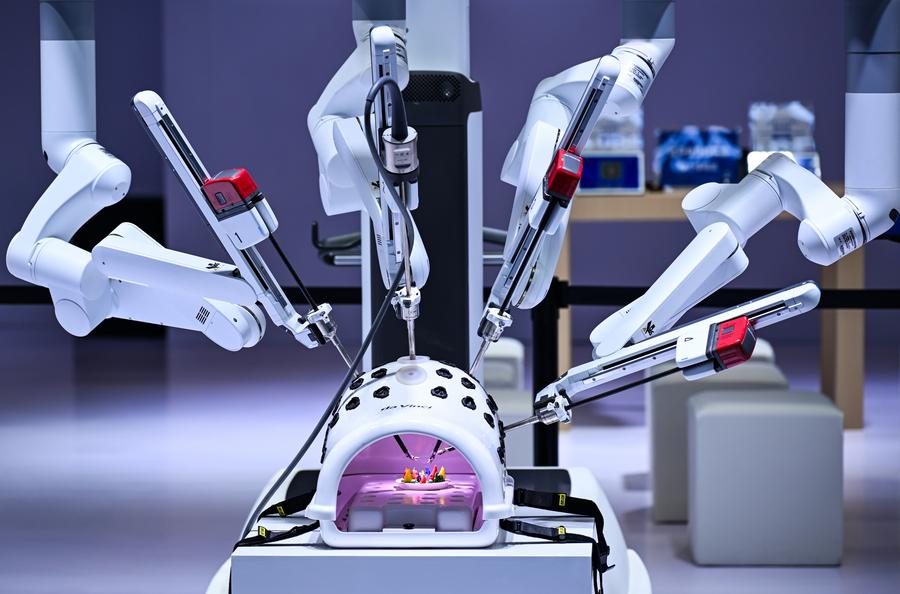
This photo taken on March 14, 2025 shows a surgical robot demonstration during the 2025 China Medical Equipment Conference & Medical Equipment Exhibition held at Chongqing International Expo Center in southwest China's Chongqing Municipality. (Photo: Xinhua)
"I give lectures all the time," Levitt told the chatbot. "I'm going to tell people just how stupid you were and how you lied to me." The AI chatbot apologized and promised to send someone to check the places—before admitting: "Sorry, I can't do it."
A fake restaurant is easy to expose. But when AI helps design drug molecules that are subsequently synthesized and tested in laboratories, the stakes are much higher. Can AI identify the right biological targets and predict how drugs will behave in the human body? And can scientists trust its predictions without fully understanding how it reaches them?
At the 2026 World Laureates Forum in Shanghai, three leading scientists—Michael Levitt, Daniela Rhodes and Pascal Mayer—discussed AI's promise and limitations in drug discovery, offering contrasting perspectives on how the technology could reshape scientific research.
Can AI predict what works?
To critics who see AI as a "black box," Levitt offers a reminder: Biology itself remains full of mysteries.
"We know that water is H2O. It's a very simple molecule—yet ice is floating on water," Levitt said. "How can a simple molecule give such complicated behavior? We don't understand."
Drug regulators such as the US Food and Drug Administration require evidence that a medicine is safe and effective, not necessarily a complete explanation of every mechanism behind its effects.
"You can look at the AI model as a black box, but biology is working with black boxes all the time," Levitt said. "I think a cell is as complicated as Shanghai."
Even for familiar painkillers, scientists do not understand every step of how the drugs work. For Levitt, the priority is to test predictions against reliable experimental data and ensure that findings can be independently reproduced.
Daniela Rhodes, an emeritus scientist at Cambridge's MRC Laboratory of Molecular Biology and a 2023 World Laureates Association Prize winner, agrees that medicine has often advanced through experimentation before scientists fully understood why a treatment worked.
"In China, you have Chinese herbal medicine, which, through centuries of experience, you know that they might cure some disease, but we don't understand the mechanism," Rhodes said. "Whether it's a chemist or AI designing a drug, it has to go through very rigorous clinical trials."
But Rhodes emphasizes that a promising prediction is not an established scientific fact. Her career has focused on determining the structures of biological molecules. In 1976, while pregnant, she grew the first crystals of the nucleosome core, a structure that helps package DNA inside chromosomes. Researchers subsequently spent 21 years determining its atomic structure.
Advances in cryo-electron microscopy and machine learning have since dramatically accelerated this kind of research. By 2018, some stages of the process could be completed in as little as four days. Using Nvidia GPUs, researchers could identify millions of particles rather than selecting them manually.
Yet even powerful AI tools have limits. AlphaFold, the protein-structure prediction system developed by Google DeepMind, relies on decades of accumulated experimental knowledge.
"It's a really good prediction, but it's still a prediction—it's not the absolute truth," Rhodes said.
The distinction matters particularly in medicine. Many drugs have historically been tested mainly on men within a limited age range. Identifying a molecule that interacts with a particular protein is only the beginning; researchers must still establish how it behaves in different human bodies.
AI can help identify promising drug candidates, but laboratory experiments and clinical trials remain essential. Rhodes has used machine-learning tools in her laboratory since 2018, although she prefers books and face-to-face conversations to AI chatbots in her personal life.
The human variable
If AI can model proteins and screen drug candidates, could it also simulate patients?
A drug may benefit one person but have little effect—or produce different side effects—in another. Levitt predicts that within a decade, researchers could use computer models of 1,000 virtual patients to evaluate a drug before proceeding to human trials. Such models could account for differences in genetics, age and geographical background.
Computer models of diabetes have existed for more than 30 years, Levitt said. He believes similar approaches could eventually be applied to other diseases. Researchers already use computational models to predict toxicity, including how substances may become harmful after being metabolized or interacting with other chemicals.
The biggest obstacle to building more accurate virtual patients, he said, is the lack of sufficient clinical data.
Still, Levitt is optimistic. He compares the development of AI models to self-driving cars, saying: "The self-driving car is ten times more safe than a human being. Although it makes mistakes still."
Many existing medicines work for only about 60 percent of patients. Levitt believes better virtual patient models could help doctors identify those most likely to benefit, potentially raising the success rate to 90 percent.
He does not, however, believe computer simulations can replace clinical trials. They can help researchers screen drug candidates before testing them in people, but evidence from real patients remains essential. AI may help people make lifestyle choices, he said, but patients with serious illnesses must consult doctors. AI should not directly prescribe medicines.
Asked whether virtual patients would need physical bodies, Levitt argued that computer simulations could be sufficient to predict certain side effects.
"If you give the drug and the algorithm measuring all the biochemical systems says he will feel pain in his stomach, you don't need a robot to say, 'Oh, I'm feeling bad,'" Levitt said.
He acknowledged that some models would be inaccurate, while others could become reliable enough to accelerate drug development. But patients with rare conditions or unusual biological characteristics might still fall outside the range of what a model can predict.
Rhodes remains skeptical. Because clinical trials have often focused on men, she said, researchers still lack sufficient information about how drugs affect people of different sexes and ages.
"Well, to me, that's science fiction still... the variability between different human beings in terms of how we react to a drug," Rhodes said. "Interesting question: is the average person a man or a woman? Because most drugs, actually, up to date, have practically only been tested on males of a certain age."
Beyond the limitations of clinical data, Rhodes worries that unreliable AI-generated information could enter scientific databases and compromise future research. She also questions whether the enthusiasm surrounding AI is partly driven by financial interests.
"How is it that the richest people in the world are all people who work in AI?" Rhodes said. "I am concerned that it is hyped because of the financial rewards that come with the hype."
She argues that governments need rules to ensure AI is used responsibly. AI drug discovery depends heavily on existing databases of proteins, molecular structures and experimental results. Its usefulness may therefore be limited in areas where scientists still know little about the underlying biology.
Mayer sees a related problem: AI can identify patterns in large datasets, but biological systems are complex. An overlooked factor or feedback mechanism can fundamentally change the outcome of a prediction.
"It's a very dense viscous solution," Mayer said. "As long as you don't have all that knowledge, all your simulations, all your predictions will be biased and not very pretty, not very reliable."
Mayer expects AI to become increasingly important across scientific disciplines, including mathematics. As researchers adopt these tools and feed them new data, AI systems will continue to improve. Some research tasks may eventually be automated, he said, although the extent of that change remains uncertain.
Even so, he does not believe humans will lose their ability to understand biology. Researchers can still interpret and verify AI-generated results. He also points out that the human brain consumes far less energy than today's computers.
The art of asking 'why?'
The debate over AI's role in science extends beyond drug discovery. In October, OpenAI uploaded 722 mathematical preprints from an unreleased AI model to GitHub in a single day. Mathematicians, including Fields Medalists Terence Tao and Peter Scholze, joined more than 1,600 signatories in condemning the release through the newly formed Association for Human Mathematics. They criticized it as a corporate "demonstration of power" that sidelined human understanding.
The controversy reflects a broader question: Can AI produce results without displacing the human thinking that gives science its meaning?
Levitt takes a more practical view. He has worked with computers since the 1960s, when he used punch cards to run programs on mainframe computers. For him, AI is another tool that can help researchers move beyond one question and tackle the next.
In June, after Google's Gemini mastered a programming language Levitt had invented decades earlier, he began treating AI models like graduate students: useful and tireless, but not always right.
Today, he uses Claude, GPT and DeepSeek as a virtual research team, asking them to review papers from different perspectives. When a Fudan University student told him he had trained Claude on his advisor's papers to create a "professor model" that could review drafts, Levitt approved.
"You think you're cheating, or being lazy, but you're actually learning about him," Levitt said.
He links this approach to advice from his scientific mentor, Francis Crick, co-discoverer of DNA's double helix:
"You should never work more than 70 percent hard. Because if you work more than 70 percent hard, when a new idea comes along, you can't jump on the new idea."
For Levitt, the key is not to accept AI's answers without question. New technologies have always caused anxiety, he said, and people often look back on the past as if life was easier then. Young researchers should instead learn to challenge what they see. If AI changes an answer from A to B, scientists must determine which answer is supported by evidence.
He believes researchers who reject AI simply because it makes mistakes risk falling behind. The ability to question its conclusions, rather than accept them, will become increasingly important.
Mayer, however, shares some of the mathematicians' concerns. In an increasingly competitive research environment, scientists may feel they have little choice but to use AI—even if the technology could eventually replace some of their work.
"We're in a competitive race where nobody can avoid using AI," Mayer said. "And eventually, it may replace humans. Who knows what happens next?"
For Rhodes, preserving the human side of research is essential. At Cambridge, she used to write down her planned experiments on Fridays, take the weekend off and cross half of them off on Monday after gaining a fresh perspective.
She urges young scientists not to let AI do all their thinking. They need to develop their own knowledge, remain curious and gain practical laboratory experience. Without hands-on work, young researchers may struggle to understand how science works or recognize worthwhile questions.
"AI cannot think out of the box," Rhodes said. "The box is the database you have."
To avoid being misled by fake restaurants or unreliable scientific predictions, Levitt offers a final piece of advice: question everything.
"Don't assume anything is right—in fact, assume it's wrong," Levitt said. "Just learn to keep on saying, like a six-year-old when your mother is going crazy: 'Why? Why? Why?'"