


DPP slammed for politicizing Sun Yat-sen's commemorations amid fears of failed 'de-Sinicization' agenda: expert
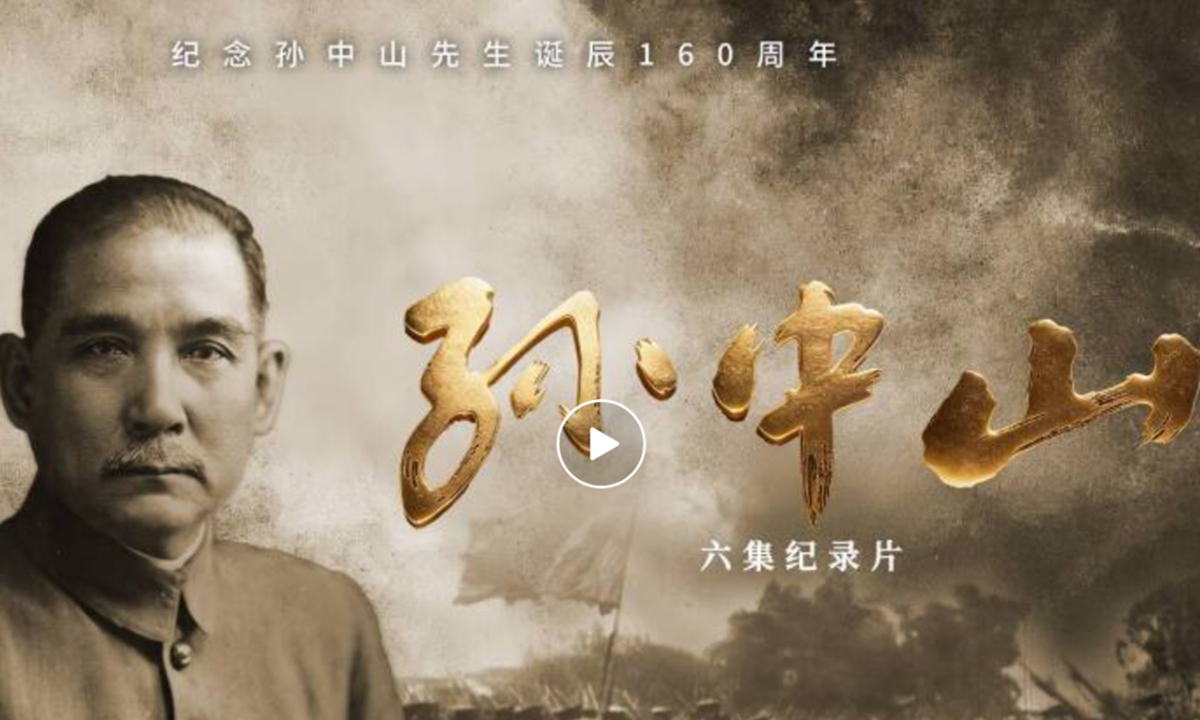
The documentary Sun Yat-sen Photo: CCTV News
A historical documentary on the forerunner of China's anti-feudalism revolution, Sun Yat-sen, began airing on China Central Television (CCTV) on Sunday, ahead of mainland commemorations marking the 160th anniversary of his birth on Thursday. The release comes amid the Taiwan authorities' move to discourage people on the island from attending commemorative events on the mainland, which a Chinese expert said exposes the Democratic Progressive Party (DPP) authorities' fear that their "de-Sinicization" agenda could fail, as well as their politicization of shared historical memory.
Such efforts would ultimately prove futile in the face of the overwhelming trend toward national reunification, the expert said.
The documentary, titled Sun Yat-sen, traces the revolutionary leader's life and career through historical records and archival materials. The documentary explores Sun's patriotism, revolutionary commitment, and vision for national progress, while highlighting the contemporary significance of his ideals in promoting solidarity among Chinese people at home and abroad, advancing peaceful development of cross-Straits relations, and realizing national reunification, according to CCTV News.
The Standing Committee of the 14th Chinese People's Political Consultative Conference (CPPCC) National Committee previously adopted a decision on holding commemorative events on the occasion of the 160th anniversary of the birth of Chinese revolutionary and statesman Sun Yat-sen. However, Taiwan's so-called "Mainland Affairs Council (MAC)" recently said that applications from people on the island who require official permission to travel to the mainland to attend the events would not be approved. It also urged people from other sectors not to travel to the mainland, Hong Kong, or Macao special administrative regions to participate in or co-organize related activities.
The DPP authorities were politicizing shared historical memory and using the pretext of "united front" activities to discourage cross-Straits exchanges, Zhang Wensheng, deputy dean and a professor at the Taiwan Research Institute at Xiamen University, told the Global Times on Monday.
Zhang attributed the move to the DPP's pro-independence political mindset, saying it reflected concerns that closer contact with the mainland could strengthen Taiwan residents' sense of shared identity with people across the Straits and their identification with the concept of one China.
"Their concern is that Taiwan residents may see for themselves that many of the visions Sun Yat-sen outlined have been realized on the mainland," Zhang said.
He added that the DPP authorities feared their "de-Sinicization" agenda could collapse, as it would ultimately prove futile in the face of the overwhelming trend toward national reunification.
Sun's legacy of seeking national salvation, promoting democracy, and revitalizing China continues to resonate with people on both sides of the Straits. Sun initiated the 1911 Revolution and advanced the Three Principles of the People, while also promoting cooperation with the Communist Party of China (CPC), the expert noted.
Sun remains widely respected on the island of Taiwan, where he is traditionally referred to as the "Father of the Nation," Zhang said. Commemorating Sun today should involve reflecting on his aspirations to save the country, safeguard national unity, and revitalize China.
By discouraging participation in the mainland commemorations, the DPP authorities were acting contrary to the spirit of Sun's legacy, the expert said. He added that the MAC's claim that Sun's political ideals differed from those of the Communist Party of China (CPC) was untenable.
In response to the MAC's claim, spokesperson Zhu Fenglian of the State Council Taiwan Affairs Office said at a press conference on November 4 that promoting national reunification and national rejuvenation were ideals that Sun had pursued throughout his life.
Chinese Communists were the most resolute supporters, most loyal collaborators, and most faithful successors of Sun's revolutionary cause, Zhu said.
Under the leadership of the CPC, the Chinese people had made widely recognized achievements over more than a century of struggle, with many of the blueprints envisioned by Sun having become reality, she added.
Zhu slammed the DPP authorities for betraying Sun's legacy and disrespecting his character, saying that history could not be betrayed and that national reunification was an inevitable trend.