


Laurent Lafforgue: A mathematician with a literary mind
At Fudan University, students gathered around Laurent Lafforgue, holding out notebooks, mathematics books and student cards for him to sign. He signed them one by one with a smile. With his slightly long, softly curled hair and plain, solid-colored clothes, he seemed more like an approachable teacher than an academic celebrity.
Lafforgue is one of the most distinguished mathematicians of his generation. His work on the Langlands program, which seeks to uncover hidden connections between seemingly distant branches of mathematics, earned him the Fields Medal in 2002. He later turned to Grothendieck's topos theory, extending his search for deeper connections across mathematics.
At the 2026 World Laureates Forum in Shanghai on October 31, he delivered a keynote address on artificial intelligence (AI). For a mathematician whose early passion was literature, AI raises fundamental questions about the nature of human thought.
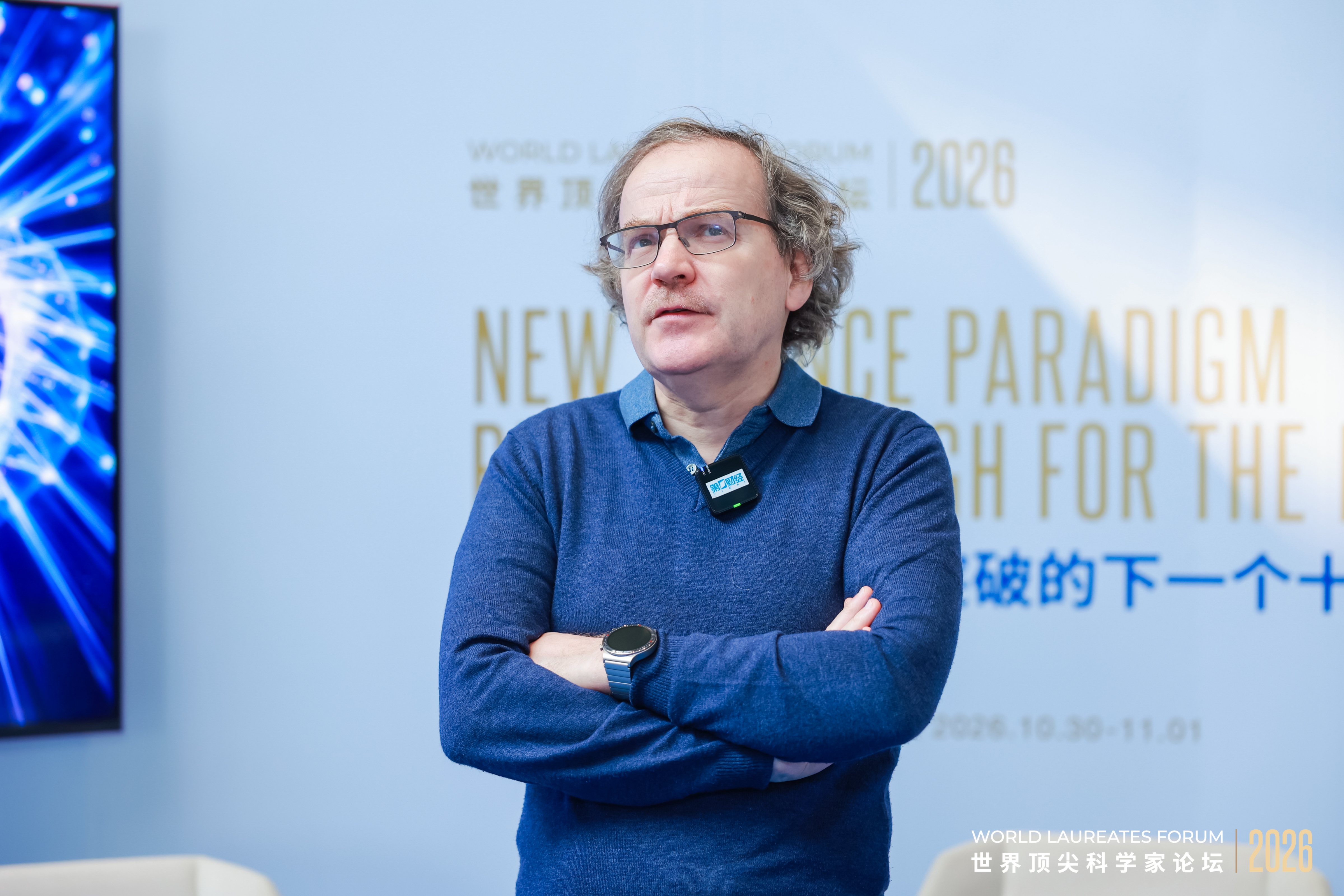
Laurent Lafforgue at the 2026 World Laureates Forum in Shanghai (Photo provided by 2026 World Laureates Forum)
New links
Proposed by Canadian mathematician Robert Langlands in 1967, the Langlands program describes deep correspondences among fields such as number theory, Galois theory and automorphic representations.
In 2002, the journal Inventiones Mathematicae published a 241-page paper by Lafforgue, then 35. In it, he extended Vladimir Drinfeld's work on the Langlands correspondence over function fields of positive characteristic. That same year, he received the Fields Medal in Beijing.
Lafforgue did not rest on his laurels. He later turned to topos theory, associated with Alexander Grothendieck, which offers another framework for connecting mathematical fields. A turning point came in 2011, when he met mathematician Olivia Caramello at the Institut des Hautes Études Scientifiques (IHES) in France. Caramello had approached him because she saw his work on the Langlands program as a remarkable mathematical bridge between distant fields. "I thought he might be interested in my theory of toposes as 'bridges'," Caramello recalled.
Although Lafforgue had little background in mathematical logic, his admiration for Grothendieck inspired him to explore topos theory beyond its geometric foundations. Their discussions developed into a 15-year collaboration, and they have since written two books together. "Few established mathematicians, let alone a Fields Medalist, would take up a new field with such intellectual generosity and curiosity," Caramello said. For Lafforgue, topos theory offered a way to continue seeking structures that link mathematics, logic, topology and formal languages.
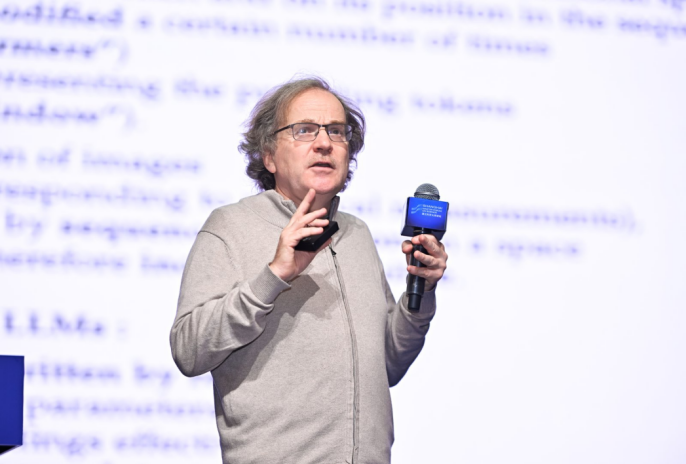
Laurent Lafforgue at the Pujiang Science Master Forum in Shanghai (Photo provided by Pujiang Science Master Forum)
Read by numbers
During a lunch with students at Fudan University, Lafforgue turned to the student beside him and asked: "Do you know what PhD stands for?"
"Doctor of Philosophy," the student replied.
"Exactly, exactly!" Lafforgue said, smiling and gesturing animatedly. He explained that "philosophy" comes from the Greek for "love of wisdom," adding that wisdom was something worth loving.
Lafforgue's interests beyond mathematics date back to his youth. He recalled an early fascination with history, particularly ancient Greece and Rome, followed by a passion for French and Russian literature. While studying at the École normale supérieure in Paris, he discovered another kind of beauty in Grothendieck's writings: mathematical beauty. He admired Grothendieck's imagination and command of language, and liked to think of him as a "poet."
Yet choosing mathematics as a career was far from easy. At 23, Lafforgue was torn between mathematics, literature and a potentially lucrative career in administration, recalled Christophe Soulé, a member of the French Academy of Sciences who guided him early in his career.
The two discussed what each path might offer. "In mathematics, you see what you are doing. You work hard, and you see the results of your hard work," Soulé told the young Lafforgue. "If you are in administration, you see something happening, but you're not sure that it is the result of your effort." A week later, having given the decision considerable thought, Lafforgue chose mathematics.
Soulé also recalled that, while studying at the École normale supérieure in Paris, Lafforgue solved a problem Soulé had assigned him in just three weeks. Lafforgue later told him, "This was not a good question."
"Now I will not give you any more problems. The next question will be yours," Soulé told Lafforgue when he joined the French National Centre for Scientific Research after completing his studies.
But where did that "next question" come from? During his first three years as a researcher, Lafforgue searched for one without making substantial progress. It was not until 1993, under the supervision of mathematician Gérard Laumon, that a "very difficult, very beautiful" research path opened up before him. Just 18 months later, Lafforgue completed his doctoral thesis. Nine years later, in 2002, he won the Fields Medal.
Yet his growing commitment to mathematics never displaced his love of literature. He admires Blaise Pascal's Pensées and sees mathematics as closely connected to philosophy. He has also drawn inspiration from Balzac, whose La Comédie humaine, or The Human Comedy, runs to thousands of pages. Compared with that, Lafforgue reasoned, a few hundred pages of mathematics were no cause for complaint. He sees mathematics as something built from words, sentences, paragraphs and books, not simply formulas and calculations.
He is particularly interested in how language shapes mathematical thinking across cultures. At the 2002 International Congress of Mathematicians in Beijing, Lafforgue used slides in both French and Chinese to show his respect for linguistic diversity. He often asks Chinese students whether they study mathematics in Chinese, and has suggested that the pictorial nature of Chinese characters may encourage visual thinking. He contrasts European languages, whose written forms he sees as linear, with Chinese writing, which he considers "more space-like." He believes these differences could give rise to different ways of doing mathematics. "There are many different possibilities to develop culture, in particular to develop mathematics. The diversity of languages is good for everybody," he said.
China ties
Lafforgue first visited China in 2002. He remembers the construction cranes scattered across the city, an image of rapid development that stayed with him.
In 2017, Huawei engineers in France invited him to give a lecture. He initially doubted that engineers would be interested in fundamental mathematics and declined. They persisted, however, and he eventually agreed to explain topos theory to a non-specialist audience. To his surprise, some of the engineers became fascinated by the subject. The encounter led to further exchanges and a longer collaboration. In 2019, he became the first holder of the Huawei Chair in Algebraic Geometry at IHES. In 2021, he joined Huawei's research team in France.
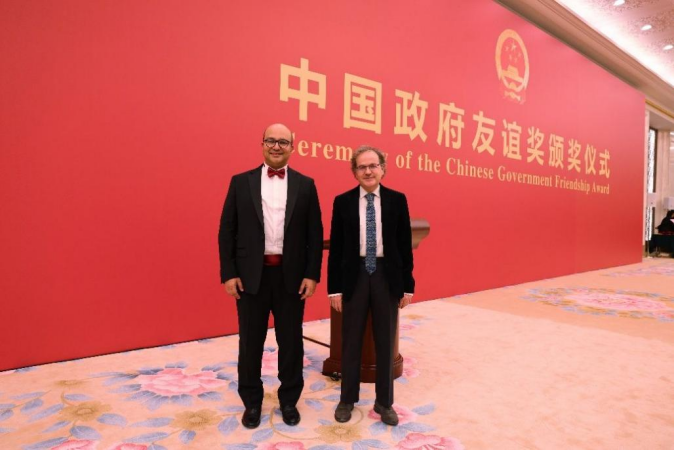
Laurent Lafforgue (right) at the Chinese Government Friendship Award ceremony (Photo provided by University of Science and Technology of China)
His engagement with China extends beyond research. Since 2019, Lafforgue has served as director of the French committee of the China-France Mathematics Talents Class at the University of Science and Technology of China. Over the years, he has given lectures, helped revise teaching plans and spent time with young students.
Ma Xiaonan, director of the Chern Institute of Mathematics, described Lafforgue as a leading figure in the program. "He was very engaging with the students. After a lecture, he would sometimes spend more than an hour answering their questions," Ma said.
His sustained involvement in the program has made a significant contribution to China's mathematical talent development. In 2025, Lafforgue received the Chinese Government Friendship Award in recognition of his contributions to the development of mathematical talent and scientific research in the country.
His ties to China are personal, too. "I eat too much," Lafforgue joked about his visits to China. He sees a shared tradition: "In China, as in France, we like to share good food together. It is an opportunity to build human relationships and an important part of social life." Outside his academic work, he also enjoys cycling, though he has never ridden a bicycle in China. "I hope to buy one in China soon," he said with a smile.
At a lunch with students at Fudan University, the conversation ranged from studying in France to AI and Pascal's mechanical calculator. Li Xiang, a student at Fudan's School of Mathematical Sciences, described him as approachable, saying, "He was willing to answer every question we asked, and his explanations were always detailed, clear and easy to understand."
Human minds
Language also shapes his approach to AI. For a recent lecture, he wrote his notes by hand in French, then used AI to turn them into slides and translate them into English. The system even spotted possible errors in his handwriting and handled technical terms well.
His use of AI is only one part of a broader inquiry. Together with collaborators, he is exploring how topos theory might contribute to AI. A recent monograph, Generation of Grothendieck Topologies, Provability and Operations on Subtoposes, lays the groundwork for what its authors describe as a possible "topossic deep learning" approach. Put simply, the idea is to give AI something like a map of relationships between ideas.
Topos theory can relate local information to a broader picture, identify structures that remain unchanged across contexts, connect formal descriptions with meaning and transfer knowledge. Such features may help AI systems organize knowledge and reason more transparently, though the approach remains a work in progress.
Lafforgue sees a gap between a system's ability to produce results and our understanding of why it works. "It works, but we don't understand why," he said. "It can provide resources to you, but it will not spare you the effort."
He also hopes AI may change mathematical writing. Older mathematical texts, in his view, often had a more literary style than contemporary papers. He expects renewed attention to language, philosophy and richer forms of thought. "I certainly expect that it will go in the direction of literature and philosophy," he said.
For Lafforgue, whose intellectual life has long moved between mathematics and literature, the possibilities of the human mind remain beyond the reach of machines. "We are human beings. We are human minds, and our possibilities go beyond that."