


The enduring power of market
SHANGHAI, Nov. 10 (Xinhua) -- Across the globe, even as trade is increasingly seen as a complex dynamic to navigate, companies still grapple with a fundamental yet pressing question: Where can they unlock their next market for growth?
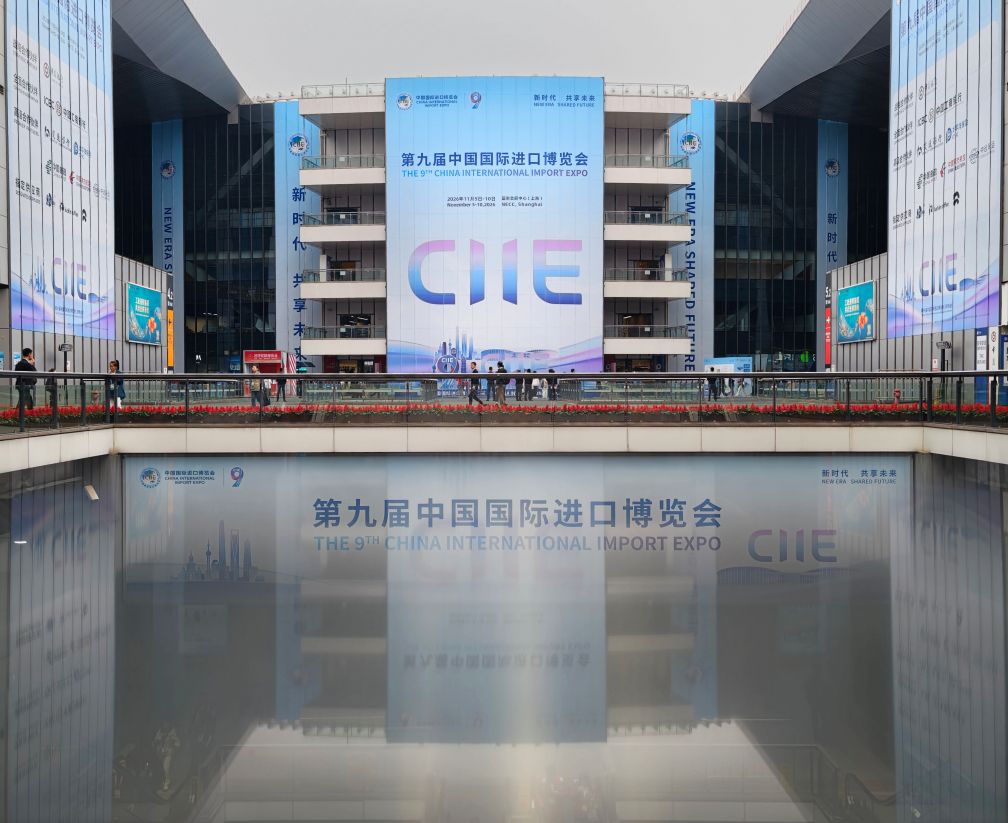
People walk past an billboard themed on the ninth edition of the China International Import Expo (CIIE) at the National Exhibition and Convention Center (Shanghai) in East China's Shanghai, Nov 5, 2026. (Photo: Xinhua)
For thousands of global firms, this question took them to Shanghai in east China this past week. While the world beyond the exhibition halls has been growing more guarded, the bustling aisles of the ninth China International Import Expo (CIIE) were brimming with exactly what businesses are looking for: customers, suppliers, innovation and room for growth.
Wrapping up on Tuesday, the six-day event attracted a record 4,142 overseas exhibitors this year. Among them are more than 300 Fortune Global 500 companies and industry heavyweights, and over 2,000 are first-time participants.
For the eighth year running, U.S. exhibitors claim the largest exhibition space at the CIIE, joined by leading participants from Germany, the UK and France. Their robust turnout is a market-driven vote of confidence in China's opportunities. Even as calls for "decoupling" persist, China is still a market they cannot afford to overlook.
As Sean Stein, president of the U.S.-China Business Council, has pointed out, competition between the United States and China is inevitable in some areas, but it need not stand in the way of constructive dialogue and practical cooperation wherever interests converge. Above all, companies from the world's two most dynamic economies should be able to work together and cooperate.
That is the power of the market. In a climate marked by caution, a large, dynamic and open market continues to attract global businesses seeking growth. Few markets, after all, can match China's combination of purchasing power, industrial strength, supply chains, and a fast-evolving consumer base.
With a population of 1.4 billion, China recorded retail sales of consumer goods exceeding 50 trillion yuan (about 7.44 trillion U.S. dollars) for the first time last year, a figure expected to increase by another 10 trillion yuan over the next five years. For 17 consecutive years, the country has remained the world's second-largest importer.
But size is only part of the story. China is more than a destination for selling goods. Companies from around the world have brought their latest technologies and products to the CIIE as a launchpad for opening flagship stores, building factories and setting up R&D centers.
French tiremaker Michelin sums up its approach in a simple phrase: "With China, for the World." This strategy is increasingly evident in how multinationals engage with China -- not just as a market for sales, but as a place to innovate, collaborate and create value for global markets.
The benefits of China's market, notably, extend beyond multinational corporations. Nearly 13,000 overseas small businesses participated in the first eight editions of the CIIE. For developing countries, the CIIE offers a gateway to the rapidly expanding Chinese market, creating opportunities to increase exports, move up the value chain and improve livelihoods at home.
This year, the expo's free exhibition space for least developed countries increased by 17 percent. Supported by measures such as zero tariffs and streamlined customs clearance, Tanzanian cashews, Zambian honey and Nepalese handicrafts are finding their way to a wider market via this expo.
The commitment to opening up is also reflected in China's efforts to pursue trade balance. Promoting balanced growth in imports and exports has been written into the outline of the 15th Five-Year Plan (2026-2030), alongside plans to continue hosting the CIIE and other major trade fairs, such as the Canton Fair in south China.
Rather than treating trade as a zero-sum contest, China has called for an "upward balance" in trade, as a more balanced trading relationship cannot be achieved by restricting trade or shutting out foreign goods. It requires greater openness and a bigger global economic pie, creating more opportunities for all.
The CIIE matters because it gives this process a tangible form. Over its nine editions, the CIIE has evolved from an invitation extended by China into a shared commitment among participants and a choice embraced by the world.
The expo's continued appeal speaks to a simple truth: trade is not a tool of geopolitical competition, but a means of creating shared growth. In an uncertain world, the crowds in Shanghai are a powerful reminder that the market still has a strong, enduring voice.