


Kuaizhou targets 2027 maiden flight and first-stage recovery of reusable rocket, unveils development roadmap
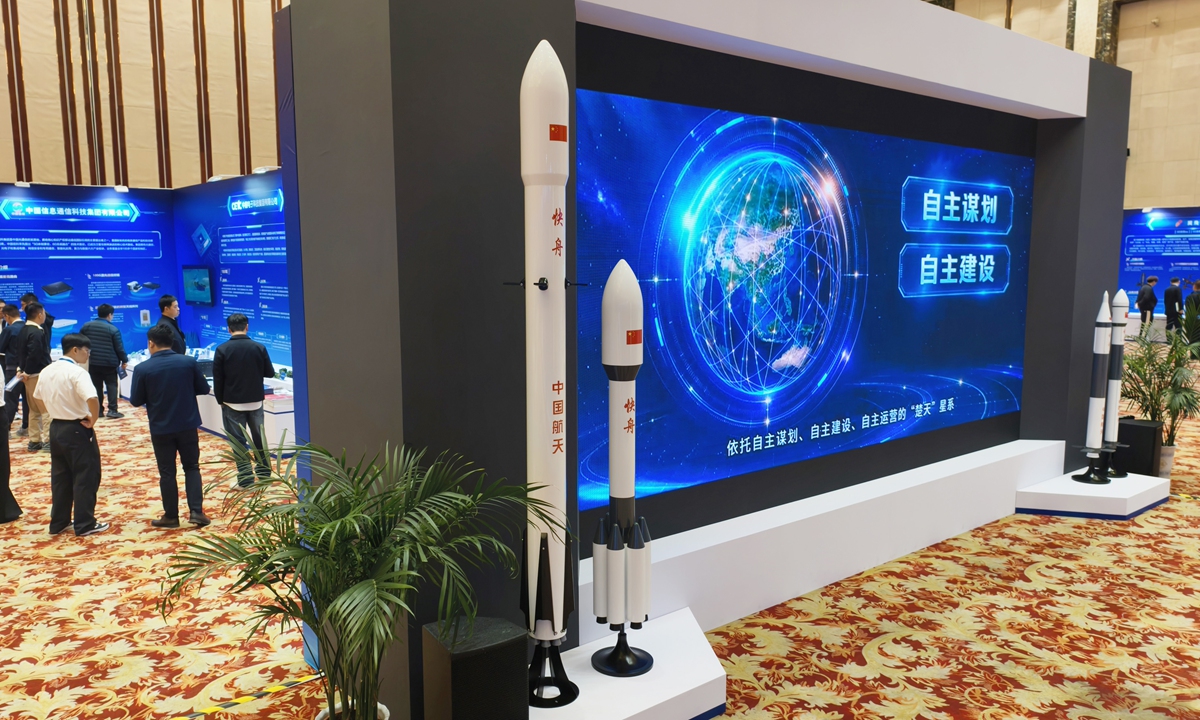
Kuaizhou rocket model (Photo: VCG)
China's space sector has seen another development in the development of a new reusable launch vehicle, with Wuhan-based Kuaizhou Aerospace targeting 2027 for the maiden orbital flight and first-stage recovery of its Kuaizhou-6 liquid-propellant rocket, which is designed to carry a payload of about 20 tons. The company also plans to conduct at least 50 launches over the next three years using its Kuaizhou-1A and Kuaizhou-11 rockets, the Global Times learned from Kuaizhou Aerospace on Tuesday.
According to a press release by the firm, Kuaizhou will accelerate development of its Kuaizhou-6 reusable liquid-propellant rocket, targeting its maiden orbital flight and first-stage recovery in 2027.
The rocket is designed to have a payload capacity of about 20 tons. By the middle of the 15th Five-Year Plan period (2026-2030), the company plans to upgrade the rocket with a 140-ton-class liquid-propellant engine and put it into large-scale commercial service, further increasing its payload capacity and advancing the engineering application of reusable launch technology.
The company also plans to develop lower-cost medium-lift launch vehicles. Building on its existing technologies and production capacity, it will adopt a standardized, modular and flexible approach to developing the Kuaizhou-12 solid-liquid hybrid rocket. The rocket, with a payload capacity of about 10 tons, is scheduled to make its maiden flight and enter the market in 2027, with a targeted launch cost of no more than 20,000 yuan ($2,800) per kilogram.
Kuaizhou also outlined a three-stage roadmap for its liquid-propellant engine program. In 2027, it aims to complete a cumulative 15,000 seconds of hot-fire testing for its 80-ton-class liquid oxygen-methane engine and deliver the engine for operational use, while completing design-validation hot-fire tests of a 140-ton-class engine. Before 2030, the company plans to complete design-validation hot-fire tests of a 200- to 300-ton-class liquid oxygen-methane engine.
Meanwhile, Kuaizhou plans to conduct more than 50 launches over the next three years using its Kuaizhou-1A and Kuaizhou-11 carrier rockets, aiming to establish routine, high-frequency launch operations. The company said the effort would help consolidate its rapid space-response capabilities and support national emergency needs.
To further expand its ambitions, Kuaizhou plans to strengthen its research, testing and final assembly facilities at its Wuhan headquarters, while further developing its liquid-propulsion research and development center in Beijing.
The company also plans to expand its testing capabilities for 300-ton-class liquid-propellant engines and establish testing and launch capabilities in Jiuquan and Wenchang, aiming to achieve independent control over the entire chain of research, development, production and testing.