


From colonial Kenya to top science prize: Vishva Dixit's journey across borders
On the eve of receiving one of the year's major international science prizes, Vishva M. Dixit was thinking about failure.
Asked in Shanghai on October 30 what he would tell his younger self, he offered a lesson in keeping his balance. "When you fail, don't get too low, and when you succeed, don't get too high," he said. "You go through cycles of success and failure."
The next morning he shared the 2026 World Laureates Foundation Prize in Life Science or Medicine with Yuan Junying, Wang Xiaodong and Shao Feng for their contributions to uncovering the molecular mechanisms of programmed cell death, the process by which cells dismantle themselves.
When this process goes awry, it can contribute to cancer and inflammatory diseases.
The road there was anything but straight.
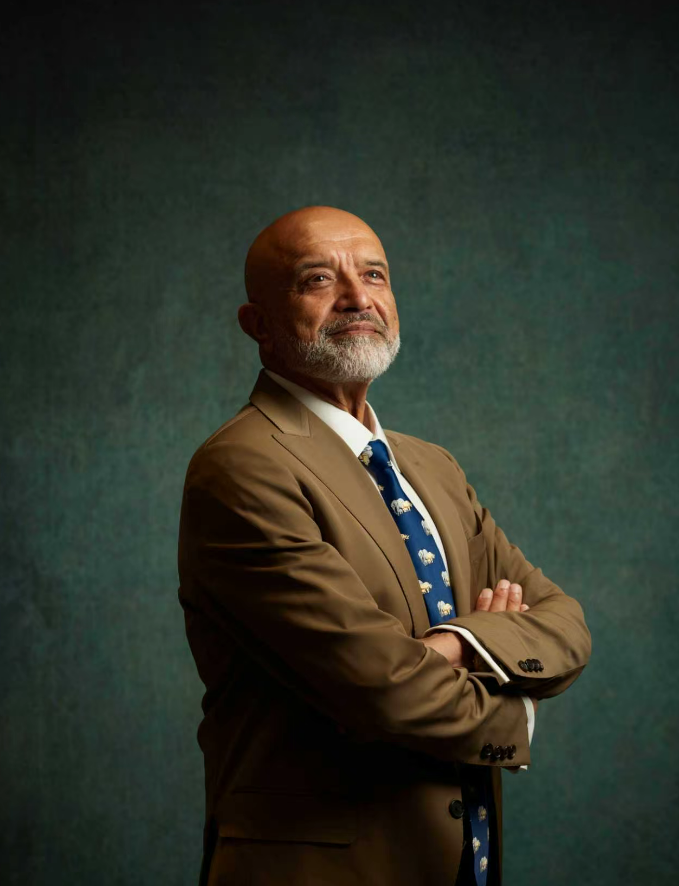
Vishva Dixit (Photo: Jin Liwang)
'I have a chip on my shoulder'
Dixit was about 7 when he first learned how firmly a society could draw its boundaries.
In colonial Kenya, the Boy Scouts held a fundraising competition in which children earned money by doing odd jobs.
Figuring that white families had more money, Dixit ventured into their neighborhood in search of work.
One family responded by releasing a German Shepherd. The dog came charging toward him and the terrified boy wet his pants.
That was not his only encounter with the color line.
Dixit remembered walking with his father, who warned him not to step onto a golf course reserved for white people.
The memory sharpened a conviction that has stayed with him.
"Colonial domination – one group seeking to dominate another – always struck me as wrong, something to rebel against," Dixit said. "It fired in me the feeling that the status quo was not acceptable, that change was needed and that society needed to be fair."
Despite the inequalities outside, Dixit grew up in a family that offered him considerable opportunities.
Both his parents were doctors who had moved from India to Kenya.
As a boy, Dixit often visited the crowded clinic and accompanied his father on house calls.
At home, books and magazines filled the shelves.
When poor eyesight made sports less appealing, Dixit turned increasingly to reading.
His parents bought him a Time-Life science series that opened up worlds far beyond his own.
Medicine, however, was initially more his parents' ambition than his.
Having lived through political uncertainty in East Africa, they believed a medical degree would give their children security. Dixit himself was more drawn to subjects such as physics.
It was his older brother, already a medical student, who changed his mind.
One day, his brother took him to a hospital children's ward and introduced him to a boy.
Dixit spoke with the child in Swahili and they played together.
The boy seemed cheerful and healthy.
Only afterward did his brother explain that the child had leukemia and was unlikely to survive another six months.
"Why couldn't we save him?" Dixit recalled wondering.
The encounter stirred his interest in biology and he eventually secured admission to the University of Nairobi's medical school.
There, physiology professor Edward Hettiaratchi deepened his fascination with the principles underlying living systems.
In 1981 Dixit arrived at Washington University in St. Louis with a medical degree but virtually no laboratory experience.
He approached William A. Frazier, a professor of biochemistry, hoping for a chance to learn.
"Have you used a pipetman?" Frazier said.
"No."
"What about a pH meter?"
Again, no.
Frazier took him in.
For an entire summer he worked alongside Dixit at the laboratory bench, teaching him experimental techniques and encouraging him to question established knowledge.
At the department's weekly meetings, nicknamed the "Shark Tank," even published scientific findings were subjected to scrutiny.
Dixit was learning not only how to conduct experiments but also how to think like a scientist.
What Frazier recognized, Dixit believes, was the hunger that drives so many immigrants.
"When you arrive as an immigrant, in a sense you have nothing to lose and everything to gain," he said. "Nothing ventured, nothing gained. You have to take a chance, and if it doesn't work out, you do something else.
"That has been a recurring theme in my life."
By the time he joined the University of Michigan, he had begun building an academic career.
His research on thrombospondin, a protein involved in cell adhesion and interactions with the extracellular matrix, led to publications and grants, and put tenure within reach.
But the field was already well established.
Dixit worried he might make only incremental contributions rather than fundamental discoveries.
"I was more of a journeyman," he said.
He had come too far to settle for following a path others had mapped.
Near the end of his assistant professorship, he made what he later regarded as one of the biggest gambles of his career: walking away from the research that had brought him success.
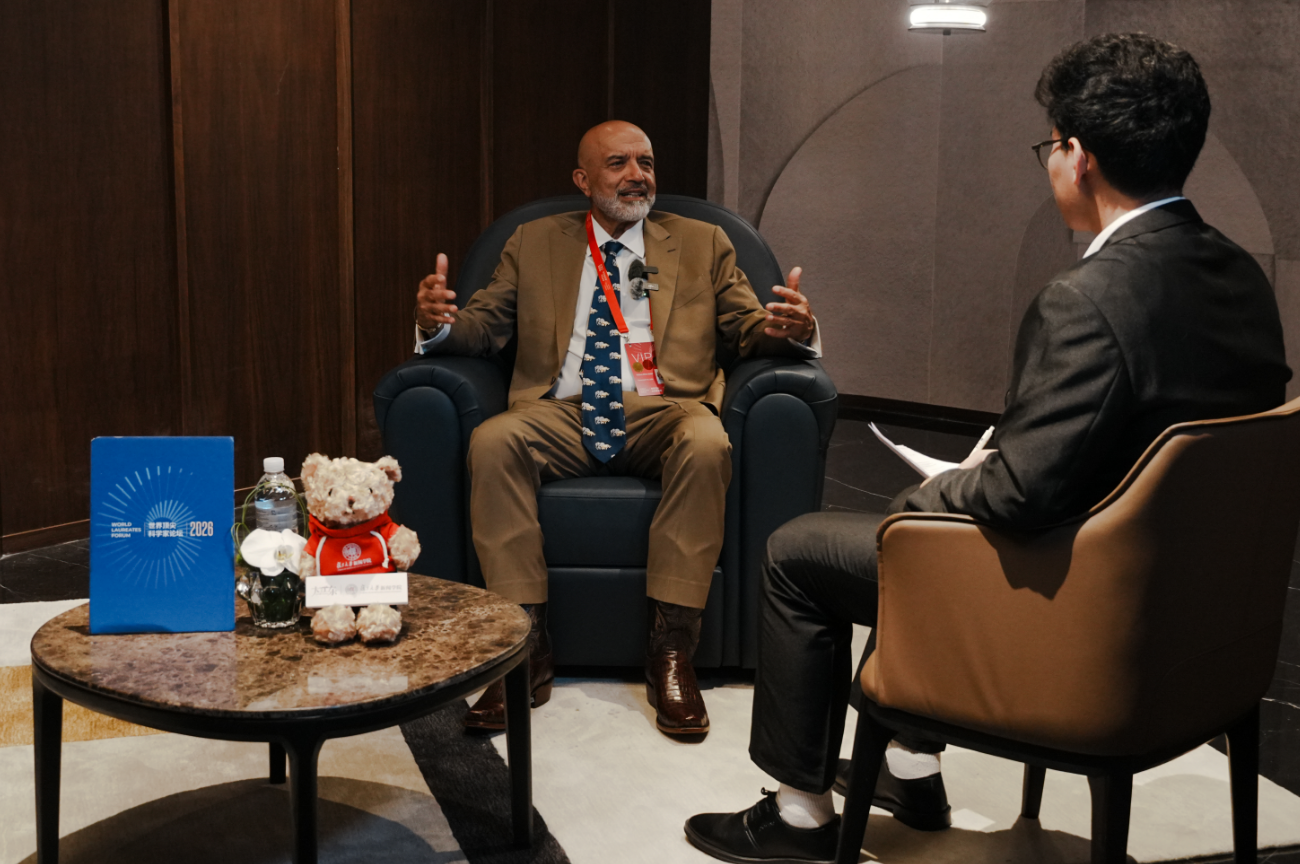
Dixit is interviewed by the People's Daily (Photo: Wang Zeyu)
'It was a gamble'
The question he wanted to pursue took shape during a conversation at the University of Michigan.
Rory Marks, an Australian visiting scientist in pathologist Peter Ward's laboratory, was studying endothelial cells, which line blood vessels.
Dixit knew these cells from his earlier work on blood clotting.
Together they wondered how tumor necrosis factor, an inflammatory signaling molecule, affected their behavior.
As he read more about the molecule, Dixit came across an intriguing observation: Under certain conditions, it could cause cells to die. How could a signal arriving at the surface of a cell trigger its destruction?
He decided to investigate.
With Muneesh Tewari, a physician-scientist trainee in his laboratory, Dixit began screening compounds that might interrupt the death signal.
The logic was to work backward: If a compound kept a cell alive, it might reveal something about the machinery that normally killed it.
A scientist in Japan supplied an antibody that activated Fas, a receptor capable of triggering cell death.
This gave the Michigan team a reliable way to induce the process they wanted to stop.
For much of Tewari's first year, however, the experiments yielded little.
The team screened hundreds of compounds. Some slowed cell death, but none stopped it completely.
The team was working almost blind.
"We had no idea what the cell-death machinery was," Dixit said. "It was a gamble. We thought that if we screened enough compounds, maybe we would get lucky.
"To make really important breakthroughs, you have to fail a lot. There has to be more tolerance for failure."
A crucial clue came from another organism.
Research led by H. Robert Horvitz at MIT had identified CED-3, a protease essential to programmed cell death in a tiny worm.
The finding suggested that related enzymes might play a similar role in mammals.
To test the idea, Dixit and Tewari turned to Guy Salvesen and David Pickup at Duke University, who supplied CrmA, a protein produced by cowpox virus that inhibits certain caspases.
One evening, while Dixit was working on a grant proposal, Tewari burst into his office.
"You have to come to the microscope," Tewari said.
The cells were alive: Those that would normally have died after their Fas receptors were activated had survived in the presence of CrmA.
The result provided strong evidence that caspases, a family of protein-cutting enzymes, were involved in death-receptor-induced apoptosis.
Subsequent studies by Dixit's group and its collaborators identified a key protease, initially named Yama and later known as caspase-3.
Their work, together with that of other researchers, helped establish how signals from cell-surface death receptors activate a cascade of enzymes inside the cell.
Tewari, who worked with Dixit through the cell-death breakthroughs, remembers a demanding mentor who nonetheless gave his students considerable freedom.
Their relationship long outlasted Tewari's years in the laboratory. In an email Tewari described decades of encouragement and professional support from Dixit.
Beyond any single discovery, Dixit said, it is the uncertainty of scientific exploration that makes the work rewarding.
"CRISPR came from studying how bacteria defend against a viral attack," he said. "Who would have thought it would give us such an important tool?"
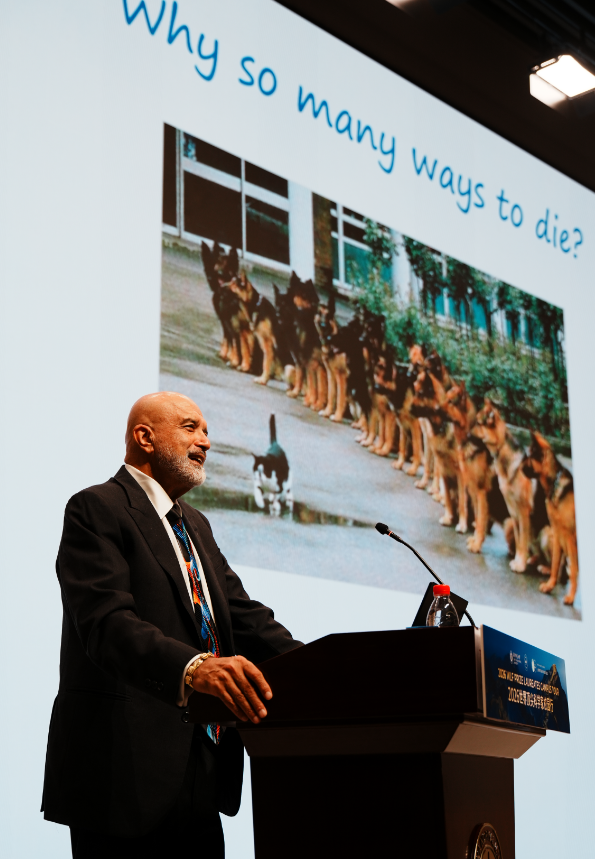
Dixit lectures in Shanghai. (Photo: Qian Zhongyuan)
'I suppose I am a citizen of the world'
Years after leaving Kenya, Dixit returned to Nairobi with his brother to settle the hospital bill incurred during their father's final illness.
Raj Kumar Dixit, also a doctor, had spent months in a private hospital before dying of pancreatic cancer.
The brothers, both living in the United States, expected a substantial bill.
At the payment desk, they learned it had already been settled.
Members of the community had raised the money.
For decades, Dixit's parents had treated patients around Kericho, often visiting their homes after a full day at the clinic.
Those who could afford treatment paid. Those who could not received care free of charge.
Many were Black Africans living under a colonial system that divided communities by race.
This was the same country where, as a child, Dixit had been chased by a dog after entering a whites-only neighborhood.
Yet his parents' work had connected their family with people across those divisions.
Growing up among different cultures and later studying and working in the United States taught Dixit how much people shared despite their differences.
"People everywhere want a good life, food and shelter, and a better future for their children," Dixit said.
What distresses him is tribalism, the tendency for groups to be set against one another despite how much they share.
"I suppose I am a citizen of the world," he said. "I do not identify exclusively with one group."
Despite concerns in the United States over dependence on Chinese biotechnology, he argued that international cooperation should speed up – not obstruct – the development of new medicines.
"If you are a dying patient, you don't care if your medicine was made in China or America," he said.
Looking ahead, Dixit shows no sign of slowing down.
"I still feel I have a lot of gas left in the tank," he said. "I'm still excited about science.
"I'm considering starting my own company."