


Chinese-backed Simandou iron ore project in Guinea completes full commissioning of northern industry chain
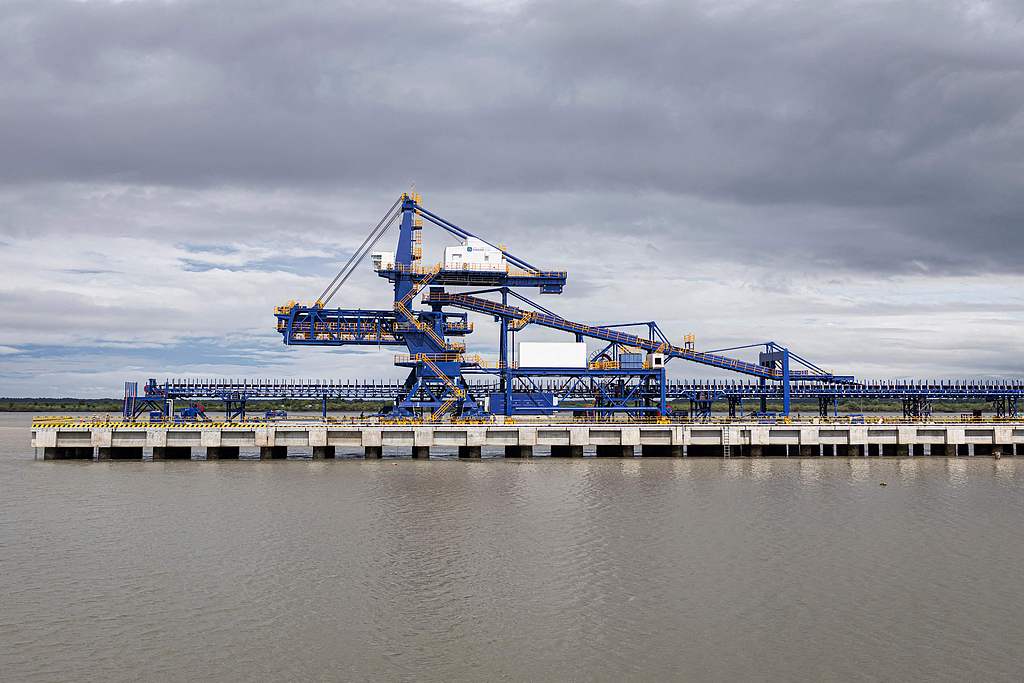
Simandou iron ore project in Guinea (File photo: VCG)
China Baowu Steel Group announced on Thursday that the north section of the Simandou iron ore and infrastructure project in Guinea, a world-class hematite deposit, has been completed and entered operation. Industry observers said the achievement marks diversification of China's iron ore import sources and highlights the growing capability of Chinese companies in global resource development and integrated project delivery.
The mine project, operated by the Chinese-backed Baowu Winning Consortium Simandou (BWCS), has completed the full-line heavy-load trial run of its second series downhill conveyor system. This marks the full completion and commissioning of the entire northern block industrial chain, encompassing mine, railway and port, China Baowu Steel Group said in a statement sent to the Global Times on Thursday.
According to Chinese analysts, the stable supply of Simandou's premium iron ore resources is expected to provide a solid foundation of low-carbon raw materials for the development of China's steel industry and the global steel sector. It also marks a new milestone in cooperation between China and African countries on iron ore resources and cooperation under the China-proposed Belt and Road Initiative.
In November 2025, the Simandou project officially commenced operations in Guinea. With a total cost of approximately $20 billion, the project brings together industry giants, including Rio Tinto, Chinalco, and China Baowu Steel Group, and spans mining, railways and ports. It is expected to gradually ramp up to an annual output production capacity of 120 million tons.
Located in southeastern Guinea in west Africa, the Simandou deposit stretches about 110 kilometers along a mountain range. With estimated reserves of around 4.41 billion tons, it is Africa's largest iron ore deposit and one of the world's highest-quality large open-pit hematite ore bodies.
The northern section of the mine holds roughly 1.54 billion tons of resources with an average iron grade of 65.28 percent, and is designed for a total annual capacity of 60 million tons. Its first and second production lines are each planned at 30 million tons per year.
The full completion of the Simandou north project is highly significant. As the quality of major global iron ore resources continues to decline, the project's potential to supply high-grade ore at a large scale is seen as especially valuable, Wang Guoqing, research director at the Beijing Lange Steel Information Research Center, told the Global Times on Thursday.
"For China, the project is expected to provide a more stable and higher-quality raw material source for the steel industry, while helping diversify China's iron ore import sources, which will lead to enhanced supply capacity and help improve China's iron ore supply and strengthen supply chain security," Wang said.
China's dependence on imported iron ore remains high. According to customs data, China imported about 1.26 billion tons of iron ore in 2025, setting a new record after three consecutive years of growth. Of that total, Australia accounted for about 60.3 percent, while Brazil remained the second-largest source at around 22 percent.
Guinea has become an increasingly important supplier to China. In the first three quarters of this year, China imported 10.08 million tons of iron ore from Guinea, placing the West African country among China's top 10 iron ore import sources, according to China's General Administration of Customs.
Analysts said that once Simandou iron ore project reaches full production, its output will account for about 5 percent of global iron ore supply, equivalent to nearly 10 percent of China's annual iron ore imports. That scale, they said, will help reduce China's reliance on Australian and Brazilian iron ore and strengthen its bargaining power in international iron ore trade over the medium and long term.
Beyond resource security, the mega project has also been promoted as a model for greener overseas mining development.
According to China Baowu Steel Group, 70 electric mining trucks have already been deployed at the Simandou mine, with the number expected to rise to 110 by the end of this year. Once fully in use, the fleet is expected to cut diesel consumption by 33 million liters a year and reduce carbon emissions by about 88,000 tons of carbon dioxide annually.
The project has also brought significant social and economic benefits to Guinea by creating more than 60,000 jobs, investing $22.92 million in community support and infrastructure, as well as significantly improving public health conditions in project areas.
According to the company's statement, the full completion of the Simandou north project will provide a solid green raw material base for the development of China's and the world's steel industries, while injecting long-term momentum into Guinea's economic and social development.
Industry insiders said that the project could serve as a benchmark for Chinese companies participating in global resource development. They noted that if Simandou can demonstrate strong performance in safety, environmental protection, community relations and operational efficiency, it could become a model for future Chinese overseas mining investment.