


NASA renews Mars sample-return push as US media cites China pressure; experts warn rivalry narrative could backfire
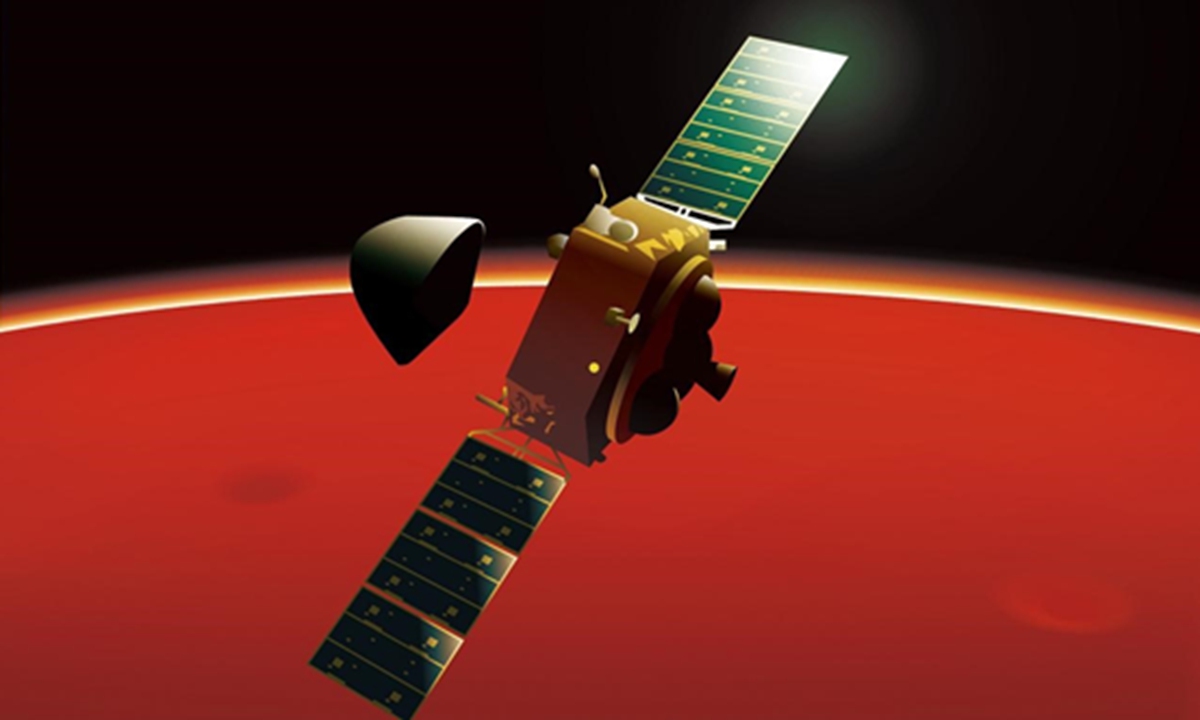
China's Tianwen-3 mission is scheduled to launch around 2028 Schematic diagram (Photo: VCG)
As NASA renews its push to bring Martian samples back to Earth, US media has cited progress in China's Tianwen-3 mission as a source of competitive pressure. Chinese space experts warned on Thursday that hyping a space race with China could backfire, fueling unrealistic deadlines, greater cost overruns and scientific risks, while failing to address NASA's underlying engineering and management challenges. They also stressed that China's Tianwen-3 mission follows its own scientific roadmap rather than seeking to outpace the US.
US space news site Space.com reported on US local time Wednesday that NASA is launching a fresh effort to reassess how samples collected by its Perseverance rover could be brought back to Earth, following years of mounting costs, technical difficulties and uncertainty surrounding the Mars Sample Return (MSR) program.
Notably, the report identified China's progress on its Tianwen-3 Mars sample-return mission as a "forcing factor" prompting NASA to reconsider its approach.
Pang Zhihao, a senior space expert, told the Global Times on Thursday that placing the two Mars sample-return missions within a competitive framework reflects a familiar narrative in US media rather than the fundamental nature of space exploration.
"The Chinese and US Mars sample-return missions are independently planned scientific projects, with different schedules and technical approaches. Tianwen-3 is rooted in China's step-by-step planetary exploration program, with the goal of obtaining Martian samples for cutting-edge scientific research, rather than benchmarking itself against or catching up with the US," Pang said.
Kang Guohua, a senior member of the Chinese Society of Astronautics, told the Global Times that hyping the so-called "China pressure" serves to divert attention from NASA's own cost overruns and management failures, turning China into an external target to justify funding demands.
China's Tianwen-3 mission is seeking evidence of whether life has ever existed on Mars, the mission's chief scientist, Hou Zengqian, told Xinhua in September. The mission aims to bring Martian samples back to Earth for detailed analysis.
As a key step in China's planetary exploration program, Tianwen-3, planned for launch around 2028, is expected to become the first Mars sample-return mission in human history. NASA's Perseverance rover has collected samples on Mars. A follow-up mission would be needed to bring them to Earth. In contrast, Tianwen-3 aims to accomplish both sampling and return in a single mission, Xinhua reported then.
Pang explained that the mission's schedule is determined by objective scientific and engineering constraints, including Earth-Mars launch opportunities occurring approximately every 26 months, launch capacity, liftoff from the Martian surface, orbital rendezvous, sample containment and planetary protection.
"Hastily pursuing the 'first' in deep-space exploration could compress essential testing and verification procedures, creating serious risks," Pang warned.
NASA's Mars Sample Return program has faced repeated difficulties over its technical complexity, escalating costs and prolonged development schedule. Previous assessments suggested the program could cost as much as $11 billion, with the return of samples potentially delayed until 2040, according to the Space.com report.
Pang said NASA's difficulties stem from a combination of complex engineering requirements, cost overruns and project management challenges, rather than any single technological obstacle.
He argued that repeated changes to mission designs, shifting requirements and complicated supply-chain coordination have further increased costs and slowed progress.
"Portraying China as a competitor through a geopolitical rivalry narrative may help secure congressional funding in the short term, but it cannot fundamentally resolve engineering challenges," Pang told the Global Times.
"Geopolitical competition narratives cannot solve engineering problems. Simply warning that China might get there first will not make billions of dollars in cost overruns disappear," said Kang, who is also a professor of aerospace engineering at Nanjing University of Aeronautics and Astronautics. "China's Tianwen-3 is proceeding at its own pace, targeting a launch in 2028 and a sample return in 2031, with a streamlined mission architecture and an emphasis on risk control. Successfully bringing Martian samples back to Earth matters far more than winning a race to be first."
Kang argued that the real obstacles facing the US program lie in project management and resource allocation, rather than the speed of China's progress. "Ironically, such rhetoric amounts to an acknowledgment that China's space program has become a timeline benchmark that the US can no longer ignore when planning its own missions," he said.
Pang warned that politically driven competition could encourage unrealistic deadlines, potentially forcing projects to accelerate development before critical technologies have been adequately verified, further aggravating budget overruns and technical risks.
Chinese Foreign Ministry spokesperson Guo Jiakun remarked on April 24, China's Space Day, that space is not an arena for rivalry among major powers and that China would continue to pursue open cooperation in space exploration.