


China initiates steps to explore the Jupiter system
The China National Space Administration has begun to take concrete steps to prepare for one of its ambitious interplanetary expeditions — the Tianwen 4 that aims to explore the Jovian system.
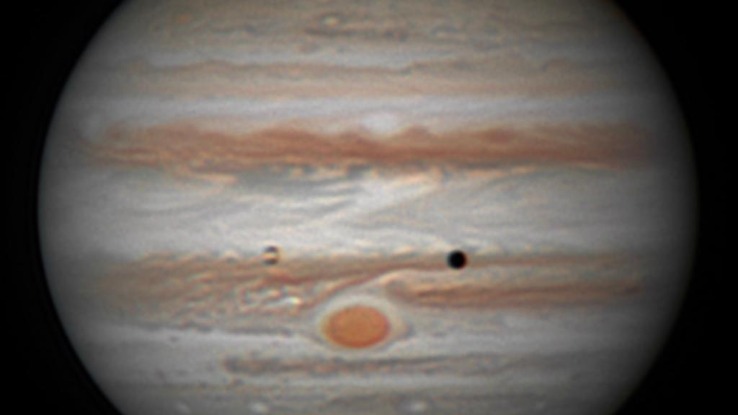
Photo via China Daily
The administration announced on Friday that the robotic probe is set to orbit Jupiter and land on its second-largest moon, Callisto, for close observation and survey.
To achieve these goals, the Lunar Exploration and Space Engineering Center of the administration started on Friday soliciting research and development proposals for scientific equipment that mission planners have decided to put on the Tianwen 4 spacecraft.
According to the center, the Tianwen 4 will be equipped with 12 scientific payloads on its orbiter and lander.
The orbiter will carry 10 payloads for two core research areas. Space environment detection tools — including a magnetic field and wave detector, particle analyzers, a soft X-ray spectrometer and a far-ultraviolet imager — will explore Jupiter’s multi-band auroras, the interaction between its vast magnetosphere and solar wind, and how solar particles spread through the outer solar system. Remote sensing apparatus such as cameras, a laser altimeter, a visible-infrared imaging spectrometer and a gamma-ray spectrometer will map Callisto's terrain, analyze its surface composition and detect radioactive elements.
The Callisto-bound lander will bring two in-situ measurement instruments — a surface composition analyzer that will identify materials at the landing site via Raman spectroscopy, and a surface magnetometer that will take on-site magnetic readings. Combined with orbital data, the surface magnetometer will help separate ionospheric and interior magnetic signals, offering key insights into Callisto’s internal structure and its potential subsurface ocean.
The center noted that it encourages overseas institutes to join programs led by Chinese organizations or submit their own proposals.
According to information previously published by Chinese space mission planners, the Tianwen 4 probe is scheduled to be launched by a Long March 5 heavy-lift carrier rocket from the Wenchang Space Launch Center in Hainan province around 2029.
To date, humankind still lacks comprehensive knowledge of the Jovian system and has performed only a handful of exploration operations. Therefore, the gas giant planet is full of opportunities for science and discovery, Zhang Rongqiao, a top mission planner at the CNSA, said.
While Jupiter, the largest planet of our solar system, has been known for a long time, the first detailed observations of it were made by Galileo Galilei in 1610 with a small telescope.
The first spacecraft to visit Jupiter was the United States' Pioneer 10 in 1973. Since then, this planet has been visited by several passing probes and orbiters.
The most recent Jovian mission was launched by NASA in October 2024. The spacecraft, named Europa Clipper, is the first mission designed to conduct a detailed study of Jupiter's icy moon Europa. The spacecraft is traveling 2.9 billion kilometers to reach Jupiter in April 2030.