


China and Arab political parties call for deeper exchanges on governance, administration
Political party representatives from China and Arab countries have called for deeper exchanges on party governance and state administration, saying such efforts will contribute to building a China-Arab community with a shared future and promoting world peace and development, at a high-level event in Suzhou, Jiangsu province.
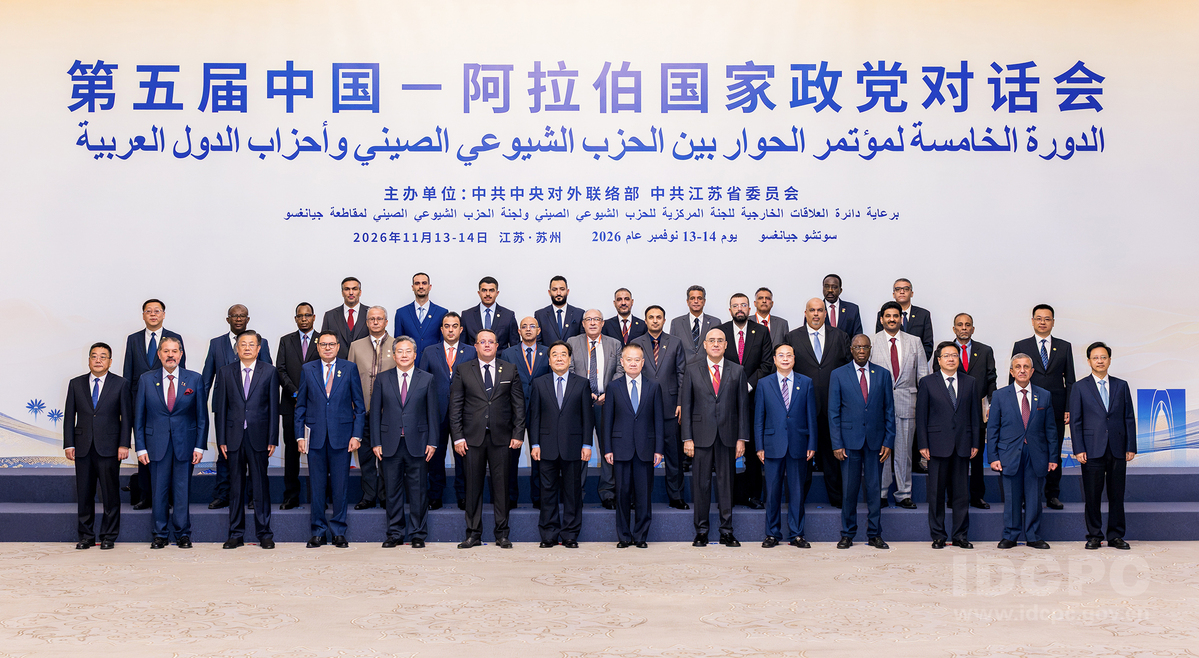
The fifth China-Arab States Political Parties Dialogue opens in Suzhou, Jiangsu province, on Friday. (Photo via China Daily)
At the opening ceremony of the fifth China-Arab States Political Parties Dialogue on Friday, Liu Haixing, minister of the International Department of the Central Committee of the Communist Party of China, said that amid accelerated changes unseen in a century and profound adjustments in the Middle East, the Communist Party of China is ready to strengthen strategic communication with political parties in Arab countries and continue to firmly support each other on issues involving their respective core interests and major concerns.
Liu emphasized that China will always work to build peace, promote stability and contribute to development in the Middle East.
He mentioned the Chinese film Once Upon a Time in the Middle East, a recent box-office hit, saying it reflects the Chinese people's understanding of peace: ensuring that ordinary people are not displaced, and that children have homes to return to, food to eat and access to education.
This is also the most fundamental starting point of China's Middle East policy — helping people in the region move beyond the shadow of war and live in peace and security, he said.
Sidney Sokhona, first vice-president of the National Assembly of Mauritania, said the dialogue between Chinese and Arab political parties has particular significance amid geopolitical tensions and international uncertainties.
Mauritania hopes to see China-Arab cooperation further developed while strengthening ties between Asia and Africa, he said, calling for balanced and mutually beneficial partnerships in education, infrastructure, agriculture, food security, new technologies and economic exchanges.
More than 100 participants from 22 Arab countries, including political party and organization leaders, business representatives, and delegates from think tanks and media outlets, are attending the two-day event in Suzhou.
This year marks both the 70th anniversary of the establishment of diplomatic relations between China and Arab states and the 10th anniversary of the establishment of the China-Arab States Political Parties Dialogue platform.
Since the inaugural dialogue was held in Yinchuan, Ningxia Hui autonomous region, in 2016, four editions and one extraordinary meeting have been held, providing an important platform for strategic communication, exchanges of ideas, practical cooperation and closer people-to-people ties between China and Arab countries.
A highlight of this year's dialogue is its emphasis on linking political party exchanges with local development and business cooperation, according to the organizers. The event features a dedicated business dialogue designed to better align China-Arab practical cooperation and support high-quality Belt and Road cooperation.
Official data from the International Department of CPC showed that all of the 22 Arab countries and the Arab League have signed deals with China on Belt and Road cooperation, with more than 200 joint projects implemented to benefit nearly 2 billion people on both sides. China-Arab trade reached $422 billion in 2025.
Jiangsu province, for example, has taken the lead in developing an industrial capacity demonstration zone between China and the United Arab Emirates, a key project under the Belt and Road framework.
Meanwhile, a direct container shipping service linking Taicang Port in Suzhou with the Port of Jeddah, Saudi Arabia, has opened an efficient and reliable maritime logistics route connecting the Yangtze River Delta region with Saudi Arabia and other Middle Eastern countries.