


Explainer: APEC comes to Shenzhen: where 'China Opportunity 2.0' meets the world
BEIJING, Nov. 15 (Xinhua) - Next week, the gaze of the Asia-Pacific will turn to a young metropolis in southern China that, about four decades ago, was little more than a quiet fishing village.
Shenzhen will play host to the 33rd Asia-Pacific Economic Cooperation (APEC) Economic Leaders' Meeting -- the first time in 12 years that China has hosted the top event of the region's highest-level, most extensive and most influential economic cooperation mechanism.
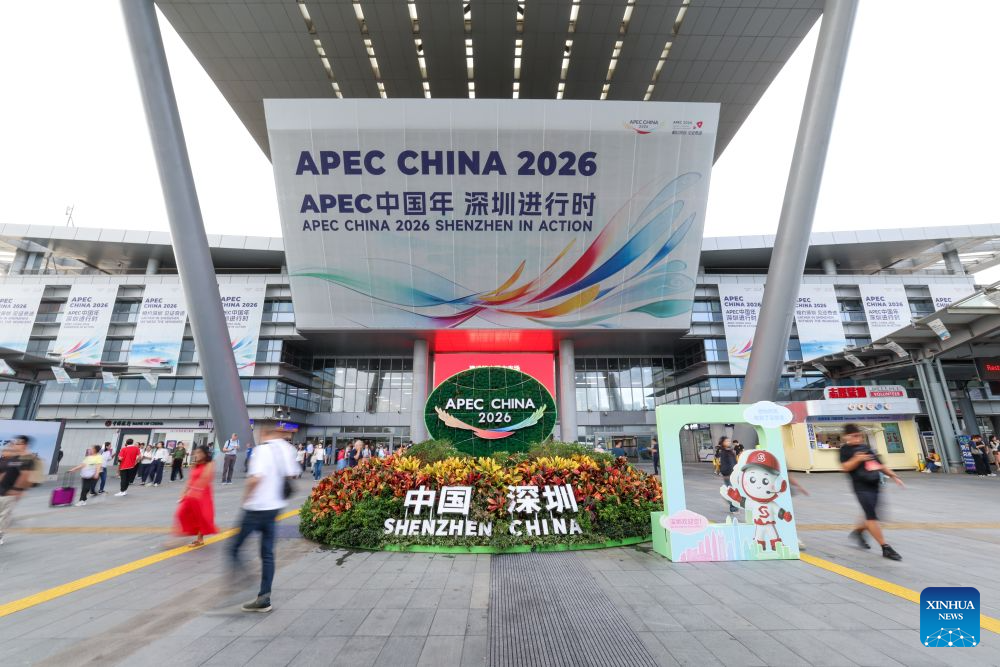
This photo taken on Nov. 4, 2026 shows an APEC-themed poster at Shenzhen Bay Port in Shenzhen, south China's Guangdong Province. China will hold the 33rd APEC Economic Leaders' Meeting in Shenzhen from Nov. 18 to 19. (Photo: Xinhua)
China officially joined APEC in 1991. Shenzhen, adjacent to Hong Kong, will become the third Chinese city after Shanghai and Beijing to welcome this gathering.
Its rise over the past few decades stands as a miracle in the annals of global development, demonstrating what the Chinese people can achieve.
When Shenzhen was designated a special economic zone in 1980, its GDP stood at just 270 million yuan (around 40.2 million U.S. dollars). By 2025, that figure had soared to 3.87 trillion yuan, trailing only Shanghai and Beijing.
China's choice of Shenzhen mirrors a pattern common to other APEC economies, which tend to favor national capitals, major economic or technological hubs, or internationally renowned tourist destinations as host cities.
For the 2026 APEC "China Year," China has set openness, innovation and cooperation as its three priorities. They echo the very forces that have shaped Shenzhen's development: openness is the city's defining feature, innovation its greatest strength, and cooperation a driving force behind its continued growth.
MARKET FOR THE WORLD
Shenzhen's rise over more than forty years owes much to China's reform and opening up. One of the country's first special economic zones, Shenzhen has been a city of opportunity from the very beginning, pioneering one move after another.
Countless entrepreneurs and innovators have gone there to pursue their ambitions, international investors have established a presence, and Chinese companies such as BYD and Huawei have grown from local businesses into global players.
Shenzhen's tale has unfolded in step with the country's opening up. Today, China is expanding high-standard opening up. It has granted zero-tariff treatment to 63 countries, while remaining the world's second-largest importer for 17 consecutive years.
In recent years, alongside further opening up the flow of goods, services, capital and talent, China has steadily expanded institutional opening up -- a key hallmark of high-standard opening up -- with respect to rules, regulations, management, and standards.
The aim is to build a business environment that is transparent, stable and predictable, and to bring China's institutional framework into closer alignment with international standards.
Shenzhen is a core city in the Guangdong-Hong Kong-Macao Greater Bay Area. Under "one country, two systems," the area's distinctive environment of three customs territories and three currencies has created valuable opportunities to explore the alignment of legal rules, cross-border professional practice, mutual recognition of qualifications, streamlined customs clearance and common standards.
In this sense, the area serves as a testing ground for bridging different systems and improving institutional connectivity across the Asia-Pacific.
INNOVATION DIVIDENDS
Today's Shenzhen is internationally known for its technological prowess and is often dubbed "China's Silicon Valley."
It now boasts more than 2 million professionals in science and technology. Yet when the special economic zone was first established in 1980, the city's entire pool of technical personnel consisted of just two people: a tractor mechanic and a veterinarian.
This contrast captures the scale of Shenzhen's transformation. In recent years, Shenzhen's output of new energy vehicles, industrial robots and civilian drones has maintained double-digit growth for extended periods.
The city has also become a popular destination for shoppers and technology enthusiasts looking to scour Huaqiangbei, its famed electronics market, for the latest products and cutting-edge innovations.
China's industrial strengths in emerging sectors such as renewable energy and electric vehicles are no accident. They are the result of years of technological accumulation, well-developed industrial supply chains, and the opportunities created by a vast domestic market.
If the "China Opportunity 1.0" of the past was largely about offering the world market dividends via China's enormous consumer market and low-cost production factors, today's "China Opportunity 2.0" is about delivering even greater market dividends while generating innovation dividends through technological progress and industrial upgrading.
In China, businesses from around the world can quickly find partners to work with across the entire process, from research and development and prototype testing to mass production. Companies can tap into the Chinese market while strengthening their competitiveness in global markets.
Seeing these advantages, foreign companies have increasingly moved beyond simply selling their products in China in recent years. Many have also established research and development centers and regional headquarters in the country.
In 2025, 14,000 new foreign-invested enterprises were established in China's scientific research and technical services sector, a year-on-year increase of 27.2 percent.
COOPERATION FOR SHARED PROSPERITY
The ocean connects rather than divides. Linked by the Pacific, the Asia-Pacific is one of the world's most dynamic economic regions, with deeply integrated regional economies and closely interconnected industrial and supply chains.
Cooperation underpins the shared prosperity of the Asia-Pacific and is essential to building an Asia-Pacific community. Against a backdrop of rising unilateralism and protectionism, one of China's most important responsibilities as APEC host is to help bring economies back to the path of openness and cooperation.
With global challenges -- climate change, food and energy security, demographic shifts and development imbalances -- intertwined and compounding, no single economy can prosper alone.
Over the past year, the 2026 APEC "China Year" has produced substantial results. Working with other APEC member economies, China has organized more than 300 APEC meetings and events, which covered a wide range of areas, including trade, tourism, small and medium-sized enterprises, and energy. They helped build consensus on a series of areas for cooperation.
Next week in Shenzhen, participating economies are expected to build on that consensus and deliver more practical outcomes in key areas such as trade, connectivity, the digital economy and artificial intelligence.
Such progress would provide fresh impetus for economic growth and prosperity across the Asia-Pacific and beyond.