


ASEAN summit opens as Philippines' parallel security agenda draws scrutiny
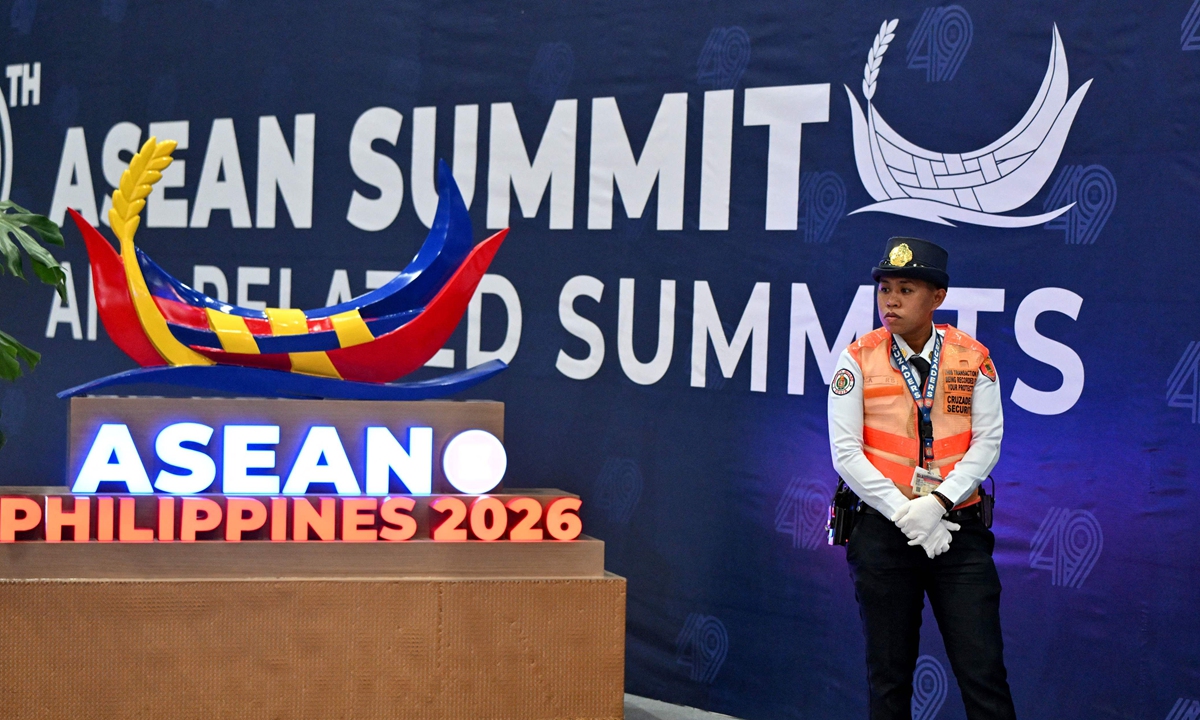
A security guard stands in the press centre during the 49th Association of Southeast Asian Nations (ASEAN) Summit in Manila on November 15, 2026. (Photo: VCG)
The 49th ASEAN Summit and Related Meetings opened in Manila on Sunday, with Philippine President Ferdinand Marcos Jr. calling for regional unity and progress on a South China Sea Code of Conduct (COC), but he offered no clear timeline for concluding the long-awaited agreement. Against the backdrop of a planned Quad leaders' meeting in the Philippine capital, Chinese experts interviewed by the Global Times questioned whether Manila was using its ASEAN chairmanship to advance its own maritime security agenda rather than prioritizing regional consensus.
Addressing the opening plenary, Marcos outlined three strategic priorities under the Philippines' ASEAN chairmanship - peace and security anchors, prosperity corridors, and people empowerment, according to the official Philippine News Agency. On the South China Sea, he called for advancing efforts toward an effective and substantive COC in accordance with international law, including the 1982 United Nations Convention on the Law of the Sea (UNCLOS), local news site Philstar reported on Sunday.
While Marcos pledged to complete 19 priority economic deliverables before Manila's chairmanship ends, he did not provide a deadline for the COC, which ASEAN foreign ministers had previously targeted for completion in 2026, according to Philstar.
Gu Xiaosong, an expert on Southeast Asian studies, told the Global Times on Sunday that the Philippines' dual identity - serving as ASEAN chair while also being a claimant state in the South China Sea disputes - has amplified the duality in its actions. "As ASEAN chair, the Philippines is expected to promote regional cooperation and development, but as a claimant in the South China Sea, it also seeks to advance its own national interests," Gu said.
Ding Duo, director of the Center for International and Regional Studies at the National Institute for South China Sea Studies, said Marcos' approach reflects a duality between his stated commitment to regional peace and Manila's expanding security cooperation with external powers.
"While Manila talks about peace, stability and accelerating the COC negotiations, it continues to strengthen military and security cooperation with external powers such as the US, Japan and Australia," Ding told the Global Times on Sunday.
Ding said the Philippines should use its ASEAN chairmanship to promote dialogue and regional unity rather than portray its own maritime positions as ASEAN's collective stance. "Manila should act as a bridge and promote unity, rather than use its chairmanship as a platform to pressure China," Ding said.
At the invitation of President Marcos, Chinese Premier Li Qiang is scheduled to attend the 29th China-ASEAN Summit in Manila from November 15 to 16, according to a November 11 announcement carried by the Xinhua News Agency.
China has consistently supported ASEAN centrality in the evolving regional architecture and advocated resolving differences in the South China Sea through dialogue and consultation. Beijing has also emphasized the importance of fully and effectively implementing the Declaration on the Conduct of Parties in the South China Sea (DOC) and advancing consultations on a COC, while promoting practical cooperation and maintaining peace and stability in the region.
COC hurdlesForeign Secretary Maria Theresa Lazaro said on Saturday that approximately 77 percent of the paragraphs in the proposed COC had been agreed upon, while acknowledging that substantive issues remained unresolved. Lazaro declined to detail the remaining sticking points, deferring to an official announcement from ASEAN leaders during the 49th ASEAN Summit.
A Southeast Asian diplomat involved in summit preparations told AFP that an agreement was not expected to be signed during the Manila summit. Philstar reported that outstanding differences include the COC's geographic scope, definitions of sensitive terms and whether the agreement should be legally binding.
Gu said the Philippines, as ASEAN chair, should have made greater efforts to advance negotiations toward the targeted conclusion this year. "Although some 70 to 80 percent of the negotiations have reportedly been completed, the remaining 20 to 30 percent may prove the most difficult, as they involve substantive differences that will require considerable efforts to resolve," Gu said.
He pointed out that different interpretations of the geographic scope could complicate efforts to establish a common framework, while sensitive terms require careful definition. "If the definition is too broad, it may be difficult for the parties to follow, but if it is too narrow, implementation could also become challenging," Gu said as he elaborated on the difficulties of translating general principles into workable rules.
Another major challenge concerns whether the COC should be legally binding and how its provisions would be implemented, Gu noted.
"If the COC is legally binding, the parties must determine how to ensure compliance. But without effective implementation mechanisms, it risks becoming little more than an extension of the existing DOC," he said.
Ding said the COC should build on the DOC and focus on crisis management and practical cooperation. He warned that Manila's pursuit of closer military cooperation with external powers could undermine the political trust needed to advance negotiations.
Quad challenges ASEAN centralityLeaders of the US, Japan, Australia and India are anticipated to meet in Manila on Tuesday, according to Reuters, citing two people familiar with the planning. The meeting would be the first Quad leaders' summit since September 2024 and the first since US President Donald Trump returned to office.
Reuters reported that critical mineral supplies and the security of commercial shipping routes could feature on the agenda. Although the Quad members have maintained that the grouping is not directed against any particular country, it is widely viewed as a mechanism balancing China's regional influence.
Gu said the timing of the Quad gathering illustrates how the Philippines is seeking to advance security priorities involving external powers alongside the ASEAN agenda. "The Quad meeting has little to do with ASEAN's own agenda, yet it has been arranged on the sidelines of the ASEAN summit," he said.
Adding to the security-focused activities surrounding the ASEAN summit, AFP reported that an annual seminar on the South China Sea began on Sunday less than five kilometers from the main summit venue, with Philippine Defense Secretary Gilberto Teodoro, who was sanctioned by China earlier this year, delivering a keynote address.
Ding warned that holding a Quad meeting alongside ASEAN-related gatherings could create a parallel security framework that risks weakening ASEAN's central role in regional affairs.
He noted that ASEAN countries generally favor strategic autonomy and practical cooperation, rather than being drawn into confrontation between major powers.
Despite the attention to security issues, the ASEAN summit also highlighted economic integration. Leaders are reportedly expected to tackle economic uncertainty and energy crises.
Ding stressed that maritime disputes should not be allowed to overshadow the broader relationship between China and ASEAN.
"Maritime disputes are only one aspect of China-Philippines relations, rather than a problem between China and ASEAN as a whole. Mutually beneficial cooperation remains the mainstream of China-ASEAN relations," Ding said.
He called for continued adherence to a dual-track approach, under which disputes are addressed through negotiations by directly concerned countries, while China and ASEAN jointly maintain peace and stability in the South China Sea.