


How far can we go? China's deep space missions in the next five years
(Photo: VCG)
Editor's note: Under China's 15th Five-Year Plan, which begins this year, the nation is expected to comprehensively advance its deep space exploration program. How far will China's spacecraft go beyond its Low Earth Orbit space station and imminent moon-landing programs? Will Mars, Jupiter and other celestial bodies become their next destinations? Yang Yuguang, the chairman of the International Astronautical Federation (IAF) Space Transportation Committee, tells us more. The article reflects the author's opinions, and not necessarily those of CGTN.
China has already achieved great success in its lunar exploration program. With the success of Chang'e-4 and Chang'e-6, China became the first country to conduct a soft landing on the far side of the moon and the first to bring back samples from the far side of the moon. Before 2030, China plans to bring astronauts to the lunar surface and back safely. This can also be seen as a first step toward establishing a permanent manned base on the lunar surface. Before that, China will continue its robotic missions to the moon's south pole and begin building the international lunar research station.
From lunar program to beyond
But when we look beyond the moon into deeper space, China still has a long way to go.
Before 2020, China had only a joint mission with Russia in deep space exploration, called Yinghuo-1 (or Firefly-1). It was essentially a piggyback payload on the Phobos-Grunt Mars probe. But after the Phobos-Grunt spacecraft failed, Yinghuo-1 was also de-orbited and never went to Mars.
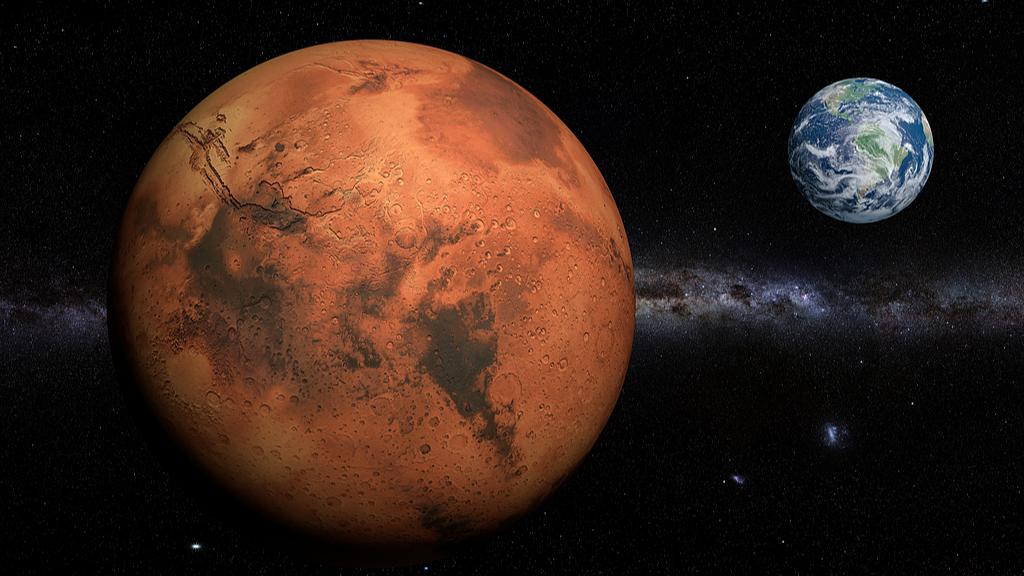
In 2020, China launched its first Mars probe, Tianwen-1. "Tianwen" means "Questions to Heaven." The probe is the heaviest spacecraft ever brought to trans-Mars orbit by human beings. This spacecraft combined an orbiter, a lander and a rover. With this mission's success, China became the second country to land a probe on the Martian surface and conduct scientific research. As this is China's first deep-space mission attempt, it's a great achievement.
But still, compared with leading countries in deep space exploration, such as the United States and the former Soviet Union, we need more technological breakthroughs to make greater contributions to human deep space exploration.
Major deep space missions
One important reason for deep space exploration is that China hopes to be a leading space power. Therefore, we should not only achieve great milestones in human spaceflight, lunar exploration, space science, and commercial space applications, but also make a giant leap in deep-space missions. In exploring Mars, Jupiter, asteroids, and other celestial bodies in the solar system, we should establish a complete architecture for the necessary technologies and scientific studies. To achieve this goal, we need to enhance our deep space exploration during the 15th Five-Year Plan (2026-2030). To this end, China will conduct several key deep space missions.
The first is Tianwen-2, a Near-Earth-Object sample-return mission. Today, the probe has already arrived at its target, asteroid 2016HO3, and is now surveying the surface of this small celestial body. Next year, it will collect samples and then bring them back to Earth. Since China is still a developing country, we always try to get more returns from a single mission. Therefore, when the Tianwen-2 orbiter brings the returner (with the samples) back to Earth, it will maneuver into an orbit that takes it toward 311P, a very special comet in the main asteroid belt, to gain more knowledge for humanity. This mission can be considered a necessary step for China to catch up with leading countries such as Japan (with Hayabusa-1 and 2) and the US (with OSIRIS-REx).
The second important deep space mission is Tianwen-3. If successful, it will be the first to return samples from the Martian surface. However, this mission also faces major technological challenges. We need one rocket to send the combination of the cruise stage, lander and ascender to trans-Mars orbit. After landing and collecting samples, the ascender will launch from the Martian surface and bring samples to Mars orbit. We will use another rocket to send the orbiter-returner combination to trans-Mars orbit. It will rendezvous with the ascender and transfer the sample to the returner; then the orbiter will leave Mars orbit and bring the returner to Earth. Before this mission, humans have never launched a spacecraft from the Martian surface, nor conducted a Mars orbit rendezvous. Although China already has experience ascending from the lunar surface and rendezvousing in lunar orbit, the corresponding two steps on Mars will be much more difficult.
The third important mission, Tianwen-4, is a Jupiter mission. As the largest planet in the solar system, it's very important for humans to learn more about it. The United States has already had successful missions such as Pioneer 10, 11, Voyager 1 and 2, Galileo, and Juno. Europe has also launched its JUICE probe to Jupiter. Unlike the missions above, China will send a probe to both Jupiter and Uranus. The main probe will enter Jupiter's orbit and eventually orbit Callisto, Jupiter's fourth Galilean moon. The secondary probe will fly by Uranus, the mysterious icy giant of the solar system. Before the Tianwen-4 mission, only Voyager 2 has visited it. If Tianwen-4 can achieve its goals, China will also become a leading country in exploration of the outer solar system.
Asteroid defense and the future of deep space exploration
Although we've already launched Tianwen-2, the asteroid sample-return probe, other asteroid studies are also important. One important aspect is asteroid defense. The China National Space Administration has announced plans to conduct an asteroid impact mission to test technologies needed to change an asteroid's orbit. This aims to develop effective measures to defend against threats from dangerous Near-Earth Objects that could potentially collide with Earth. The metals and other ores on asteroids can also be used for large-scale space exploitation. Asteroid mining is already a very hot topic in the space field. To support sustainable deep space missions, on-site resource utilization is a promising approach. But to achieve these goals, China needs to develop more powerful and more economical launch vehicles, nuclear propulsion systems, and other advanced technologies.
With the success of these missions, China can not only help the whole world better understand the solar system but also expand its commercial space activities from near-Earth space to deep space. It will mark the dawn of another great era of deep space exploration.