


When in Shanghai, they speak Shanghainese
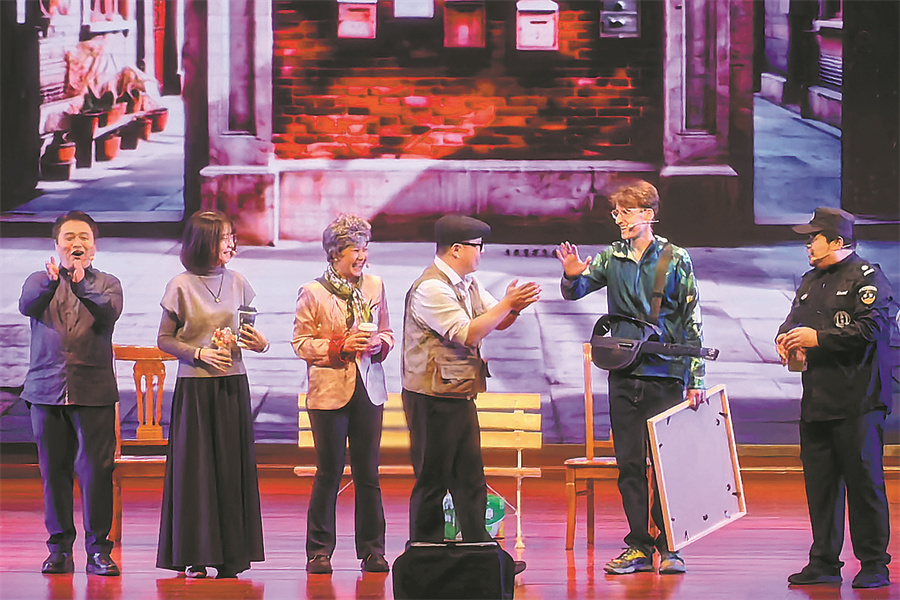
Tobias Le Compte (second from right), a jazz musician from Belgium, performs in the Shanghai-dialect comedy Hu Shang Fan Ren Ge in Shanghai's Changning district on Nov 5. (Photo provided to China Daily)
When Serbian Filip Filipovic said "liang nianji" instead of the standard Mandarin "er nianji" — both referring to the second grade — in a video, someone posted a comment to correct him. Shanghai viewers quickly jumped to his defense: He grew up in Shanghai. That's how we say it, they noted.
For Filipovic, who speaks Mandarin with a strong Shanghai accent, the episode revealed how deeply the city had shaped him.
While on tours in northern China, compliments on his fluent Chinese are often followed by a question: "You learned it in the south, didn't you?" Overseas, his Shanghainese greetings put his fellow conference participants from Shanghai at ease instantly.
Such encounters reflect Shanghai's international character.
The city recorded 7.139 million new temporary accommodation registrations by foreign nationals in 2025, up 49.6 percent year-on-year, according to the municipal public security bureau.
Filipovic's earliest teacher was the television. Watching local programs, he listened to the Shanghainese being spoken and began imitating the way of talking. Stand-up comedy came next, particularly performances by Seven, a popular comedian.
Filipovic then added Duolingo to his learning routine, describing its new Shanghainese course as "structured catch-up learning". He estimates that he understands 70 to 80 percent of the comedy programs he now watches, guessing the rest from context.
Language-learning app Duolingo launched its Shanghainese course on Oct 15. Lessons introduce phrases for situations ranging from workplace conversations to dating and everyday encounters.
Belgian jazz musician Tobias Le Compte began learning the dialect in Belgium in 2021, after watching the Shanghainese-dialect film B for Busy.
He was so serious about learning that he directed friends to send him voice messages in the dialect. Anyone who slipped into Mandarin would owe him a meal.
"I thought if I were in Shanghai, being able to speak Shanghainese might help me understand the city better," he said.
At the Chengjiaqiao Community Cultural Activity Center in Changning district, local residents now gather to watch Compte perform the kind of comedy he once studied online.
He appears in Hu Shang Fan Ren Ge, a comedy organized by the Shanghai Oriental Publicity and Education Service Center. Set in a residential community, the production brings together locals, newcomers and foreigners through stories about deliveries, waste sorting and neighbors helping one another.
His learning experience has also inspired others. When he arrived in Shanghai in 2023, people recognized him at the airport. Some parents told him his videos had encouraged their children to speak Shanghainese again.
Shi Menghui, an assistant to the head of Fudan University's Department of Chinese Language and Literature, welcomed the role played by foreign residents in popularizing Shanghainese.
Non-native speakers can notice differences that native speakers don't, Shi said, citing British missionary Joseph Edkins' 1853 compilation of the dialect's grammar as a valuable record.
"A dialect's vitality depends not only on the number of speakers, but also on how frequently it is used in public, the settings in which it is spoken and its symbolic value," Shi said.
The interest also reflects Shanghai's cultural appeal, Shi added.
Serbian resident Filipovic hopes more international residents will try speaking the dialect, starting with "nong ho" — the local way to say hello.
"Shanghai is an international metropolis. Being international and learning the local language are not contradictory," he said.