


Sustainable development: Asia-Pacific joins hands for a shared green future
Climate change, extreme weather and the energy transition are pressing challenges for economies across the Asia-Pacific, and no single member can tackle them alone.
Aligned with the APEC Putrajaya Vision 2040, regional players are tapping their respective resource endowments and building practical partnerships to advance low-carbon growth.

A visitor takes a photo of a BYD Sealion 7 car during the Big Motor Sale 2026, Bangkok, Thailand, August 30, 2026. (Photo: VCG)
Green industrial capacity and technology cooperation take shape
China's photovoltaic, lithium-ion battery and new-energy vehicle sectors are expanding localized production and technology collaboration with APEC partners, moving beyond simple product exports to build up local industrial capacity.
In Indonesia, the Cirata floating solar plant, one of Southeast Asia's largest facilities of its kind, has come online to supply clean power to the grid.
Built by Chinese contractors, the project demonstrates how PV technology can be adapted for reservoir sites in tropical APEC economies.
Chinese battery firms have also set up supporting manufacturing lines in Indonesia's industrial zones, forming integrated upstream and downstream clusters for the electric vehicle supply chain.
In Thailand, BYD's Rayong plant, with an annual capacity of 150,000 units, serves as a regional manufacturing hub for right-hand-drive new-energy vehicles.
The facility has attracted a cluster of component suppliers for batteries, motors and charging equipment, nurturing local manufacturing jobs and technical know-how.
Chinese electric buses are also operating on public routes across Santiago, Chile, cutting tailpipe emissions for the city's transit network.
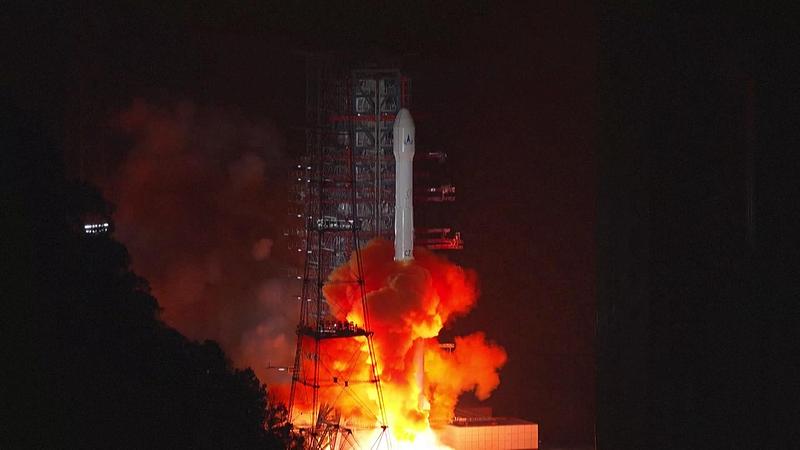
China sent Fengyun-4 03 satellite into space from the Xichang Satellite Launch Center in the country's southwestern Sichuan Province, December 27, 2025. (Photo: VCG)
Meteorological satellite data boosts climate resilience for Pacific island nations
For Pacific island economies on the front line of climate risks, shared satellite observation data has become a critical early-warning tool.
China's Fengyun meteorological satellites provide continuous high-frequency remote sensing data to support climate monitoring, tropical cyclone tracking and disaster forecasting for these nations.
Under the China-Pacific Island Countries climate cooperation initiative rolled out in 2025, Fengyun data services are open to Vanuatu, Solomon Islands, Papua New Guinea and Tonga.
The satellite system tracked volcanic ash plumes during the 2022 Hunga Tonga-Hunga Ha'apai eruption and supported emergency hazard assessments for subsequent disaster responses.
The service is part of wider efforts under the UN Early Warnings for All initiative to close the early-warning gap in small island developing states.
Digital traceability upgrades regional green supply chains
Digital tools are also helping APEC economies make regional value chains more transparent and low-carbon.
APEC trade and investment working groups have piloted digital traceability systems jointly by China, Indonesia and Peru to verify environmental and social credentials of traded goods.
The pilot schemes cover coffee, timber and textile products. Using shared digital standards, producers, exporters and regulators can trace commodity origins, record carbon footprints and check compliance with sustainability criteria.
The framework reduces repetitive compliance checks and helps certified green goods access markets across APEC more smoothly.
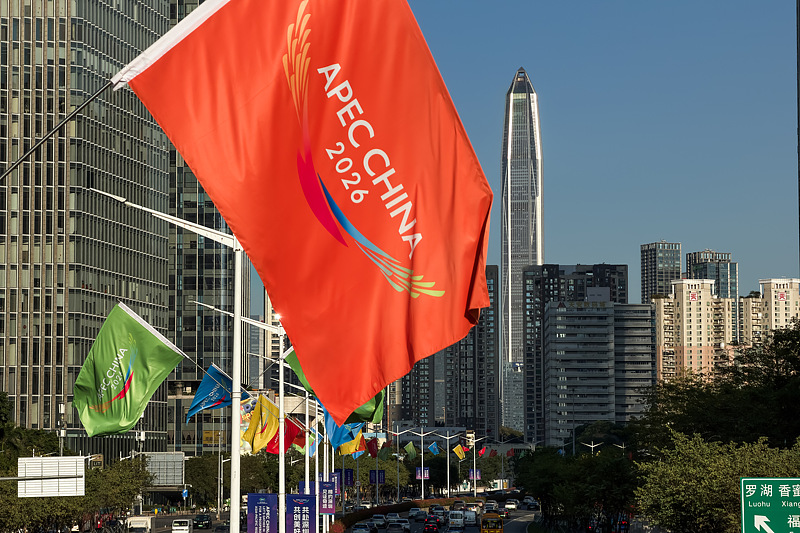
An orange flag bearing the "APEC CHINA 2026" logo flutters in the foreground, with colorful APEC flags lining a major boulevard and Ping An Finance Centre, Shenzhen's tallest building, rising in the background, Shenzhen, Guangdong Province, China, November 10, 2026. (Photo: VCG)
Inclusive technology transfer and peer learning under the Putrajaya Vision
Delegates and industry participants at the APEC Leaders' Week in Shenzhen stress that sustainable transition pathways differ widely, shaped by each economy’s natural resources, energy mix and development stage.
The Putrajaya Vision 2040 sets the long-term direction for an open, resilient Asia-Pacific community.
Progress on sustainability relies on voluntary multilateral coordination, accessible technology transfer and peer learning rather than uniform regulatory requirements.
Economies are encouraged to share mature low-carbon solutions and tailor them to local conditions, instead of adopting identical green transition roadmaps.
As the APEC "China Year" enters its Leaders' Week in Shenzhen, these on-the-ground projects illustrate a core message: shared climate risks call for shared solutions.
Inclusive technology access, capacity building and collaborative trade frameworks will translate the APEC sustainability commitments into tangible benefits for communities across the region.