


Retail giants bullish about China market
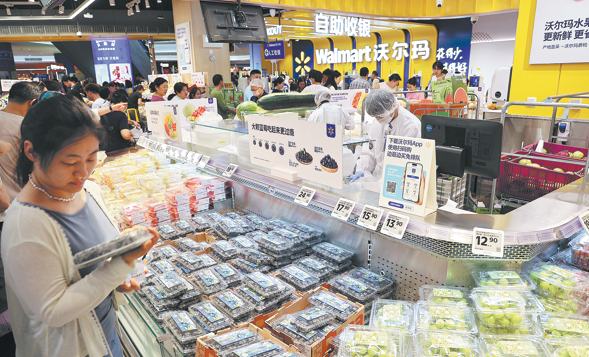
Consumers check out fruit at a Walmart store in Shenzhen, Guangdong province, on Oct 11. (Photo: China Daily)
China's retail market is emerging as a key growth engine for companies across Asia-Pacific Economic Cooperation (APEC) economies, as retailers from the United States and elsewhere accelerate investments to capture rising demand from Chinese consumers.
Recent expansion plans by US retail giants Walmart and Costco underscore growing confidence in the world's second-largest consumer market. The investments span new store openings, digital retailing and supply chain infrastructure buildout.
The move shows how multinational retailers are positioning themselves for long-term growth in China while strengthening trade and investment links across APEC markets.
Walmart China opened three next-generation stores within a month, including a new outlet in Shenzhen, Guangdong province, on Oct 11, after launching similar stores in Chengdu, Sichuan province and Nanning, Guangxi Zhuang autonomous region.
The Shenzhen Futian KK ONE store — Walmart's 49th in the city — adopts the retailer's latest compact, single-floor format, featuring optimized merchandise displays and an enhanced focus on fresh food, groceries, beverages and snacks — categories in which Walmart believes it has competitive advantages.
The company said it has upgraded around 70 stores this year and expects to renovate more than 100 by the year-end. New-generation stores are also planned for cities including Beijing and Liuzhou, Guangxi.
Beyond physical expansion, Walmart is deepening its omni-channel strategy by integrating supermarkets, neighborhood stores and online shopping through its Walmart App. The company said customers within 5 kilometers of its supercenters can receive deliveries in as little as 30 minutes.
The retailer is also investing heavily behind the scenes. In September, Walmart China signed an agreement with the Jiaxing municipal government in Zhejiang province to upgrade its smart logistics hub, the company's largest single supply chain investment since entering the Chinese market three decades ago.
Construction is scheduled to begin soon and finish in 2029. The upgraded center will expand from about 48,000 square meters to 278,000 sq m, increasing daily processing capacity roughly fourfold. Equipped with automated warehousing, intelligent scheduling systems and integrated online-offline inventory management, the hub is expected to serve both Walmart supercenters and Sam's Club stores across East China while supporting nationwide distribution.
The investment reflects Walmart's confidence in China's long-term consumption potential as retailers increasingly rely on digitalized supply chains to improve efficiency and support omni-channel retailing.
Walmart's warehouse club — Sam's Club — is also accelerating its China expansion.
On Oct 13, Sam's opened its 70th store in China in Wuxi, Jiangsu province. It is the company's third warehouse club in the city since its first opening in 2022.
China has become one of Sam's fastest-growing overseas markets, supported by rising demand from middle-income households seeking premium imported foodstuffs, private-label products and membership-based shopping experiences.
Market researcher Worldpanel by Numerator said Walmart Group maintained its leading position among China's major retailers during the first half, increasing market share by 1.2 percentage points from a year earlier.
Sam's Club remained the group's primary growth engine. Together with Walmart's accelerated rollout of neighborhood stores and expanded private-label offerings, the company's overall consumer penetration increased by about 4 percentage points.
Peng Jianzhen, director of the China Chain Store and Franchise Association, said: "Over the past three decades, Walmart China has grown into one of its leading retailers in China. Its development reflects both China's continued opening-up and the company's long-term commitment to the market and focus on quality."
"By strengthening ties with local suppliers and improving quality control, logistics and product innovation, Walmart has supported growth across the supply chain. We look forward to the company deepening its presence in China and working with industry partners to support the retail sector's healthy development."
Another US retailer is also stepping up its ambitions in the country.
Costco reported fiscal 2026 net sales of $297.2 billion worldwide, an increase of 10.1 percent year-on-year. Although the company currently operates only seven warehouses in China, compared with 939 globally, it plans to open nine additional stores by 2030, more than doubling its local network.
The expansion marks a significant acceleration after several years of cautious store openings. Costco's China business has also grown rapidly despite its relatively small footprint.
According to the China Chain Store and Franchise Association, Costco China generated sales of 10 billion yuan ($1.5 billion) in 2025. Average sales per store exceeded 1.4 billion yuan, suggesting growth has been driven more by improving store productivity than rapid expansion.
In July, Costco further broadened its reach by partnering with Chinese e-commerce platform JD.
The cooperation allows nonmembers to purchase Costco products online at prices about 20 percent higher than member prices while leveraging JD Logistics' nationwide delivery network covering more than 2,800 districts and counties.
Since trial operations began in May, the online flagship store has attracted more than 30 million visits, extending the warehouse retailer's customer base well beyond cities where it operates physical warehouses.
For international retailers, China remains not only one of the world's largest consumer markets, but also an increasingly important testing ground for omni-channel retailing, supply chain innovation and membership-based business models.
Their continued investment also illustrates the country's growing role in connecting APEC economies through trade, consumption and cross-border supply chains, as companies increasingly integrate Chinese operations into their broader regional growth strategies.