


Deepening economic and trade exchanges to expand the pie of Asia-Pacific cooperation
Established amid the wave of economic globalization, the Asia-Pacific Economic Cooperation (APEC) aims to promote trade and investment liberalization and facilitation, as well as support economic growth and prosperity. It has grown into the region's highest-level, most extensive, and most influential economic cooperation mechanism.
Since its establishment 37 years ago, APEC has stayed true to its founding mission of Asia-Pacific cooperation, firmly upheld the multilateral trading system, and fostered a sound trade and investment environment.
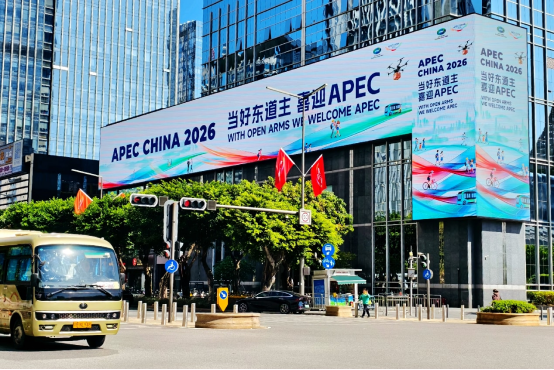
Photo shows an APEC-themed promotional sign in Shenzhen, South China's Guangdong Province, Nov. 11, 2026. (Photo: Dong Yangyong)
By continually expanding the scope of economic and trade cooperation, APEC has not only propelled the Asia-Pacific to become the world's most dynamic economic hub and a major driver of global growth, but also injected vital stability and certainty into the global economy.
Openness is the lifeblood of Asia-Pacific cooperation. Since APEC's inception, its member economies have championed open regionalism, jointly advanced trade and investment liberalization and facilitation, and steadily dismantled non-tariff barriers.
In 2025, the region's GDP reached $61.4 trillion and its total merchandise trade exceeded $26 trillion, continuously pulling the center of gravity of the world economy closer to the Asia-Pacific.

Citizens and tourists take photos at an APEC-themed floral installation at Lianhuashan Park in Shenzhen, South China's Guangdong Province, Nov. 7, 2026. (Photo: Leng Wen)
Regarding tariff reduction, APEC member economies lowered their simple average most-favored-nation tariff rates from 16.9 percent in 1989 to 5.1 percent in 2024. During the same period, the share of zero-tariff product lines expanded from 27.3 percent to 48.9 percent, creating tangible opportunities for enterprises worldwide to boost their profits.
On the policy front, frameworks such as the APEC Non-Binding Investment Principles, the APEC Investment Facilitation Action Plan, and the APEC Strategy for Investment have been rolled out and updated to continually optimize the regional investment climate.
In terms of institutional alignment, the entry into force of high-standard trade and economic agreements—such as the Regional Comprehensive Economic Partnership (RCEP), the Comprehensive and Progressive Agreement for Trans-Pacific Partnership (CPTPP), and the Digital Economy Partnership Agreement (DEPA)—has steadily deepened regional economic integration.
This year marks the APEC "China Year," for which China has designated "openness, innovation, and cooperation" as its three priority areas.
China continuously expands high-standard opening-up and shares its dividends with regional partners, contributing to broader economic integration in the region.
By shortening its negative lists for foreign investment access and steadily opening up its services sector, China has proactively opened its domestic market to Asia-Pacific economies. It is currently the largest trading partner of 13 APEC economies.
Openness is a distinctive feature of Chinese modernization. China remains committed to its fundamental national policy of opening-up, achieving its own development while enabling others to succeed.
Together with all parties, China will advance the Free Trade Area of the Asia-Pacific (FTAAP) and regional economic integration, making the pie of Asia-Pacific cooperation ever larger.