


Collaborating to create new opportunities for global economic growth
The 33rd Asia-Pacific Economic Cooperation (APEC) Economic Leaders' Meeting concludes in Shenzhen, South China's Guangdong Province, on Thursday.
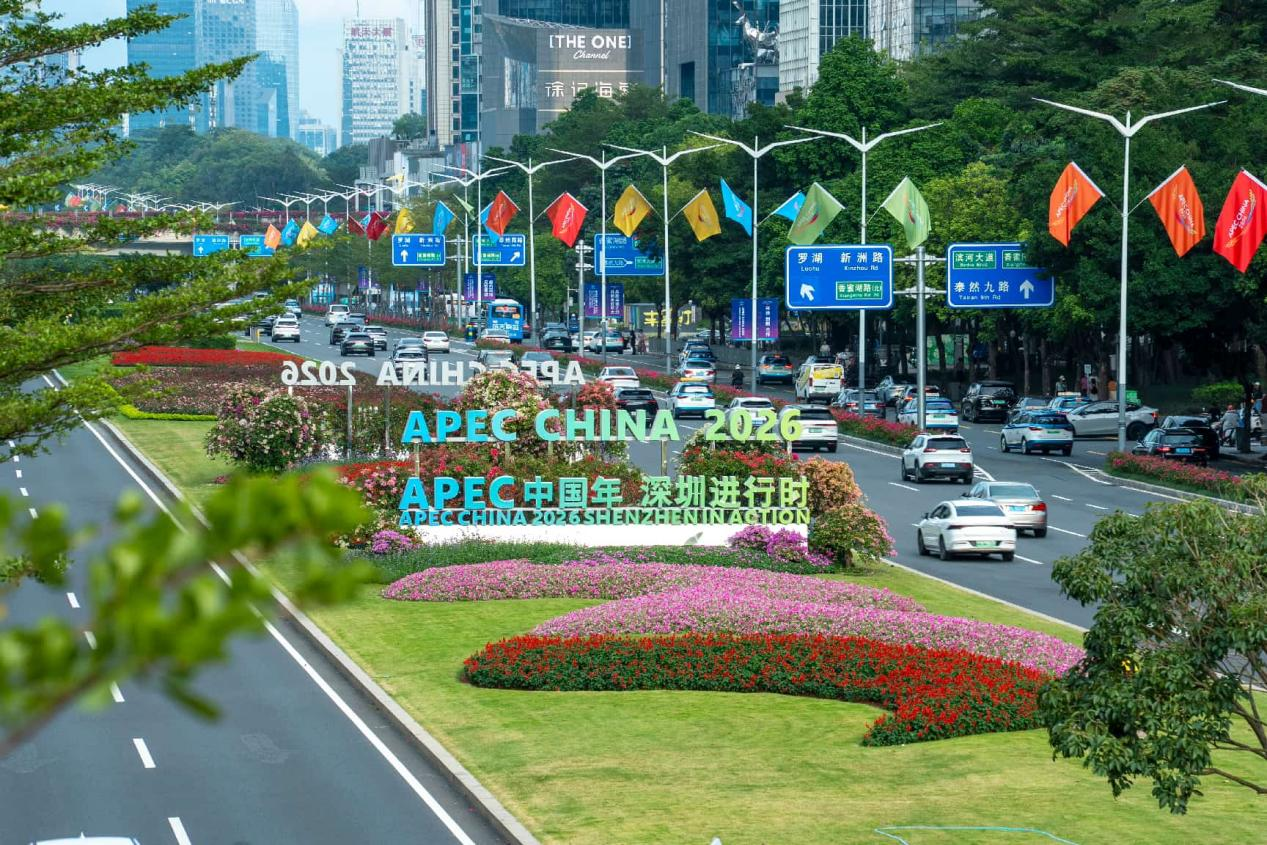
Pacific Economic Cooperation (APEC)-themed floral installations stand prominently on a street in Shenzhen, South China's Guangdong Province. (Photo/Leng Wen)
Currently, the Asia-Pacific region remains the most dynamic and promising economic region in the world. At a new starting point, economies across the region look forward to collaborating once again to create new opportunities and inject fresh momentum into global economic growth.
Facilitating economic and trade exchanges, expanding development opportunities
Openness is the lifeline of Asia-Pacific economic prosperity. Amid a complex and severe global landscape, sluggish economic growth and a declining global openness index, safeguarding the development pattern of the Asia-Pacific characterized by openness and cooperation has become a shared challenge for all APEC member economies.
In September 2026, the Pinglu Canal officially opened to navigation in South China's Guangxi Zhuang Autonomous Region. It shortens the inland waterway journey for goods from Southwest China to the sea by more than 560 kilometers compared with traditional routes.
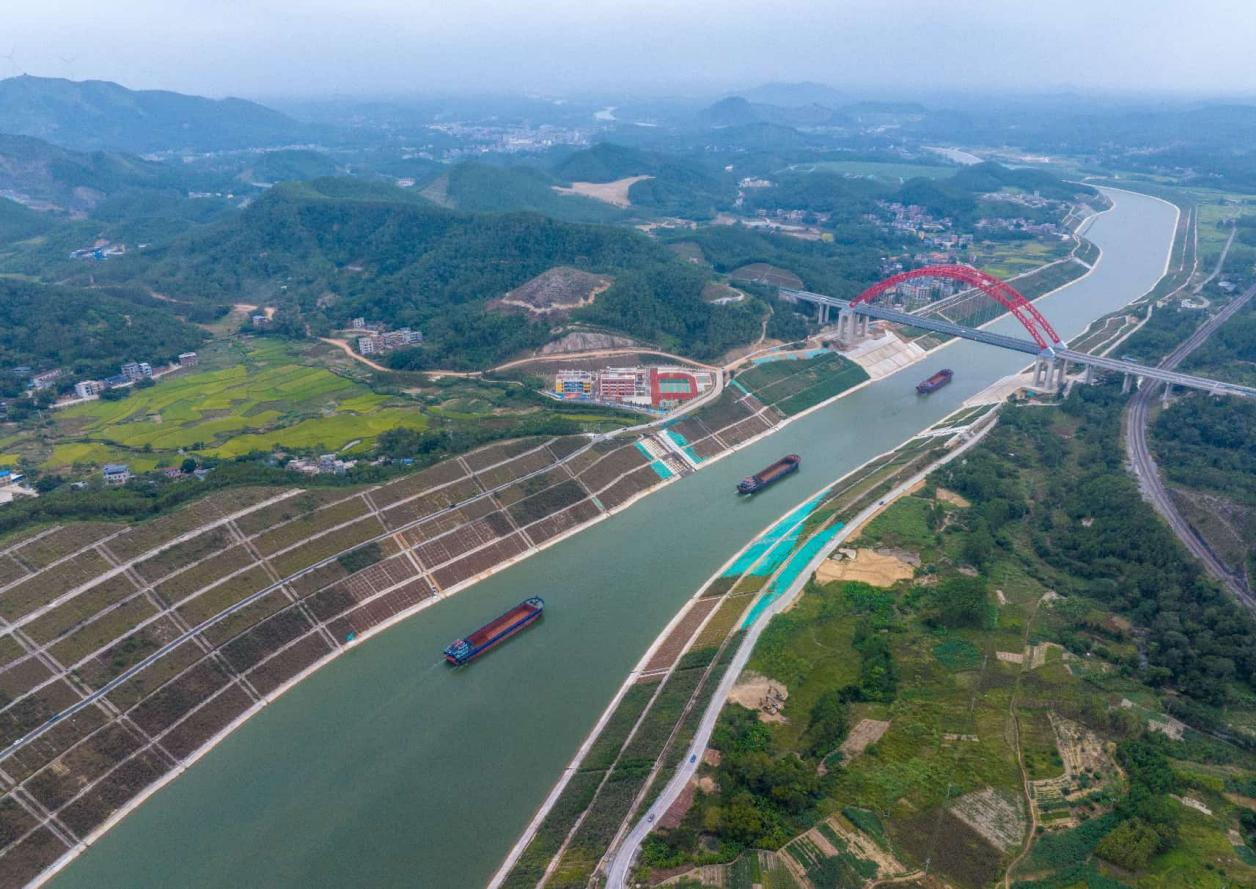
Cargo ships sail along the Pinglu Canal in South China's Guangxi Zhuang Autonomous Region. (Photo/Long Tao)
Chinese vehicle components and construction machinery parts now enter ASEAN markets more easily, while rubber, palm oil and fruit from ASEAN enter China at lower cost. The deepening, substantive and fruitful cooperation between China and ASEAN injects greater stability into the Asia-Pacific.
Trade among economies across the region remains active, as seen in vibrant scenes of heavily laden freighters arriving and departing, airports alive with continuous air traffic, and a steady stream of cross-border trucks.
In the first three quarters of 2026, China's imports and exports with other APEC economies rose 23.9 percent year-on-year to reach 24.07 trillion yuan ($3.61 trillion), accounting for 60.3 percent of its total foreign trade.
The Asia-Pacific industrial and supply chains are deeply integrated.
South Korea's tech giant Samsung Electronics inaugurated its first biopharmaceutical R&D center in China in June 2026. Chinese automaker BYD's manufacturing plant officially commenced production in July 2024 in Thailand, with an annual capacity of 150,000 vehicles.
In Indonesia, Chinese automaker SAIC-GM-Wuling has driven cooperation between 17 Chinese supply chain enterprises and over 100 local suppliers.
Through joint R&D, collaborative innovation, industrial partnerships and overseas manufacturing, Chinese companies have not only expanded space for their own development but also injected sustained momentum into Asia-Pacific growth.
China is injecting greater certainty into the Asia-Pacific business environment through a series of pragmatic actions.
These include proactively aligning with high-standard international economic and trade rules, further shortening the negative list for foreign investment, expanding the opening-up of the services sector and giving overseas businesses greater access to the vast Chinese market.
Creating new economic growth drivers, unleashing long-term development potential
Emerging sectors such as the digital economy and green, low-carbon development are becoming key focus areas of cooperation among APEC economies and important new engines of regional economic growth.
At Shenzhen Bao'an International Airport, a batch of edge AI computers manufactured by Seeed Technology Co., Ltd. is about to be shipped to Canada, Thailand and other destinations.
Thanks to its strengths in AI computing power and smart hardware innovation, the company has seen its export volume and value nearly triple in 2026.
Data from Shenzhen Customs shows that in sectors such as electronics, automobiles and machinery, China and other APEC economies have gradually forged complementary and tightly knit innovation chains.
In the first three quarters of 2026, China's exports and imports of high-tech products with other APEC economies grew by 50.3 percent year-on-year, reaching 6.66 trillion yuan ($999 billion). The country's imports of electronic components from other APEC economies surged by 56 percent year-on-year.
Green and low-carbon transformation is an inevitable trend in future development.
Several APEC member economies have successively unveiled carbon-neutrality targets, triggering a surge in demand for cooperation in new energy, critical minerals, green infrastructure and low-carbon technologies, thereby opening up new areas for economic and trade cooperation.
Chinese new-energy vehicles are selling briskly overseas. Chinese wind turbines and photovoltaic panels are taking root abroad to power green-energy infrastructure. The APEC Sustainable Energy Center continues to host policy research, capacity building and experience-sharing activities, driving mutual learning and policy dialogue among member economies.
Addressing risks and challenges together, sharing development opportunities
Over the past three decades and more, per capita income in the Asia-Pacific has more than quadrupled, and 1 billion people have been lifted out of poverty. This is an important contribution to human progress and global sustainable development.
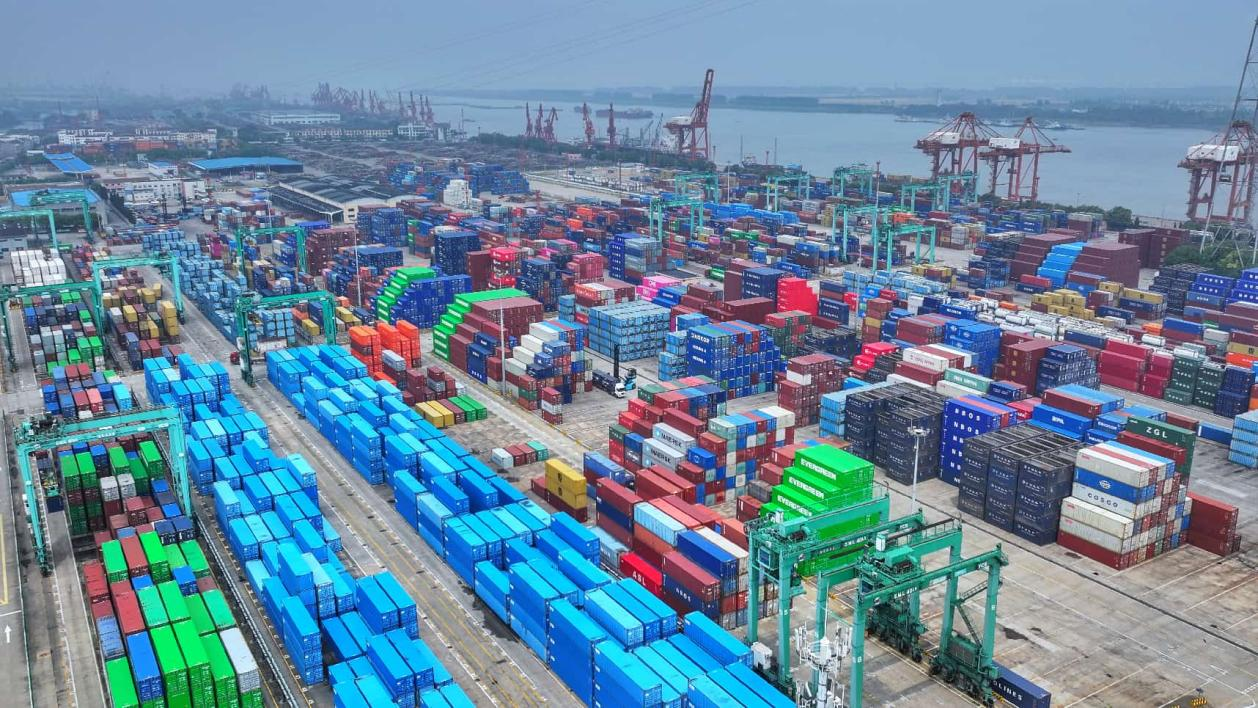
A busy scene unfolds at a container wharf at Zhangjiagang port area, Suzhou Port, in Suzhou, East China's Jiangsu Province. (Photo/Shi Borong)
APEC's role as a dialogue platform that bridges differences and champions win-win cooperation has become increasingly vital, safeguarding the continuity and stability of regional cooperation.
By spearheading the World Artificial Intelligence Cooperation Organization, China has driven cooperation in areas such as development strategies, governance norms and technical standards.
Meanwhile, APEC member economies continue to advance supply chain connectivity and alignment of industrial rules, reducing technical barriers and market entry thresholds.
By lowering transaction costs and boosting cooperation efficiency through regulatory alignment, and by strengthening development resilience and deepening regional cooperation through institutional coordination, APEC members have cemented a more robust institutional foundation for Asia-Pacific cooperation.
The well-being of the people is the fundamental goal of development. The fruits of regional economic cooperation in the Asia-Pacific have translated into benefits for the people in their everyday lives.
Thanks to trade facilitation, mutual standard recognition and other measures, cross-border e-commerce delivery times have been reduced from half a month to just a few days.
Holding an APEC Business Travel Card, foreign trade professionals can travel among fully participating economies without a visa if pre-clearance has been granted. The card is valid for five years.
Furthermore, driven by the region's efficient and coordinated supply chain, the electronics industry has achieved the widespread adoption of technologies across the region.
Upholding the three priorities of openness, innovation and cooperation, and championing the spirit of openness and connectivity, China, on its journey toward modernization, will inevitably inject greater stability and positive energy into the Asia-Pacific and the world through its own development.