


China adds 34 factories to flagship smart factory list
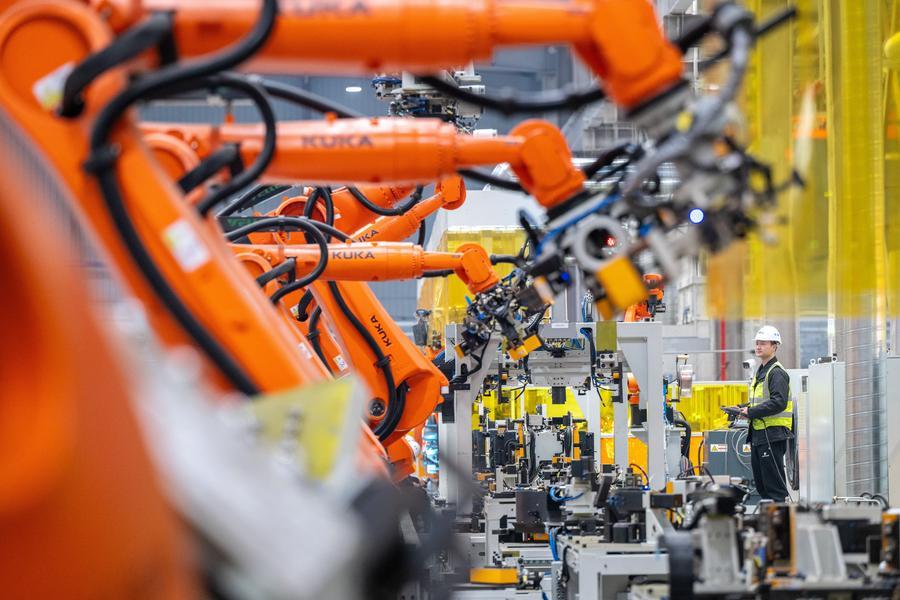
An employee works on the production line in a smart factory of Noblelift, a manufacturer and service provider of material handling equipment and logistics solutions, in Changxing County of Huzhou City, east China's Zhejiang Province, March 16, 2026. (Photo: Xinhua)
China has added 34 factories to its cultivation list of flagship smart factories, the highest tier under the country's four-tier smart factory cultivation system, bringing the total number of such factories to 49.
The list was jointly released by the Ministry of Industry and Information Technology (MIIT) and five other government departments on Thursday.
The selected factories span a range of industries and feature advanced technologies and innovative manufacturing models. They include projects developed by major manufacturers such as Xiaomi Auto and Hudong-Zhonghua Shipbuilding.
According to the MIIT, the list is designed to accelerate the development of new-generation intelligent manufacturing, and promote the intelligent, green and integrated development of the manufacturing sector.
Data showed that AI is playing an increasingly important role in these facilities. More than 70 percent of application scenarios in the second batch of flagship smart factories involve AI and these factories have developed over 1,000 industrial AI agents, with daily token consumption exceeding 300 million.
To support the construction of smart factories, the MIIT urged local authorities to strengthen services, guide efforts toward building high-quality datasets, develop industrial AI agents, explore advanced manufacturing models, and create smart supply chains in light of local conditions.
China launched the tiered cultivation system for smart factories in 2024, aiming to drive the formation of a safe, controllable and complete high-level supply system for the intelligent manufacturing sector. Flagship smart factories, the highest tier, serve as pioneers in exploring next-generation manufacturing.
The development of smart factories is part of China's broader efforts to deepen the integration of AI and manufacturing, and advance industrial digitalization and intelligent upgrading.
In October, the MIIT said China was drafting policies on next-generation smart manufacturing. The measures include expanding digital systems and AI use in basic and advanced factories, while supporting top-tier factories in exploring next-generation architectures and future manufacturing models.
New growth drivers are becoming a major source of industrial growth in China. In the first three quarters of 2026, high-tech and digital manufacturing accounted for just more than 20 percent of industrial value-added output but contributed over half of industrial growth, according to the National Bureau of Statistics