


China Focus: China-Singapore Tianjin Eco-City enters new development phase
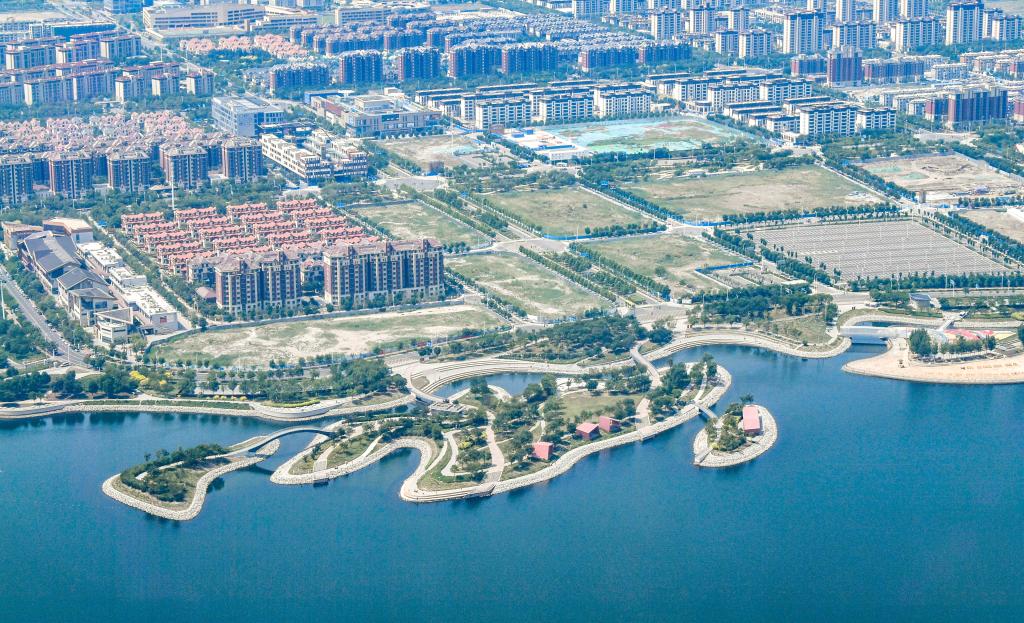
This aerial view taken on June 16, 2023 shows a view of the China-Singapore Tianjin Eco-City in north China's Tianjin Municipality. (Photo: Xinhua)
TIANJIN, Nov. 21 (Xinhua) -- Amid a landscape dotted with factories and crisscrossed by heavy truck traffic in north China's Tianjin Municipality, the China-Singapore Tianjin Eco-City stands out as an unexpected oasis of greenery.
In early winter, flocks of migratory birds, including relict gulls under state protection, forage and rest on coastal mudflats. Notably, the number of recorded bird species in the eco-city has doubled to more than 200 since the start of its development, indicating remarkable improvement in the local environment.
Construction of the eco-city, the world's first intergovernmental eco-city, began on a barren stretch of saline-alkali wasteland in 2008. Thanks to years of massive restoration efforts, the area has been transformed into a green city where man and nature coexist in harmony. With a population of 220,000, the eco-city has a green coverage rate of over 50 percent.
According to a development plan (2024-2035), the eco-city aims to build itself into a national demonstration zone for green development, adhering to green, low-carbon and high-quality development, focusing on high-value-added industries and featuring a world-class business environment.
The National Animation Industry Park in this eco-city is home to nearly 2,000 enterprises spanning animation and film, digital games, short-drama production and digital cultural products, forming a complete industrial chain.
Tianjin Mdog Animation Studio is among the companies incubated in the eco-city. Specializing in VR-based immersive experiences in large venues, the company brought several projects to shopping malls and tourist attractions in Vietnam, Malaysia and Indonesia, according to company executives.
Besides enterprises specializing in photonic chips and integrated circuit testing equipment, healthcare industries in the eco-city are also gaining momentum. In terms of green infrastructure, a distributed photovoltaic power project in the eco-city's biomedicine industrial park was recently connected to the grid and put into operation, supplying power for enterprises in the park.
Currently, the eco-city is home to more than 170 medical and health enterprises covering multiple fields including medical device manufacturing, traditional Chinese medicine equipment and medical big data services.
In addition, efforts are underway to attract more high-value-added industries, such as advanced manufacturing and resource recycling. The eco-city is home to the headquarters of China Resources Recycling Group Co., Ltd., a centrally administered state-owned enterprise.
This year, the eco-city released an updated action plan for building a first-class business environment.
Li Long, head of the China-Singapore Tianjin Eco-City Administrative Committee, said the eco-city has entered a new stage of development, shifting its focus from city building to industrial growth.
The eco-city will adhere to its positioning and strive to become a modern, people-centered city, Li noted.