


3.95-billion-year-old rock discovered in China, oldest known in Asia
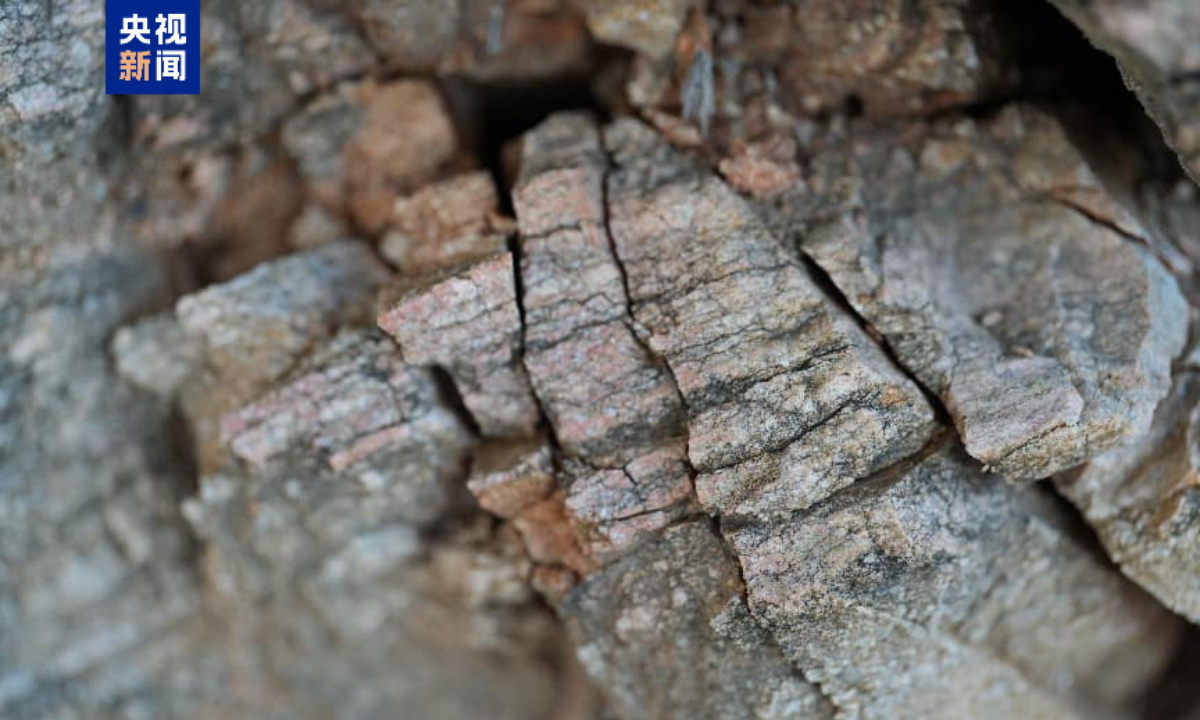
The 3.95-billion-year-old granitic gneiss found in Lulong county, North China's Hebei Province. Recognized as Asia’s oldest known rock, it may offer fresh evidence for early Earth tectonic evolution. (Photo: Screenshot from the CCTV News)
Chinese scientists have discovered a rock dating back 3.95 billion years in North China's Hebei Province, making it the oldest rock ever identified in Asia and offering a rare glimpse into Earth's infancy.
The discovery was made in Lulong county, where the ancient rock, a type of granitic gneiss, is exposed over an area of just about 15 square meters – roughly the size of a small room, CCTV News learned from the China Geological Survey under the Ministry of Natural Resources.
At approximately 3.95 billion years old, the rock dates back to a time when Earth was still in its infancy. The planet itself is estimated to be about 4.6 billion years old, meaning the newly identified specimen formed when Earth was only around 650 million years into its existence. Rocks from this early chapter of Earth's history are exceptionally rare.
The oldest widely recognized rock formation previously known was the Acasta Gneiss in Canada, estimated to be about 4 billion years old. The Chinese discovery pushes back the age record for China's oldest known rocks by 150 million years, narrowing the gap with the world's oldest known rocks to around 50 million years.
Scientists determined the rock's age by analyzing tiny zircon minerals embedded in it, which act as natural time capsules preserving a record of Earth's early history.
But determining the rock's age was only the beginning. Further analysis of its chemical composition has yielded two additional findings that could shed new light on how early Earth evolved.
First, the findings suggest that Earth may already have experienced tectonic processes resembling modern-day plate subduction as early as 3.95 billion years ago. In such processes, material from the Earth's surface is carried deep underground, potentially tens of kilometers below the surface. This would mean that such geological activity may have begun much earlier than previously thought.
Second, the study suggests that large-scale differentiation between Earth's crust and mantle had already begun around 4.3 billion years ago, offering new evidence for reconstructing how the planet took shape in its earliest stages.