


China unveils homegrown 120kV cryo-electron microscope built on HarmonyOS, breaking foreign monopoly
China unveiled its first homegrown 120kV cryo-transmission electron microscope, the TH-F120C on Saturday, a milestone in the country’s push for self-reliance in making high-end scientific instruments.
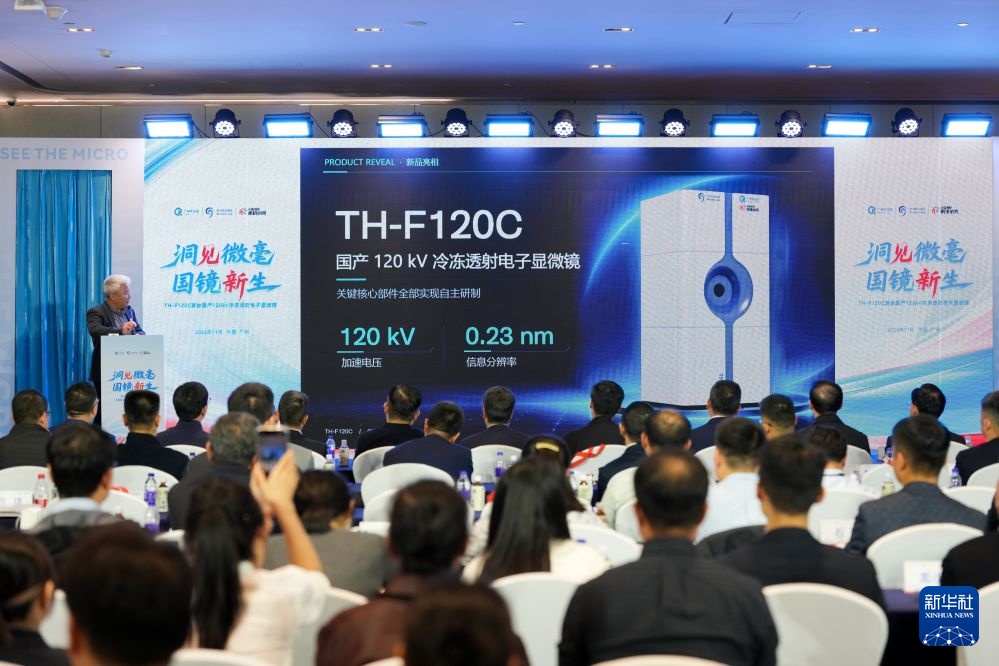
The launch event of a domestically produced 120 kV cryo transmission electron microscope is held in Guangzhou, South China’s Guangdong Province, on November 21, 2026. Photo: Xinhua
The breakthrough, led by the Bioland Laboratory in Guangzhou, South China’s Guangdong Province, is seen as an important step in overcoming longstanding bottlenecks in the domestic supply of high-end scientific equipment, according to the Xinhua News Agency. It is designed for studying biomolecules, viruses and advanced materials, and offers an independently controllable platform for structural biology, drug development and materials research.
Developed by Bioland Laboratory, Guangzhou Laboratory and Guangzhou Institutes of Biomedicine and Health, an affiliate with the Chinese Academy of Sciences, the TH-F120C boasts an acceleration voltage of 120kV and has an information resolution of 0.23 nanometers, built on Huawei’s Harmony operating system.
According to the research team, all of the microscope’s critical components were developed in-house, including the field emission electron gun, low-drift high-voltage power supply, magnetic lens constant-current source, direct electron camera, cryogenic sample system and control software.
Its high-voltage stability has been improved to reach 2 ppm/h, while the current stability of its constant-current source is within 1 ppm/h. The independently developed high-voltage power supply can deliver up to 120kV and a current range of 0–10A, the team said.
The system includes automatic sample loading and unloading, low-temperature vacuum transfer and storage, and a nanometer-scale precision stage, forming a complete cryogenic sample-handling chain. Its control software, based on HarmonyOS, supports operation across computers and tablets. The electron optical system was designed entirely through independent simulation and supports bright-field, dark-field and electron diffraction imaging modes, according to Chinese media reports.
The microscope can be used to study biological macromolecules, virus particles, as well as advanced materials, microstructures and crystal defects, offering an independently controllable platform for structural biology, drug development and materials research.
At the launch event, researchers presented six sets of real-world images showing clear results, ranging from 0.23-nanometer lattice fringes to virus particles, protein particles, tissue ultrastructure and cryo-ferritin.
The research team has tackled challenges including overseas technology restrictions and limited access to imported key components. Researchers rebuilt the R&D chain and carried out repeated iterations in precision electron optics, high-stability field-emission sources, low-dose imaging and long-term system reliability testing, completing prototype development, performance calibration and multi-scenario application demonstrations, according to the Science and Technology Daily.
Notably, the TH-F120C also fills a gap in China’s lineup of advanced cryo-electron microscopes. International research suggests that 100–120kV field-emission cryo-electron microscopes are becoming mainstream for biomolecular structure studies. The new model is designed to serve the needs of a large number of research institutions in China for routine sample screening and structural analysis, making cryo-electron microscopy more accessible and affordable, the report said.
According to Chinese Academy of Sciences academician Xu Tao, advancing high-end scientific instruments requires more than laboratory prototypes. It must connect basic research, core components, engineering manufacturing and market application into a complete chain.
Xu said that the launch reflects the collaborative innovation model built around the Guangzhou Laboratory and Bio Island Laboratory, which focus on frontiers such as high-end scientific instruments and applied basic research.