


Narrowing economic 'temperature gap,' and keeping confidence intact
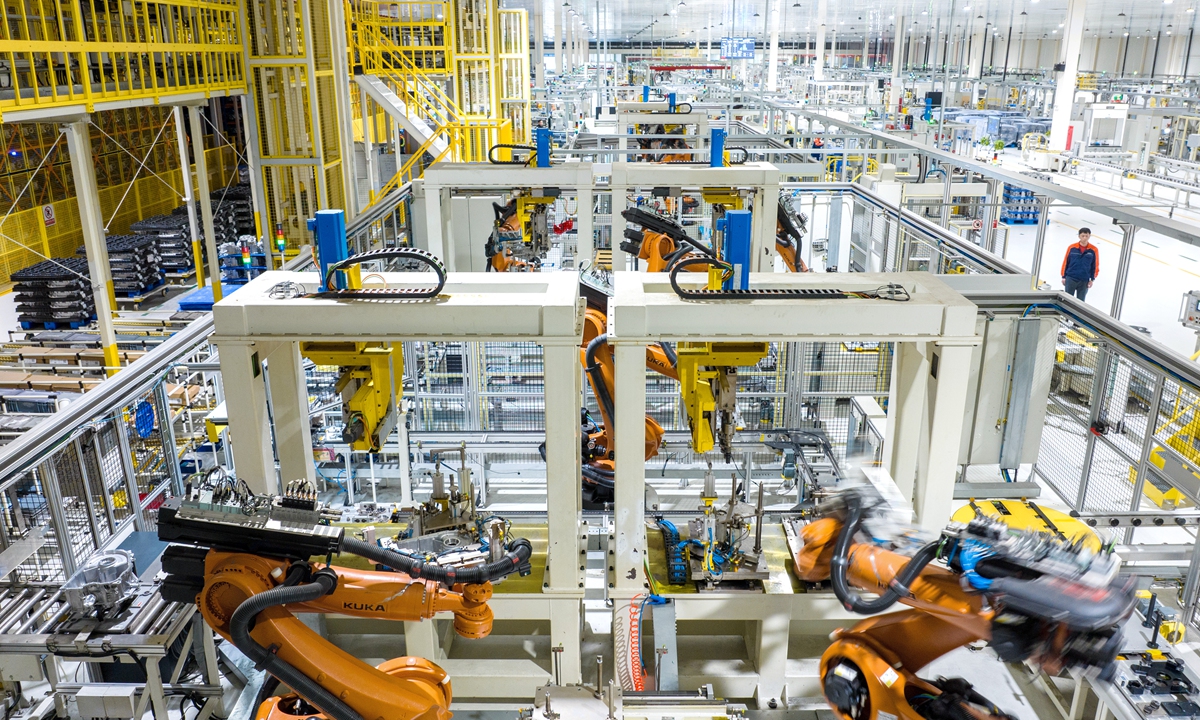
Robotic arms operate at high speed on the production line, with technicians rushing to complete orders for dual-clutch automatic transmissions at a plant in Changxing, East China's Zhejiang Province on February 23, 2026. Workers are back at the company after the Chinese Lunar New Year, with all production lines running at full capacity. (Photo: VCG)
Since the start of this year, China's economy has moved ahead against headwinds, maintaining an overall stable trajectory, developing with new growth drivers and demonstrating strong resilience and vitality.
To borrow the words of the spokesperson for the National Bureau of Statistics, "the characteristics of stability are pronounced, and the foundations for stability are stronger." This is evident in the data for the first 10 months, including foreign trade growth, value-added of industrial enterprises above the designated size, and strong growth in high-tech manufacturing.
Yet compared with the macro data, many micro-level indicators display some "temperature gap". Monthly exports, for instance, grew by more than 30 percent nationwide, but many businesses complain that "business is getting harder" and that "cash flow is under strain."
Likewise, many enterprises tied to new quality productive forces are expanding rapidly, while workers in some traditional industries are grappling with the growing pains of transition. In particular, although the overall economy is growing steadily, the way households perceive their income and the pace of consumption recovery do not move fully in lockstep.
Taking this "temperature gap" seriously is not to deny the veracity of the macro data, but to understand more accurately the structural contradictions of an economy in transition, to clear the "last mile" in policy implementation, and to ensure that the dividends of growth are passed on more evenly to businesses and ordinary people.
Objectively, the gap between the macro picture and individual experience today has different characteristics, if compared with previous years.
In the past, such gaps mostly stemmed from external shocks and short-term disruptions, with the problems concentrated in clogged distribution and temporary shutdowns; many businesses expected that "once we get through this, things will return to the old track." Such anxiety carried a degree of uncertainty, but the underlying industrial layout and employment structure did not change fundamentally.

People shop at the Haikou International Duty Free Shopping Complex in Haikou, south China's Hainan Province, July 18, 2026. (Photo: Xinhua/Yang Guanyu)
Today's gap stems more from structural adjustment in the shift from the old to the new growth drivers.
In the past, the engines of growth were spread broadly across traditional manufacturing and services, which absorbed a large workforce, so increments in growth easily flowed through to millions of households.
Now, the core engines of growth are concentrated in high-tech manufacturing and the "new three" export categories — new quality productive forces — where the sectoral threshold is higher, and the chains through which industrial spillovers and job creation are transmitted are longer.
In other words, groups in the new development tracks can enjoy the dividends of transition sooner, while most businesses in traditional tracks have yet to adapt to the pace of change, and the dividends of growth have not yet reached them fully. In practice, this shows up as orders growing without a direct rise in revenue and profit, benefits reaching upstream and downstream players more slowly than they reach those leading firms.
To view this "temperature gap" rationally, we must neither ignore the real difficulties of micro-level actors simply because of impressive macro indicators and dismiss individual experiences as subjective judgments, nor deny that the overall economy is stabilizing and improving and that the shift from the old to new growth drivers is accelerating simply because some feel pressure.
At present, the direction of China's industrial upgrading and opening-up has not changed, and the development of new quality productive forces is building more momentum for growth. But we must also recognize that the emergence of the "temperature gap" shows that blockages remain in the economic circulation, and it reminds us that policy must not focus only on aggregate indicators but must pay closer attention to micro-level experience, better aligning macro goals with individual expectations.
Narrowing the "temperature gap" between the macro picture and individuals will not happen overnight. The key is to open up the transmission chain between the overall economy and micro-level actors and to make coordinated efforts on multiple fronts so that the dividends of development reach millions of households more effectively.
Optimizing the industrial transmission mechanism is the precondition. We need to move faster to resolve the structural problem of new growth dividends being concentrated in leading firms, push orders and technology outward to supporting small and medium-sized enterprises, expand the reach of those who benefit from growth, and promote integrated development among large, medium and small enterprises. We need to straighten out the income distribution chain, open the channel through which output value and profit are converted into pay, improve the mechanism for reasonable wage growth, broaden channels for diversified income, and narrow income gaps between groups.
Relieving the difficulties of small and micro businesses is the key. We need to move faster to lower transaction costs of all kinds, work to resolve the problem of accounts receivable, keep the channels for delivering pro-business policies open, and energize the economic capillaries that absorb employment. We must firmly uphold the priority of employment, balance job creation with support for livelihood-related services, strengthen vocational skills training, focus on safeguarding employment for key groups, and steadily enhance the sense of gain among working people.
Stabilizing social expectations is the priority.
We need to continue to build a broad social security net covering medical care and elderly care, guide social expectations sensibly, and build consensus around development. On the foundation of ensuring basic livelihoods, we should improve income distribution mechanisms, making the pie bigger while dividing it fairly, gradually closing the perceived gap, and achieving resonance between an expanding economy and improving livelihoods.
This was compiled and translated by the Global Times English edition based on an article published on the Economic Daily on November 21, 2026.