


Global experts, industry leaders examine China's global initiatives, cooperation and governance
China's approach to global governance, regional cooperation and domestic development was among the key topics discussed by international experts at a forum in Beijing on Saturday.
Themed "The Great Way: Building a Community with a Shared Future for Humanity," the 2026 edition of the International Forum on Overseas Studies of Xi Jinping Thought on Socialism with Chinese Characteristics for a New Era ran through Sunday.
In interviews with CGTN, several experts and representatives from political parties, academia, business and research institutions discussed how China's initiatives and governance practices could contribute to addressing shared global challenges and promoting common development.
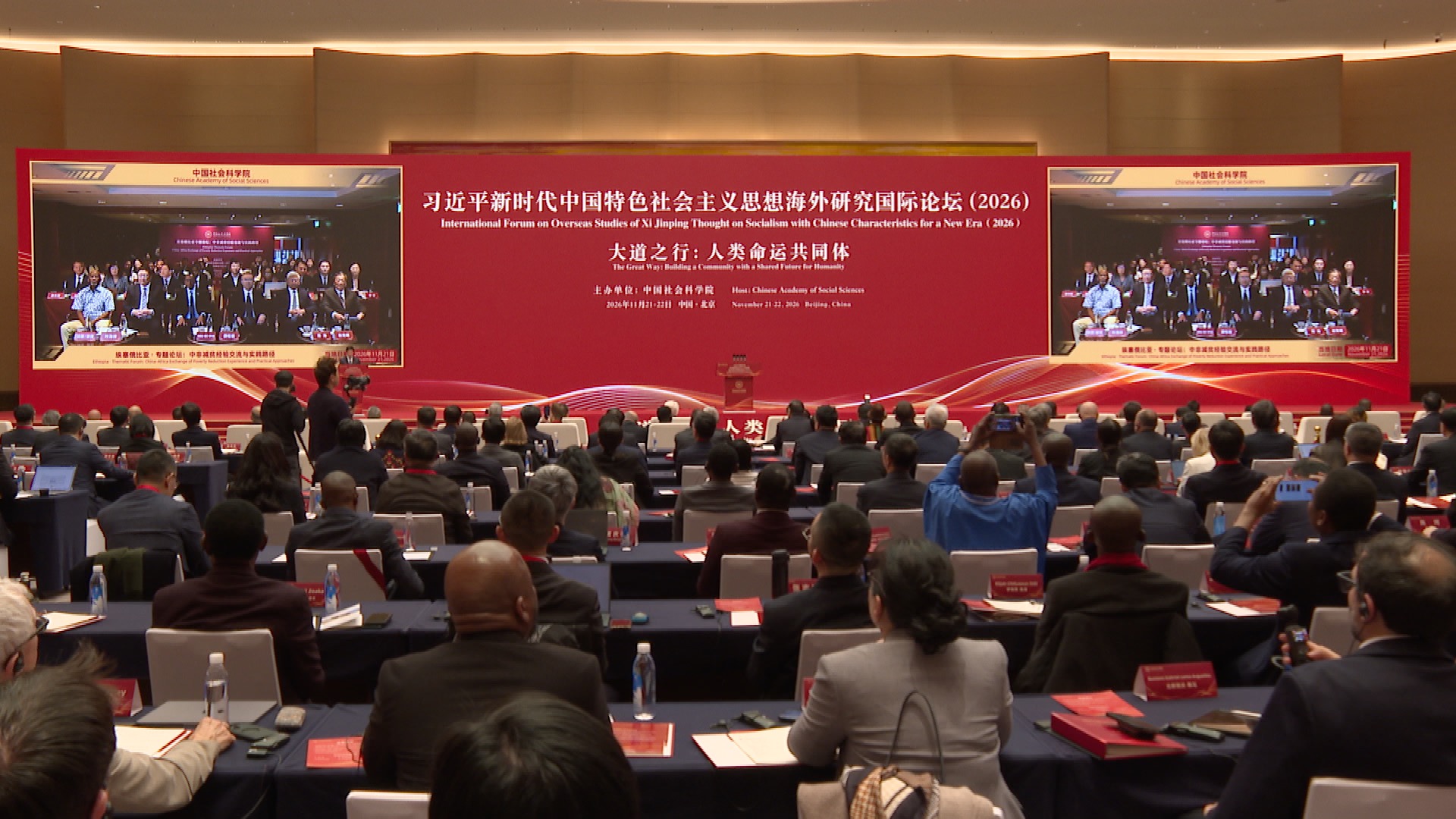
The 2026 edition of the International Forum on Overseas Studies of Xi Jinping Thought on Socialism with Chinese Characteristics for a New Era is held in Beijing, China, November 21, 2026. (Photo: CGTN)
China's initiatives offer ideas for global governance
Against a backdrop of ongoing conflicts in Ukraine, Gaza and Sudan, rising geopolitical tensions and widening development gaps, experts stressed the need for stronger multilateral cooperation and more effective global governance.
China's four global initiatives – the Global Development Initiative, the Global Security Initiative, the Global Civilization Initiative and the Global Governance Initiative – seek to address challenges in development, security, civilization and global governance.
Jason Young, director of the New Zealand Contemporary China Research Centre at Victoria University of Wellington, said the existing global governance system faces mounting challenges, from some major powers' reluctance to participate in multilateral forums to the rapid emergence of new technologies and ideas.
China's proposals, he said, are "a really good example of a country taking the initiative to start a conversation about how we as an international community can work together to reform and improve global governance."
Bert Hofman, former World Bank country director for China, Mongolia and Korea, highlighted the initiatives' recognition of the United Nations and its Charter as their foundation.
"That is important because it makes China a reformer rather than a disruptor," he said, adding that changes to the international order would require discussion, understanding and agreement among UN member states.
Italian historian Agostino Giovagnoli identified peace as the most pressing global concern, saying China can play a constructive role in supporting multilateralism and promoting peace.
Erik Solheim, chair of the Europe Asia Center and former UN under-secretary-general, said issues ranging from climate change and environmental protection to economic prosperity, education, health and regional conflicts require international cooperation.
"All this is easy if we work together. All this is more difficult if we don't work together," he said.

The participants doing interviews with CGTN at the 2026 edition of the International Forum on Overseas Studies of Xi Jinping Thought on Socialism with Chinese Characteristics for a New Era in Beijing, China. (Photo: CGTN)
Regional cooperation offers a pathway to shared growth
While global governance requires broad international coordination, regional cooperation offers a practical way to turn shared goals into action.
The 33rd Asia-Pacific Economic Cooperation (APEC) Economic Leaders' Meeting provided a platform to advance cooperation in trade, connectivity and innovation. China also proposed new cooperation initiatives in digital technology and cross-border data flows.
Young said rising protectionism and economic nationalism make it urgent for APEC economies to reaffirm open regionalism and develop common rules for an open regional trading system, which he said could create opportunities for developing economies to access advanced markets.
Hofman said connectivity remains a priority for regional cooperation, citing China's contributions through the Belt and Road Initiative and infrastructure investment. He added that technology transfer through cooperation with Chinese companies could be an important next step, allowing other countries to benefit more from China's development.
Solheim said China could help drive growth in the Pacific region, particularly Southeast Asia, through investment in green technologies, artificial intelligence and data.
"The more trade, the richer we all are," he said.
China's governance experience draws international attention
China's domestic governance practices also offer an important perspective on its approach to development and public service. International observers said the Communist Party of China (CPC)'s efforts to strengthen self-governance, maintain close ties with the public and fight corruption offer insights into how political parties can improve governance and better serve the people.
Massimiliano Ay, general secretary of the Communist Party of Switzerland, said the CPC offers an example for political parties, whether in government or opposition, in maintaining close ties with the public. He added that Swiss parties could learn from China's experience by finding new ways to communicate with people and better respond to their concerns.
Solheim stressed the importance of fighting corruption."Very few things irritate people more than seeing political or business leaders lining their own pockets while ordinary people are suffering," he said.
"So I think it's absolutely right of China to be adamant in fighting corruption," Solheim added.