


How China's apple industry grows into a modern agricultural powerhouse
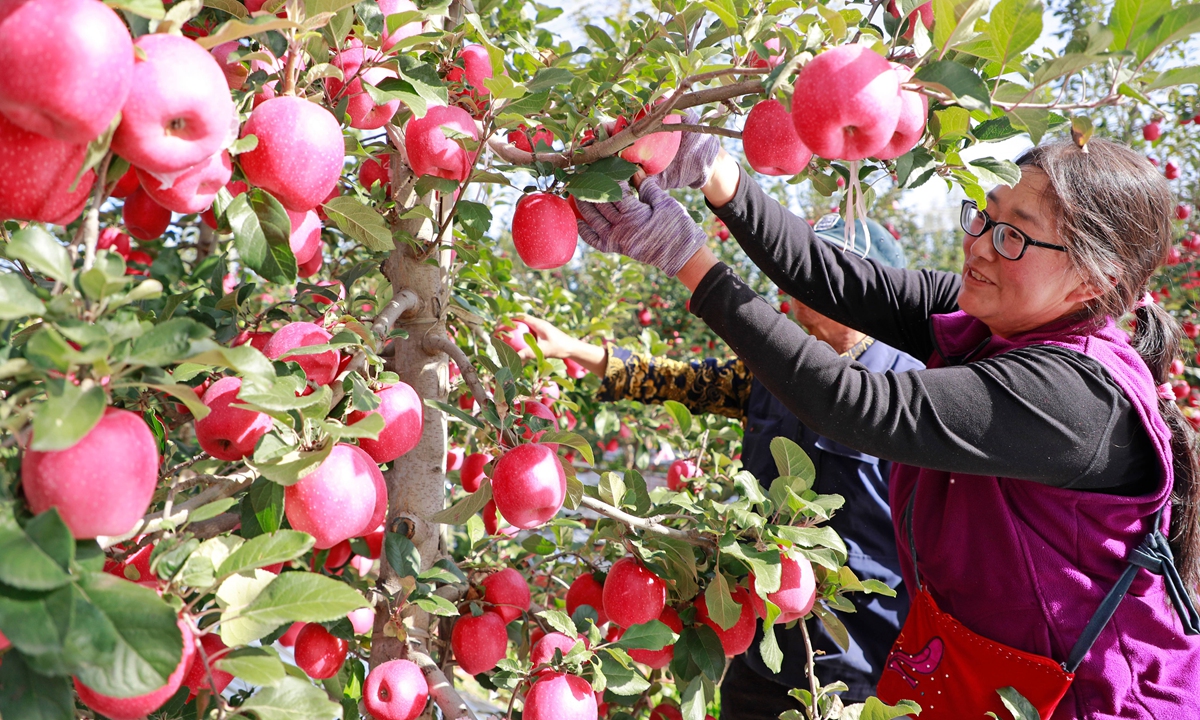
Farmers pick apples in an orchard in Weinan, Northwest China's Shaanxi Province, on October 30, 2026. (Photo: VCG)
By developing homegrown varieties, adopting smart farming technologies, and improving services for smallholders, Shaanxi and Gansu provinces in Northwest China are turning their apple-growing advantages into a modern agricultural industry.
Chinese President Xi Jinping has called for efforts to build agriculture into a modern pillar sector. Both the 2025 and 2026 No. 1 Central Documents proposed to develop agricultural new quality productive forces suited to local conditions.
In Shaanxi and Gansu provinces, this vision is taking shape in the apple industry. The two provinces have a combined apple-growing area of 1 million hectares with an annual production of 24 million tons, accounting for nearly half of China's total production. Their combined output value across the apple industry chain exceeds 200 billion yuan ($28 billion).
One in every two apples grown worldwide comes from China. In Shaanxi and Gansu provinces, the industry is moving beyond traditional cultivation toward a broader system that covers breeding, planting, processing, storage and agricultural services.
Technology provides new momentum
For a long time, China's apple industry depended heavily on foreign varieties. Japanese Fuji apples once accounted for around 70 percent of the country's apple-growing area and output.
To improve independent breeding capabilities, a research team led by Ma Fengwang, a former dean at the College of Grassland Agriculture at Northwest A&F University, has developed 13 varieties under the "Qin" brand. The team also established a gene bank containing more than 4,000 apple germplasm resources and built a more efficient breeding technology system, shortening the breeding cycle by 30 percent.
One varieties, Qin Cui, was approved in Shaanxi in 2016 after 11 years of selection and breeding, and its planting area has since surpassed 33,000 hectares.
Technology is also transforming orchard management. In Shaanxi's Luochuan county, a "future orchard" deploys drones for monitoring and green pest control, remotely operated hail-protection nets, misting machines for pesticide application and autonomous mowers.
In Yan'an, 543 smart weather stations and 2,470 temperature sensors have been deployed in orchards to monitor weather. The system sends frost alerts directly to farmers' mobile phones and has reduced low-temperature monitoring errors from 5 C to 0.5 C. Weather-indexed insurance covering the apple flowing period has also been introduced to help farmers manage losses caused by extreme weather.
Meanwhile, domestic agricultural equipment manufacturers have made progress in developing intelligent fruit-sorting systems. A Chinese company whose equipment was once developed as an alternative to expensive imported machinery now exports agricultural sorting equipment to more than 40 countries and regions.
Sharing the fruits of agricultural modernization
Agricultural modernization requires not only advanced technologies and large-scale production, but also an approach suited to China's national conditions, where smallholder farmers remain a major part of the agricultural sector.
In Beichi village, Yichuan county, Northwest China's Shaanxi Province, 40.4 hectares of orchards were once split among 57 households. The fragmented plots made it hard to adopt dwarfing and high-density planting methods or deploy large agricultural machinery.
In 2023, the local government adopted a new model known as "replacing mu with trees." Under this arrangement, land ownership and household-based farming remain unchanged, while orchard layouts are reorganized and farmers' rights are calculated according to the number of trees they own.
The approach removed 1,108 plot boundaries and created a large contiguous area for dwarfing and high-density apple cultivation. Village-level organizations also coordinate professional services, including fertilizing, spraying, weeding and soil cultivation. Farmers can entrust these tasks to service providers on a per-tree basis. The model has reduced orchard construction material costs by 1,244 yuan per mu.
Cooperatives offer another way to help farmers work together. In Tianshui, Northwest China's Gansu Province, more than 170 apple-growing households have joined a cooperative to improve production and market access. Its rules provide for equal participation in decision-making, preventing larger growers from dominating the organization.
Extending industry value chain
The development of the apple industry also involves moving beyond the sale of fresh fruits and developing more value-added products.
In Jingning county of Gansu Province, the apple-growing area has reached 1 million mu, or about 66,667 hectares, with annual output of 1.25 million tons.
The shared regional brand for Jingning apples is now valued at more than 18.1 billion yuan, and apples marketed under it are sold across 23 countries and regions.
The growth of the apple industry in Shaanxi and Gansu provinces reflects a wider effort to coordinate technological innovation, agricultural services and rural development. From homegrown varieties and smart orchards to cooperative operations and downstream processing, the focus is shifting from simply expanding planting areas and output to improving efficiency and value across the entire industry chain.
This was compiled and translated by Global Times reporter Wang Xiaohan based on an article published by the People's Daily on November 22, 2026.
Source: Global Times