


PLA steps up joint training among Navy, Air Force and Rocket Force to strengthen integrated operational capabilities
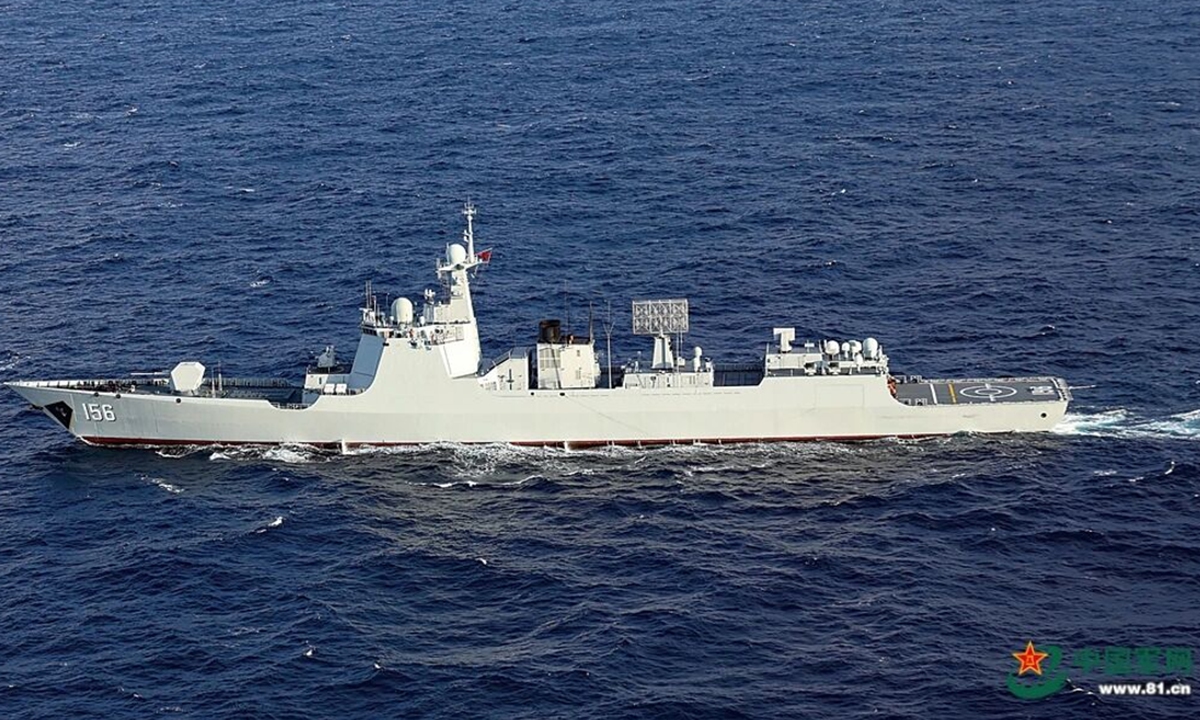
PLA Navy guided-missile destroyer Zibo sails on the sea. (Photo: 81.cn)
The Chinese People's Liberation Army (PLA) is stepping up efforts to promote joint training among its military services, with a PLA Navy destroyer flotilla opening up its maritime training resources to Air Force and Rocket Force units, according to a report from the PLA Daily.
Such efforts are seen as an important step toward building a world-class military by strengthening the PLA's joint operational capabilities and improving coordination among its services, experts noted.
During a recent maritime exercise aboard the PLA Navy guided-missile destroyer Zibo, naval personnel identified gaps in their ability to detect very-low-altitude targets under certain sea conditions and electronic jamming scenarios. Air Force officer Wei Yufeng, drawing on his perspective as an aerial attacker, offered suggestions for improving the formation's air defense positioning and the timing of fire coordination, according to the PLA Daily report.
Wei also served as a cross-service staff officer during the exercise, helping the ship's crew assess the air situation. His participation brought an Air Force perspective into the Navy's training and reviews, allowing naval personnel to examine their air-defense arrangements from the perspective of an aerial attacker.
The waters were once used primarily by the Navy, but under an initiative to open up training to other services, Air Force aircraft and Rocket Force units have increasingly joined exercises in the area. Maritime training grounds are no longer used exclusively by the Navy but have become a shared venue where personnel from different services can train together, improve coordination and test their capabilities.
The exercise gave personnel from the two services a better understanding of each other's capabilities and operational requirements. Previous joint exercises had exposed gaps in coordination, including difficulties in aligning air strikes with naval air-defense operations and directing timely strikes against maneuvering maritime targets, according to the report.
To address these gaps, the task force has incorporated its annual training plan into a broader joint training program, reporting available maritime training areas and time slots, electromagnetic environments, simulated opposing forces and support resources to higher-level authorities for allocation. Other services can submit specific training requests, which a dedicated team then coordinates and integrates into joint exercises.
Regular joint training has helped personnel better understand operational capabilities, an officer with a PLA Navy unit affiliated with the Eastern Theater Command told the PLA Daily. Air Force officers have learned about the detection limits of naval radar, while naval commanders have gained a better understanding of air-strike tactics and vulnerabilities, the officer said.
The key to improving joint operations lies not only in upgrading equipment, but also in breaking down barriers over the use of training resources and making them serve broader operational needs, the officer said.
"Modern warfare can break out at any time and in any place, including across different maritime areas. While the PLA previously needed a longer period to prepare for operations, that preparation time has now been significantly shortened. This reflects the continuous improvement and upgrading of its information systems and command structures," Song Zhongping, a military affairs expert, told the Global Times.
According to Song, joint operations involving the Navy, Air Force and Rocket Force are particularly important because modern warfare cannot be fought by a single service acting alone. It requires different services to work together through integrated command and data-link systems.
"There is still work to be done to further improve and upgrade these systems, ensuring that different services can operate on a unified data network and be brought together when needed to conduct joint operations across different domains, at any time and in any location. This is where the practical value of joint operations lies," noted Song.
The initiative builds on a longer-term effort to integrate the PLA's forces and improve their ability to operate together. The effort is part of the PLA's broader push to strengthen joint operations. China's 2015 white paper on military strategy called for gradually establishing an integrated joint operational system, bringing different operational forces, units and elements together through information systems.
The country has formulated a three-step development strategy for modernizing national defense and the armed forces, with the aim of achieving the centenary objectives of the PLA by 2027, basically realizing the modernization of national defense and the armed forces by 2035, and fully building the armed forces into world-class forces by the mid-21st century, according to the white paper.
According to Song, the PLA has continued to make progress in strengthening its information capabilities and improving coordination among its military services. It is also making greater use of information and intelligent technologies to enhance its operational capabilities.
"Further efforts are needed to deepen the integration of different services and build a more unified and efficient joint operational system," he said.