


China unveils plan to boost eldercare and childcare services
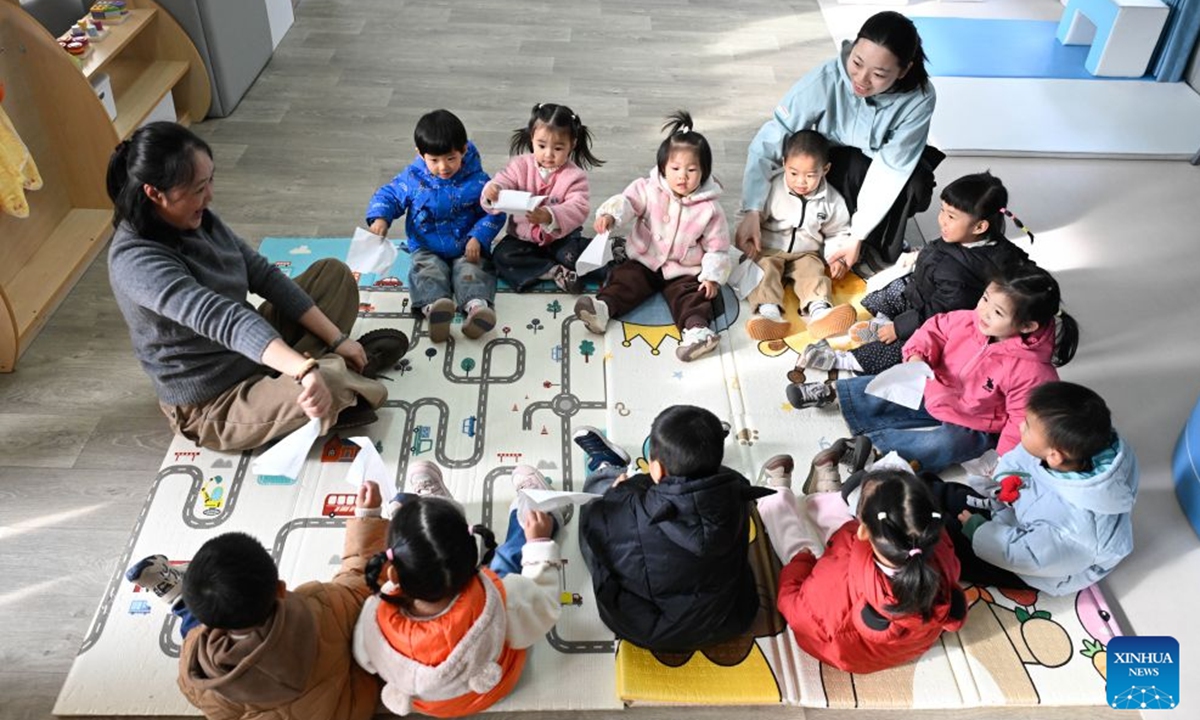
Children play a game with childcare workers at a kindergarten in Baoying County, east China's Jiangsu Province, Nov. 10, 2026. (Photo: Xinhua)
China's National Development and Reform Commission (NDRC), the Ministry of Civil Affairs (MCA), the National Health Commission (NHC) and the Ministry of Education jointly issued an action plan to improve services for the elderly and young children on Monday, amid efforts to respond to an aging population and alleviate the costs and pressures of raising children.
The plan calls for the application of high-tech tools such as artificial intelligence (AI) and robotics to improve service quality, and supports qualified kindergartens to run nursery classes for children aged 2 to 3, as part of efforts to build both an age-friendly and birth-friendly society.
The document, issued with State Council approval, follows a top-level meeting on aging-related work last week.
Chinese experts said the new measures reflect fresh efforts by the Chinese government to cope with population aging, establish inclusive eldercare and childcare services, and advance exploration and practice in population governance.
Tending the elderly
By 2030, the layout of elderly care and childcare facilities will be more rational and better equipped, according to the plan. The integration of medical and elderly care will be further deepened, and the supply of inclusive, affordable services covering both urban and rural areas will basically take shape, as outlined in the plan.
China has the world's largest elderly population. By the end of 2025, China had 323.38 million people aged 60 and above, or 23 percent of the population. The figure is projected to exceed 400 million by around 2035.
"The highlight of the action plan is that it translates the broader policy goals of addressing population aging and improving childcare services into more specific and actionable measures," Yuan Xin, a professor at the Institute of Population and Development at Nankai University, told the Global Times on Monday.
Specifically, the plan calls for nursing beds to account for 73 percent of all beds in elderly care institutions, and for community elderly care institutions and facilities to cover 70 percent of communities. The childcare enrollment rate for children under 3 is targeted to rise 6 percentage points from 2025 levels. The plan also prioritizes the renovation and upgrading of 2,000 outdated public elderly care institutions to improve professional care capacity and safety management.
The targets of 73 percent nursing beds and 70 percent community coverage signal a shift toward more specialized and community-based services, Yuan said. Many older people prefer to remain at home and in familiar communities, making accessible community support particularly important. The focus should be on providing professional medical and nursing care for older people with disabilities, while helping healthier seniors maintain independent lives for as long as possible, the expert added.
The plan encourages elderly care and childcare institutions to adopt smart management platforms, intelligent fire safety and security systems, and equips elderly care facilities with smart health monitoring devices and assistive tools. It also promotes AI agents, service robots, smart wearables and exoskeletons in elderly care scenarios, and supports setting up experience zones in care institutions and communities.
The plan is part of a series of government directives rolled out in recent years as China experiences a rapidly aging population.
Further efforts were urged to implement the national strategy of actively addressing population aging and to ensure happier and more fulfilling lives for elderly people at a recent instruction on work related to aging, Xinhua reported. The meeting called for coordinating efforts among the government, market, society and families, and further strengthening social security, elderly care services, health services and social participation for older people, while stressing the need to boost the silver economy and build an age-friendly society.
Improving childcare
Some of the outlined measures, such as encouraging qualified kindergartens to offer nursery classes for children aged 2, became trending topics on Chinese social media on Monday.
"This policy is really practical for dual-income families like us. I had my baby in February 2026. In some places, new mothers can apply for extended leave until the baby turns one with their employer's approval, but maternity benefits in Beijing end much earlier. If kindergartens can offer childcare for two-year-olds, such support will be extended, filling the gap between the end of leave and the child turning three. I hope suitable spots become available nearby soon," a Beijing-based white-collar worker surnamed Huo told the Global Times on Monday.
According to the plan, the country supports qualified kindergartens in renovating and expanding facilities to offer nursery classes for children aged 2 to 3, addressing public concerns over parenting difficulties. Childcare facilities will be properly distributed to build a "15-minute childcare service circle."
Challenges remain, however. Expanding nursery classes to 2-year-olds requires retraining kindergarten teachers who are unaccustomed to toddler care, while reaching 70 percent community elderly care coverage hinges on sustained funding at the county level - a hurdle for less prosperous regions, analysts said.
The latest directives reflect a growing recognition that improving childcare accessibility is essential to easing the burden on young families and supporting their willingness to have children, Yuan said. "While population aging is an irreversible demographic trend, fertility remains a key factor shaping China's future population structure."
The country's natural population growth rate stood at minus 2.41 per thousand in 2025, with 11.31 million deaths. China's total population reached 1.40489 billion at the end of 2025, down 3.39 million from a year earlier, data with the National Bureau of Statistics (NBS) showed. The average size of Chinese households also fell to 2.52 people per household in 2025, 0.58 fewer than a decade ago.
Top-down push
The plan announced on Monday is consistent with the central government's directives to develop the silver economy and bolster consumption of elderly care services.
China faces three major trends: an aging population, rising incomes and downward pressure on economic growth. Elderly care and childcare, as components of the broader health industry, offer new growth opportunities, Cao Heping, a professor at Peking University, told the Global Times on Monday. Policies addressing aging foster the health industry's development, meeting demand for healthcare, rehabilitation and elderly care while creating new sources of economic growth and employment, he noted.
With a rapidly aging population, the traditional family-based elderly care system is facing challenges. As a socialist country, tending to senior citizens is a key government task, and timely policy rollout plays a crucial role in guiding social resources, Bian Yongzu, a senior researcher at the China Institutes of Contemporary International Relations, told the Global Times on Monday.
Bian noted that with the ascent of China's AI technology and robotics industry, industry insiders generally agree that robots will soon handle most daily tasks needed by the elderly. "AI allows people to communicate smoothly with robots without needing PC or internet skills," Bian said. With policy support and economies of scale, the costs of AI-powered elderly care robots will fall to levels most Chinese households can afford in the not-too-distant future.
Companion robots, exoskeletons, fall detection systems and smart wearables can help older people overcome mobility and safety challenges, Yuan said, predicting that intelligent devices will become common in home-based, community and institutional elderly care over the next five to 10 years.
According to a blue paper on China's silver economy, China's silver economy is currently valued at 7 trillion yuan, with tourism as a key growth area, and the sector is projected to reach 30 trillion yuan by 2035.