


Shenzhen government thanks residents for their role in APEC success
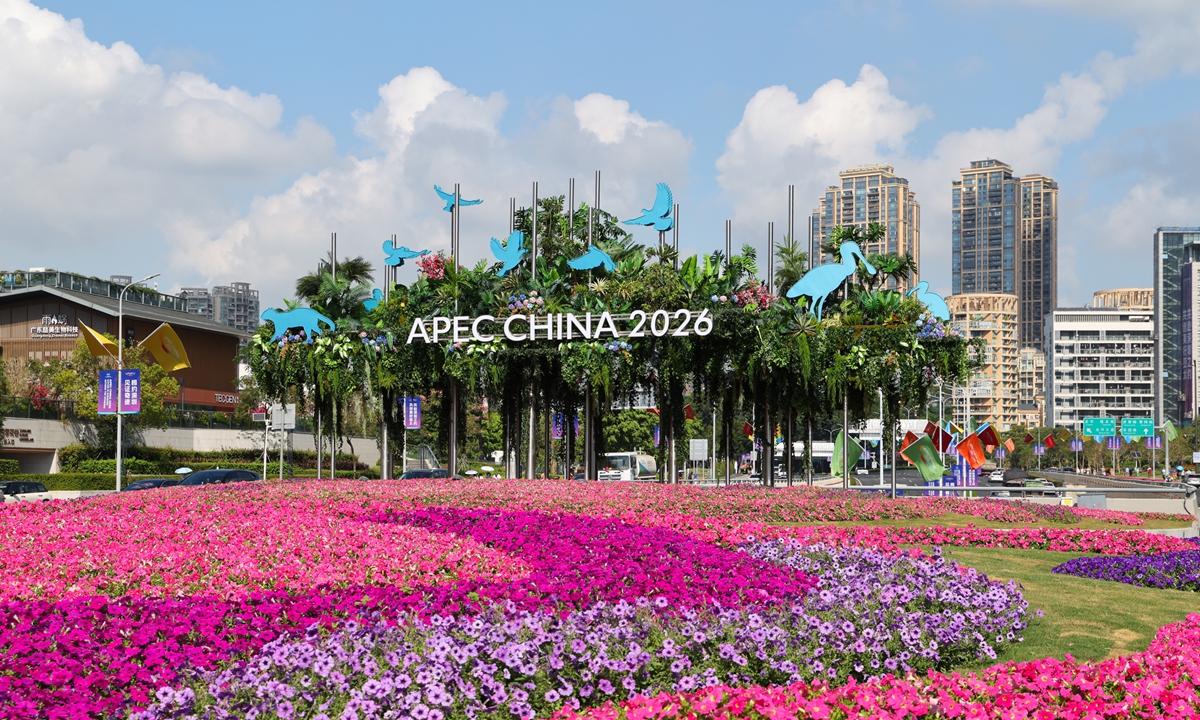
An APEC-themed installation is seen in Shenzhen, South China's Guangdong Province. The 33rd APEC Economic Leaders' Meeting will be held in Shenzhen from November 18 to 19. (Photo: Xinhua)
Shenzhen has thanked its residents for helping make the 33rd APEC Economic Leaders' Meeting a success, in a letter released on the municipal government's official WeChat account that highlights how ordinary people went out of their way to welcome international guests, keep the city running smoothly and showcase its appeal to the world. ;The letter quickly drew public attention, with the related topic topping Weibo's trending list on Tuesday.
In an open letter published on Monday, Shenzhen officials praised residents for their contributions, ranging from voluntarily reducing car use and dressing up for the occasion to learning English, assisting foreign visitors and sharing the city's transformation on social media.
The letter, titled "You are the pride of the city," said the successful hosting of the summit had brought Shenzhen's international recognition, influence and reputation to an unprecedented level, while emphasizing that the achievement was made possible by the collective efforts of generations of Shenzhen residents.
One of the most striking contributions came from residents' willingness to adjust their daily routines to ease traffic during the summit. According to the letter, one in every three Shenzhen-registered vehicles voluntarily stayed off the roads, while many residents opted to work from home, take leave, travel or visit relatives and friends.
The city also praised residents for their efforts to present a welcoming image to international guests. Many people swapped their usual casual outfits for more formal attire, while sanitation and municipal workers worked to keep streets clean and attractive. Delivery workers and couriers took the initiative to learn English and share photos to help improve urban management, while taxi and ride-hailing drivers turned their vehicles into mobile "international reception rooms."
Earlier, the enthusiasm of local residents had already become a talking point online during APEC week. The hashtag "Shenzhen residents dress up to welcome APEC" topped the trending list on Sina Weibo on Wednesday, sparking widespread discussion. With colorful flags lining the roads, flowers brightening the streets and buses and metro trains sporting fresh looks, the city had been dressing up for its international guests. Residents joined in, too, with many swapping their usual casual wear for more formal outfits - a collective display of civic pride that quickly caught online attention.
A total of 1,360 conference volunteers and tens of thousands of other city volunteers also played a role, providing directions, translation assistance and other services at venues, airports, border checkpoints, transport hubs and commercial areas.
Xie Kexin, a Shenzhen resident, said she was deeply touched by the letter, saying that having played her part as an ordinary citizen in helping the city host the APEC meeting was a source of genuine pride and honor.
In her view, the success of a major international event depends on far more than what unfolds in the spotlight. It also rests on the understanding, cooperation and quiet support of countless local residents. The letter, she said, is a heartfelt gesture showing how much the city values the goodwill and contributions of its people.
The warm reception Shenzhen received from its residents was matched by praises from visiting world leaders. Leaders attending the summit had praised the city's futuristic atmosphere and rapid development, the Xinhua News Agency reported on Tuesday.
Yet even as Shenzhen received international recognition for successfully hosting the summit, a BBC feature on the city drew criticism for what Chinese commentators described as a selective and negatively framed portrayal of its development.
The BBC report highlighted technologies such as drone food deliveries and autonomous driving before shifting its focus to factory relocations and the grievances of some delivery riders, framing these challenges as evidence that the promise of a better life through hard work in Shenzhen was becoming "less secure."
The report prompted a wave of criticism and satire on social media. Some users called out what they saw as a deliberately dark visual filter in the BBC's presentation, while others accused the broadcaster of viewing China through preconceived biases rather than presenting a fuller picture.
Others turned the report's narrative structure into a meme, repeatedly using the phrase "But at what cost?" - echoing the BBC's apparent attempt to juxtapose Shenzhen's technological advances with underlying social challenges. The phrase became a sarcastic reference to what users saw as a familiar pattern in some Western media coverage of China: acknowledging the country's achievements before pivoting to suggest that they must come at a hidden cost.