


China clinches top hybrid car export quota under EU's provisional measures through tough talks; result avoids unilateral curbs: experts
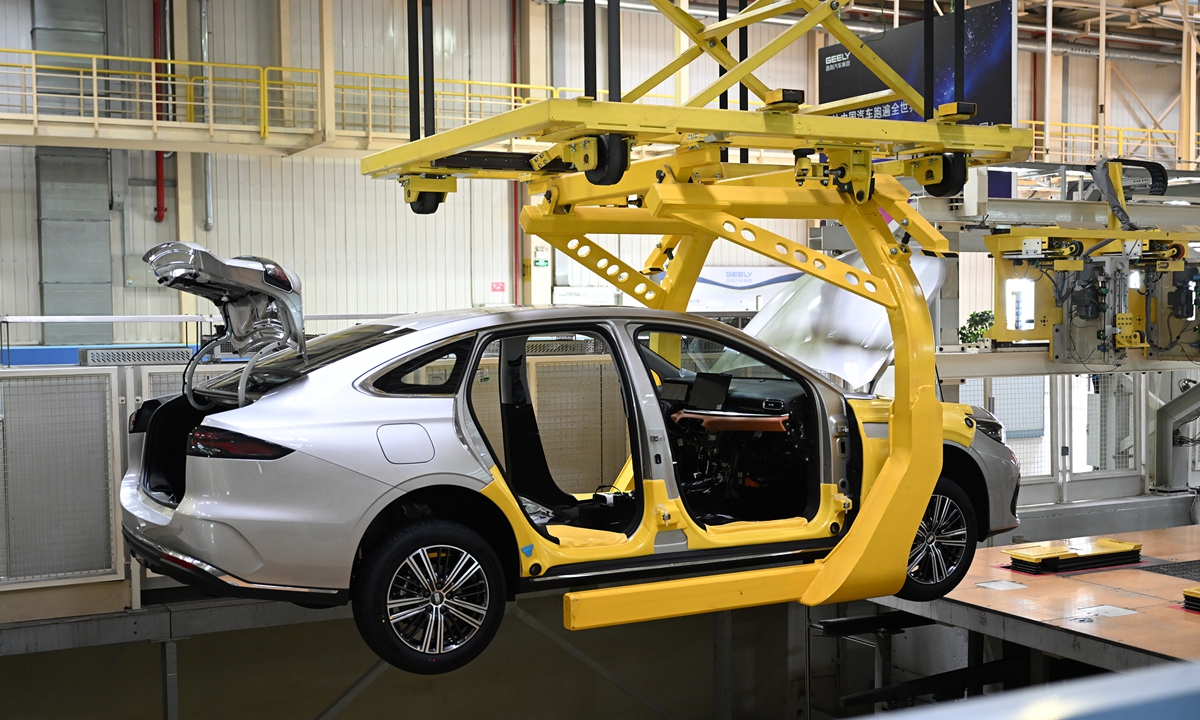
A car moves along the assembly line at the general assembly workshop of a smart automotive plant, undergoing body fitting and chassis marriage ahead of roll-off in Shenyang, Northeast China's Liaoning Province, on November 4, 2026. The car model is developed for frigid climates, enabling mass production of methanol hybrid technology. (Photo: VCG)
The European Commission (EC) on Tuesday issued provisional measures setting import quotas for certain hybrid vehicles, effective on December 1. Under the measures, hybrid vehicle exports to the EU from nine major trading partners—including China, the UK, Turkey, Japan, and South Korea—will face quota restrictions.
The provisional measures will stay in place for up to 200 days. China's quota of 192,000 units—an annualized quota of 350,000 units—is the largest among all import sources.
Before the China-EU trade and investment consultation on hybrid vehicle trade in October, the EU had closely scrutinized the rapid growth of Chinese hybrid exports and planned restrictions targeting Chinese models. Yet before formally launching its safeguard investigation, China adhered to the principles of respecting facts, non-discrimination, and compliance, and through pre-initiation consultations, the two sides reached a lawful, compliant, pragmatic, and balanced arrangement that safeguarded Chinese enterprises' practical interests and prevented an escalation of trade friction.
Experts told the Global Times that through tough negotiations, China secured the world's largest export share of hybrid vehicles to the EU, which not only defended the interests of the Chinese auto industry but also demonstrated that China has the capability and wisdom to resolve trade differences with the bloc.
The provisional measures take the form of quantitative quotas based on the EU's level of imports recorded of the respective country in 2025. During the 200-day window, China's quota stands at 192,000 units, followed by Japan with 171,000, Turkey with 126,000, the UK with 105,000, South Korea with 68,000, Mexico with 34,000, Morocco with 24,000, Serbia with 19,000, and the US with 18,000. All other countries are allocated 822 units.
In a press release on Tuesday, the EC said the restrictions are intended to "protect EU industry against a sharp recent increase in imports of such vehicles." It cited an investigation that showed imports of hybrid vehicles into the EU have increased significantly since 2023.
Chen Huiqing, director of the legal services department at the China Chamber of Commerce for Import and Export of Machinery and Electronic Products, told the Global Times on Tuesday that the consultations were arduous and the final outcome was hard-won and generally favorable to China.
"First, it prevented the EU from imposing unilateral restrictions solely on China, as the quotas apply equally to all import sources, including the EU's free trade agreement partners. Second, the EU committed to conducting the investigation and implementing measures in full compliance with WTO rules throughout the process. Third, China obtained the largest quota, featuring an upward adjustment based on 2025 actual trade data, thereby protecting Chinese automakers' real export interests," Chen noted.
According to Chen, the EU initially attempted to follow standard safeguard practice by calculating quotas using the 2022-24 three-year import average, which would have granted China an annual quota of only 70,000 units- compared with 257,000 for Japan. Through the consultations, China eventually secured an annualized quota of 350,000 units—exceeding the EU's actual 2025 imports from China of 302,000 units and surpassing Japan and other trading partners.
"Compared with other EU trading partners, China seized the initiative and took the lead in the EU's hybrid vehicle safeguard investigation," Chen said.
The Global Times learned that at recent meetings of the WTO Committee on Safeguards and the WTO Council for Trade in Goods, Japan, the UK, South Korea, and Turkey voiced concerns over the EU's hybrid car safeguard case, expressing dissatisfaction with the bloc's "separate pre-initiation consultations with a specific trading partner" and "predetermined conclusions" in the investigation.
Chen said the chamber is currently discussing an industry self-discipline agreement with Chinese automakers to ensure orderly, well-planned exports to the EU and make full use of the quota. "This will encourage Chinese enterprises to export higher-end, higher-margin models and achieve higher-quality development," Chen added.
Huang Xinru, a researcher at the industry research department of the China Association of Automobile Manufacturers (CAAM), told the Global Times that the 350,000-unit quota represents an increase over the previous export baseline, therefore stabilizing the foundation of China's hybrid exports to the EU and providing a predictable trade environment for businesses.
However, Huang noted that the quota remains below the Chinese industry's expansion expectations and will constrain the pace of export volume growth, "pushing the sector to pivot from a scale-first approach toward high-quality overseas expansion while accelerating localized production and supply chain layout in Europe." Huang said that CAAM will guide Chinese companies to plan their export pace scientifically and avoid low-price, disorderly competition.
Liang Huaixin, a research fellow at the Academy of National Security and Governance at the University of International Business and Economics, told the Global Times that the 350,000-unit quota safeguards the overall scale of China's new-energy vehicle (NEV) exports to the EU to a certain extent, averting a sharp decline and preserving room for the stable development of bilateral NEV trade.
Liang added that the consultation outcome underscores the vital role of dialogue, cooperation, and respect for WTO rules in resolving trade disputes.
"China has consistently maintained an open attitude in advancing NEV trade talks with the EU, hoping to solve trade disputes through dialogue and consultations. Specific elements of the provisional measures reflect both China's efforts and the EU's willingness to heed constructive advice. If the EU continues to meet China halfway, there is no trade friction that cannot be resolved through dialogue and cooperation," Liang said. He stressed that embedding WTO rules into the bilateral talks proves their applicability to current NEV trade frictions and the EU side must realize that optimal solutions can only be reached within the WTO framework.
China and the EU have already held more than 30 rounds of intensive consultations on hybrid and electric vehicle trade.
"China has the capability and wisdom to resolve China-EU trade differences," Chen said. She noted that the auto industry is of great concern to both sides, and that handling this issue well can prevent trade frictions from escalating.
Liang remarked that in the face of the global NEV trade wave, there is no need for the EU to panic. As long as the EU and trading partners such as China "handle it calmly and find a common rhythm" through rational dialogue, all parties can meet halfway to find a mutually acceptable, optimal solution that safeguards the shared interests of automakers and consumers and advances global NEV trade.
A spokesperson for China's Ministry of Commerce said on Tuesday that prior to the launch of the investigation, China and the EU had held consultations under their trade and investment consultation mechanism, based on the principles of mutual respect and consultation on an equal footing, reaching a lawful, pragmatic and balanced arrangement on hybrid vehicle trade.
The MOFCOM spokesperson urged the EU to honor bilateral consensus, abide by World Trade Organization (WTO) rules and uphold the principle of non-discrimination in its safeguard investigation into imported hybrid vehicles. China will closely monitor subsequent developments in the EU investigation and reserves all rights, including resorting to dispute settlement and seeking trade compensation under the WTO framework, to firmly safeguard the legitimate rights and interests of relevant Chinese industries, MOFCOM noted.