


New evidence of Denisovans and unknown ancient humans found in southern China
Newly discovered fossils in caves in South China's Guangxi Zhuang Autonomous Region revealed that Denisovans and another previously unknown ancient human lineage may have coexisted in southern China during the Middle and Late Pleistocene, opening new avenues for research into archaic human evolution in East Asia, the Global Times learned from the Institute of Vertebrate Paleontology and Paleoanthropology (IVPP).
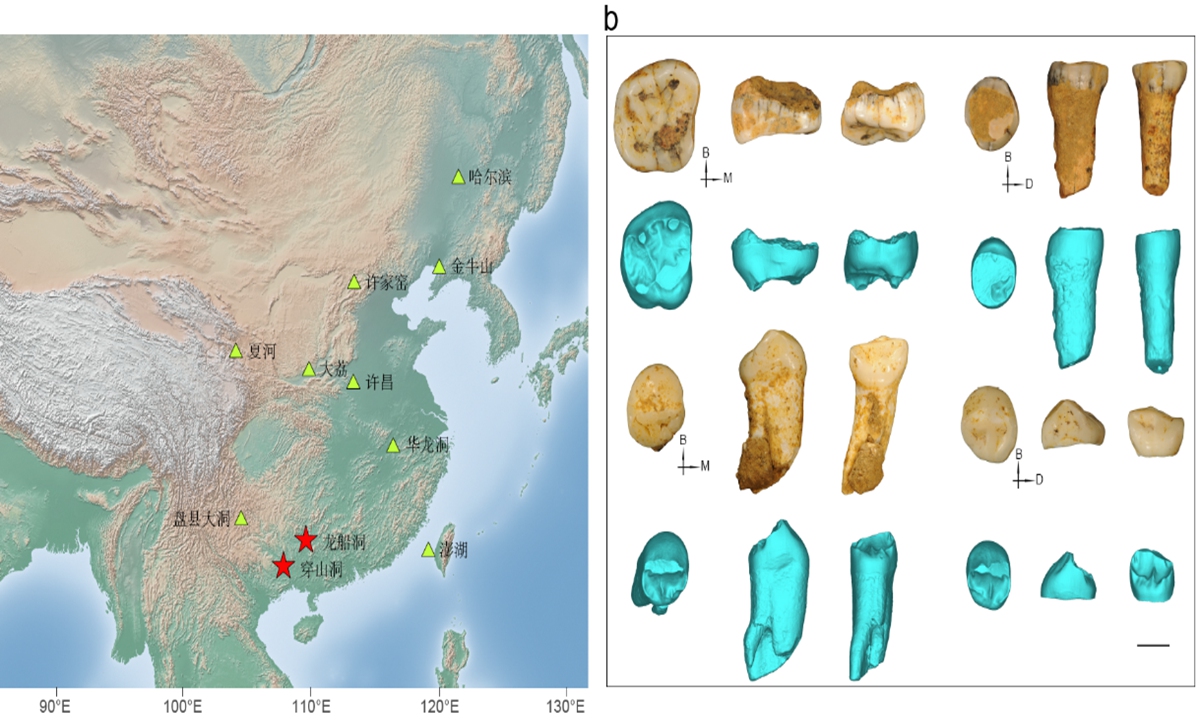
Geographic distribution of Chuanshan Cave, Longchuan Cave and other Denisovan sites in East Asia (left), and human teeth (right)
In recent years, newly reported fossils and accumulating molecular evidence have led researchers to believe that archaic humans in East Asia during the Middle Pleistocene likely belonged to the Denisovan lineage. This has seemingly clarified the classification of archaic human populations in China during this period. But were Denisovans the only human group living at the time, or did other groups coexist with them? The Lingnan region in southern China is particularly important to answering this question.
Denisovans had never previously been reported in the region, which lies in a subtropical-to-tropical transition zone with a warm, humid climate, abundant rainfall and rich plant and animal resources - conditions favorable for early human settlement.
Since 2015, the IVPP, together with the Guangxi Institute of Cultural Relics Protection and Archaeology (GICRPA), has conducted surveys along a broad migration corridor. In 2021, researchers recovered four human teeth from caves in Nanning and Liuzhou. These fossils provide key evidence for addressing the question of whether other human groups coexisted with Denisovans.
Working on the human fossils, an IVPP team, together with researchers from the GICRPA and several other institutions, conducted an integrated analysis using ancient proteomics and morphological studies.
The study found that the human remains discovered at Longchuan Cave belong to the Denisovan lineage, based on both morphological and ancient protein evidence, extending the known geographic range of Denisovans to the Lingnan region.
More importantly, the study found that the human teeth discovered at Chuanshan Cave represent a distinct population. Their protein sequences contain genetic variants specific to late Homo erectus populations dating back around 400,000 years. However, their morphology shows a combination of more advanced features than Homo erectus but more primitive traits than modern humans. This population dates back at least 101,000 years.
The study challenges the simplified view that most archaic humans in East Asia during the Middle Pleistocene belonged to the Denisovan lineage, and opens up new avenues for research.
More importantly, it suggests that southern China may have served as both a geographic refuge and an evolutionary melting pot for archaic humans. The findings provide an important reference for understanding the population structure, regional variations and possible genetic exchanges among ancient human groups in East Asia, marking a significant step toward reconstructing the evolutionary history of ancient human populations in Asia.