


Digital oversight safeguards school meals in SW China
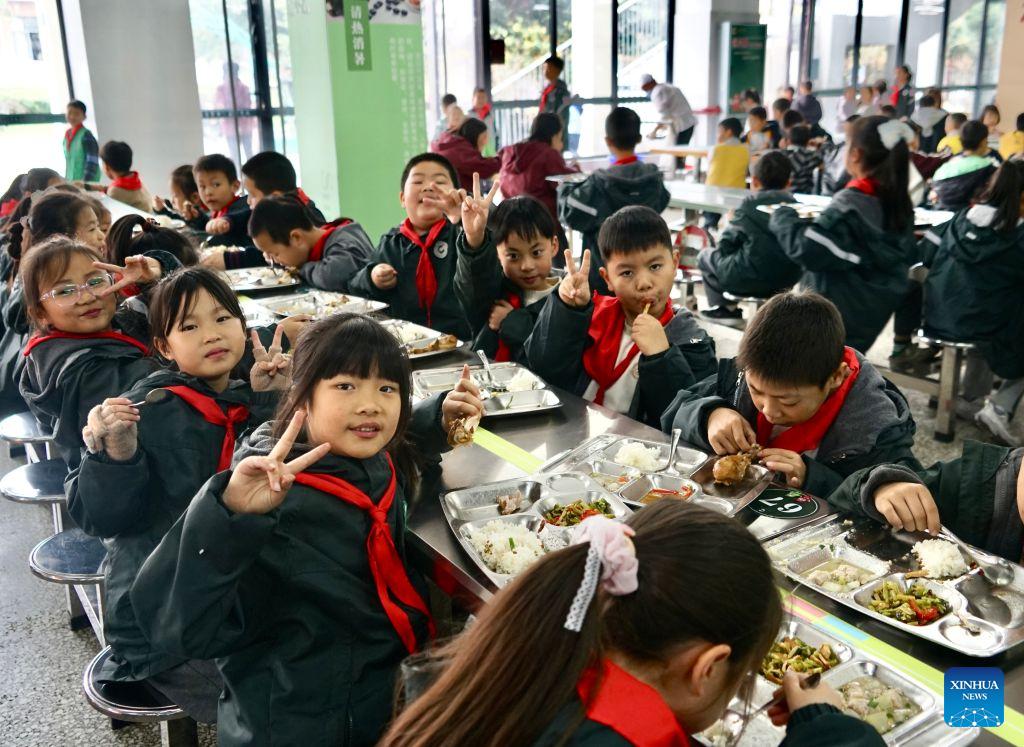
Students have lunch at a primary school in Mianzhu, southwest China's Sichuan Province on Nov. 13, 2026. In Mianzhu, a digital platform tracks food deliveries and spending across all its 48 schools and 56 canteens, serving 39,500 students in basic education. (Photo: Xinhua)
CHENGDU, Nov. 26 (Xinhua) -- Nine-year-old Wang Shaoyuan was tucking into lunch at a school canteen in Mianzhu, a county-level city in southwest China's Sichuan Province.
Meatballs braised with winter melon, celery with dried tofu, a chicken leg, rice and an egg tart filled his tray. "It's really delicious," the fourth-grader said.
There is more to this lunch than meets the eye. The pork in Wang's meatballs has a digital trail.
In Mianzhu, a digital platform tracks food deliveries and spending across all its 48 schools and 56 canteens, serving 39,500 students in basic education.
But the system was not built simply to improve school catering. It grew out of a corruption case.
In 2024, the head of a local school was disciplined after investigators uncovered a scheme involving inflated food deliveries, forged supply receipts and kickbacks paid by suppliers to school staff and administrators.
The investigation did more than identify those responsible.
By tracing how the misconduct had taken place, investigators were able to pinpoint weaknesses in the system.
Procurement, delivery, inspection and payment were handled separately, and records were difficult to cross-check. These gaps made it easier to falsify delivery records, manipulate accounts and conceal improper payments.
For Liu Xiao, head of the Mianzhu Commission for Discipline Inspection of the Communist Party of China (CPC), the findings showed exactly where oversight needed to be strengthened.
The question was not simply how to punish those involved, but how to redesign oversight so that similar practices would be harder to carry out and easier to detect.
That thinking shaped the digital platform Mianzhu went on to build.
Rather than simply putting existing procedures online, the system was designed around the vulnerabilities uncovered in the investigation. It links records of food deliveries with procurement orders, invoices and payments, making discrepancies easier to spot.
The case also illustrates a broader effort to turn the findings of investigations into improvements in governance. A nationwide campaign launched by the CPC in 2024 has targeted corruption and misconduct in more than 20 areas affecting people's everyday lives.
In the school meal sector alone, more than 130,000 instances of misconduct involving the misuse of meal funds and interference in procurement have been investigated and addressed nationwide, according to the national authorities.
Using case investigations to drive rectification and improve governance was also underscored at a key CPC plenum held in Beijing last October. The meeting called for strengthening institutions and closing loopholes in the exercise of power and oversight.
For Liu, the principle is simple: "You must not take food out of children's bowls." As he put it, "Sunlight is the best disinfectant."
In Mianzhu, putting that principle into practice involved bringing together 10 government departments, including education, market regulation and finance, to build the city-wide digital platform.
Consider the pork used to make the meatballs on Wang's lunch tray.
The platform tracks its journey from supplier to school, monitoring the delivery vehicle and temperature during transit. Each batch comes with inspection and quarantine documents that can be checked through the system.
When a shipment arrives, kitchen staff, school administrators and selected teachers inspect it together, uploading photographs and acceptance records to the system.
The platform also links procurement orders, invoices and payment records. It flags unusual purchasing volumes and prices outside preset ranges, allowing officials to check whether what schools pay for matches what they actually receive.
The city has also tightened oversight of school meal funds. All canteen revenue is deposited into dedicated government treasury accounts. Spending is restricted to authorized purposes, costs are subject to standardized accounting, and financial accounts are made public in a timely manner.
But the changes go beyond monitoring.
Bulk ingredients are now procured through public tenders and delivered centrally, replacing the fragmented purchasing once handled by individual schools. This shift has helped bring down procurement costs while making suppliers easier to oversee.
Suppliers are vetted before entering the system and assessed regularly after they begin supplying schools. Those that fail to meet the requirements can be removed.
Parents have also been brought into the oversight process.
Sixty-six parents of students have been hired as canteen staff across the city, while a new arrangement allows all parents to decide when to visit the school kitchens and what to inspect.
In a primary school's kitchen, Zhang Qin works wearing a uniform, a mask and protective boots. Across the city, AI-powered systems monitor school kitchens, flagging hygiene violations such as workers failing to wear caps or masks slipping off.
The 38-year-old has worked there for six years. Her sixth-grade daughter is among the children eating the meals she prepares.
"As a mother, I know exactly what goes into my child's meals. That gives me peace of mind," she said.